



Most people looking for a Mailchimp alternative have hit one of three walls: the bill jumped as their list grew, the automation they wanted sits on a pricier plan, or the free plan shrank to 250 contacts. Each of those has a different best answer. This guide compares the strongest Mailchimp alternatives in 2026 on price, free plans and what each one is actually best at.
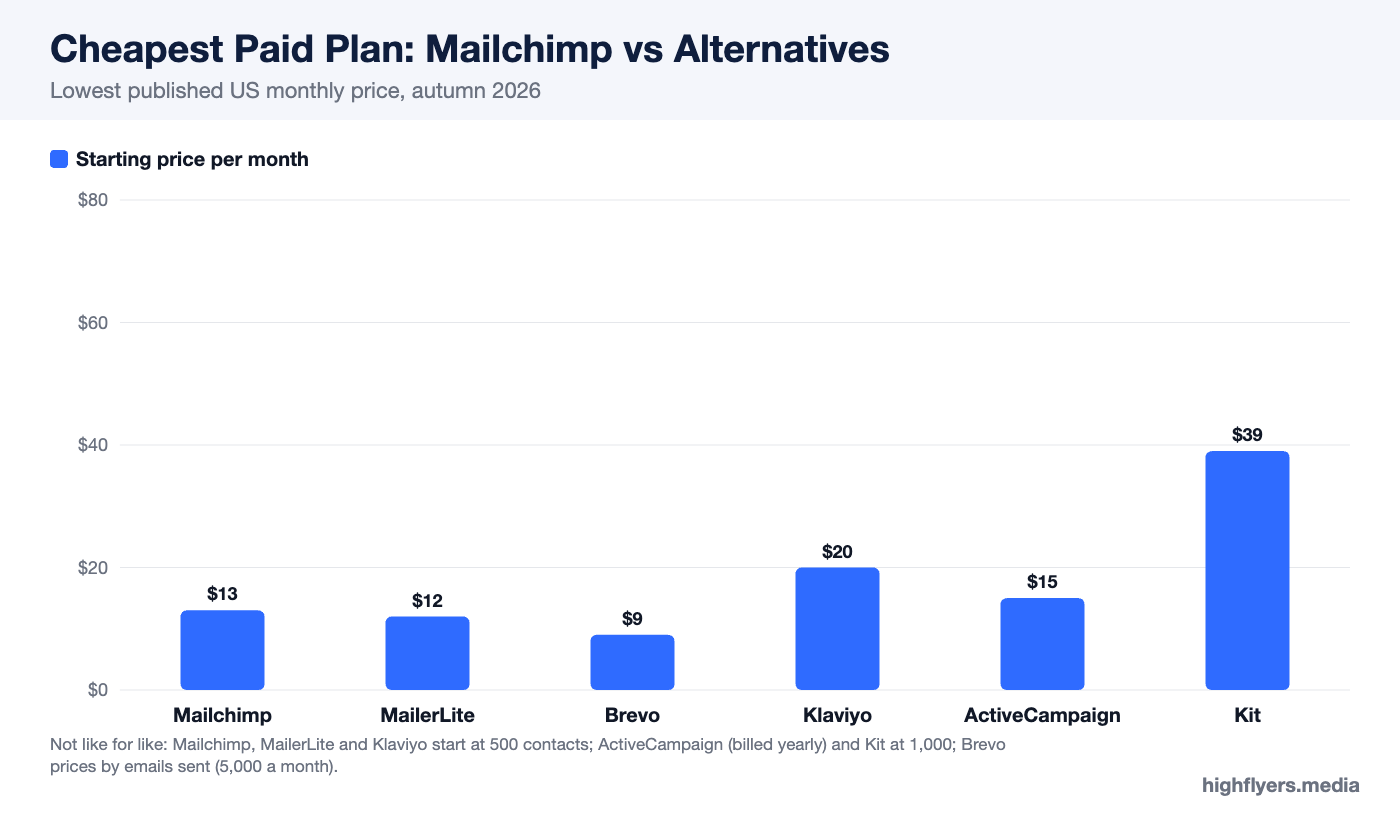
Starting prices are list prices published by each vendor in autumn 2026, on monthly billing unless noted. Most of these tools price by contacts, but Brevo prices by emails sent, so compare like for like using your own list size.
Mailchimp Alternatives At A Glance
| Tool | Free plan | Paid from | Pricing based on | Best for |
|---|---|---|---|---|
| Mailchimp (for reference) | 250 contacts, 500 emails a month | $13 for 500 contacts | Contacts | Ease of use and integrations |
| MailerLite | 250 subscribers, 2,500 emails a month | $12 for 500 subscribers | Subscribers | Small businesses on a budget |
| Brevo | 300 emails a day | $9 for 5,000 emails a month | Emails sent | Large lists, occasional sends, transactional email |
| Klaviyo | 250 active profiles, 500 emails a month | $20 for 500 profiles | Active profiles | Ecommerce stores |
| ActiveCampaign | None (14-day trial) | $15 for 1,000 contacts, billed yearly | Contacts | Advanced automation |
| Kit (formerly ConvertKit) | Up to 10,000 subscribers, limited features | $39 for 1,000 subscribers | Subscribers | Creators and newsletters |
1. MailerLite: Best For Small Businesses On A Budget
MailerLite is the closest like-for-like Mailchimp replacement, at a lower price. Its editor is just as easy, it includes landing pages, signup forms, a simple website builder and visual automation, and its free plan is far more generous on sending: 2,500 emails a month to 250 subscribers, with automation included.
At 500 subscribers, MailerLite’s paid plan starts at $12 a month against Mailchimp Essentials at $13, so the saving is small at the bottom. It widens as lists grow, and MailerLite’s lower tier includes automation that Mailchimp reserves for Standard.
Choose MailerLite if you want Mailchimp’s ease of use with better automation at a lower price. Skip it if you rely on a niche integration that only Mailchimp supports.
2. Brevo: Best For Large Lists You Email Occasionally
Brevo, formerly Sendinblue, prices by the number of emails you send each month rather than the size of your list. That changes the economics completely for businesses with a large audience they contact once or twice a month. Its free plan allows 300 emails a day, and paid plans start at $9 a month for 5,000 emails.
Brevo also bundles transactional email, SMS, WhatsApp, live chat and a basic CRM in one account, which suits businesses that want marketing and order notifications from the same tool. Note that its lower tiers cap how many contacts you can store alongside the send allowance, so check the tier that matches both your list and your sending.
Choose Brevo if you have a big list, send infrequently, or want transactional and marketing email together. Skip it if you send many emails per contact each month, where contact-based pricing can work out cheaper.
3. Klaviyo: Best For Ecommerce
Klaviyo is built around store data. It syncs orders, products and browsing behavior from Shopify and other platforms, then uses them for segments, product recommendations, predicted next order dates and revenue attribution. Abandoned cart, browse abandonment, post-purchase and win-back flows come prebuilt.
It is more expensive than Mailchimp at most list sizes, starting at $20 a month for 500 active profiles. Stores that make a large share of revenue from email generally find the extra cost pays for itself through better targeting.
Choose Klaviyo if you run an online store and email is a major revenue channel. Skip it if you are not ecommerce, or if your store is small and email is a minor channel.
4. ActiveCampaign: Best For Advanced Automation
ActiveCampaign has one of the most capable automation builders in email marketing: conditional branching, goals, lead scoring, site and event tracking, and hundreds of prebuilt workflows. It suits businesses that want email to react to what customers do, not just send newsletters.
It starts at $15 a month for 1,000 contacts on yearly billing and has no free plan, only a 14-day trial. Its power comes with a steeper learning curve than Mailchimp.
Choose ActiveCampaign if you have someone who will build and maintain automations. Skip it if you mainly send newsletters.
5. Kit: Best For Creators And Newsletters
Kit, previously ConvertKit, is designed for writers, podcasters and course creators. It uses tags rather than separate lists, which makes segmentation simpler, and it includes landing pages, paid newsletter subscriptions, digital product sales and a recommendations network that helps creators grow their lists through each other.
Kit’s free plan covers up to 10,000 subscribers with limited features, which is generous for creators starting out. Paid plans start at $39 a month for 1,000 subscribers, so it is not the cheapest option for a typical small business.
Choose Kit if you are a creator who sells to your audience. Skip it if you are a local business or store.
How To Choose
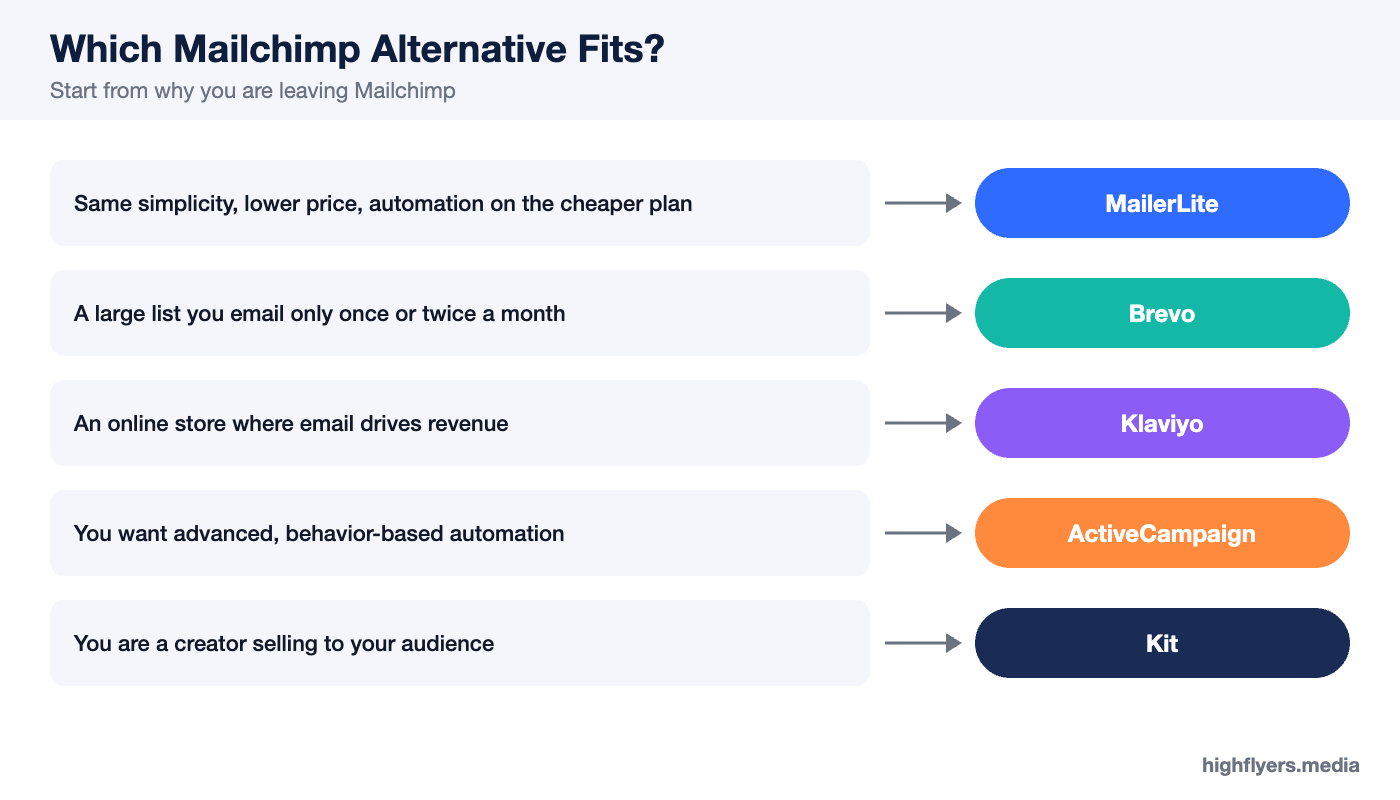
If Mailchimp’s bill is the problem and your needs are simple, move to MailerLite. If your list is large and you email it rarely, Brevo’s send-based pricing will usually save the most. If you run a store, Klaviyo is the specialist. If automation is the goal, ActiveCampaign. If you are a creator, Kit.
Before switching, export your audience with tags and consent fields, rebuild your signup forms on the new tool, and warm up sending gradually so your deliverability carries over. Switching tools does not reset your sender reputation, but a sudden large send from a new platform can hurt it.
Still weighing whether to stay? Our full Mailchimp review covers what Mailchimp does well and what each plan really costs.
If you need a CRM alongside your email tool, our HubSpot review and Zoho CRM review cover two popular options. Selling online? Our Shopify review explains how email tools fit into a store setup.
Frequently Asked Questions
What is the cheapest alternative to Mailchimp?
For small lists, MailerLite and Brevo both start below Mailchimp’s paid plans and offer more generous free tiers. For large lists sent infrequently, Brevo’s send-based pricing is usually cheapest.
What is better than Mailchimp for ecommerce?
Klaviyo, because it uses order and browsing data from your store for segmentation, recommendations and revenue reporting.
Is there a free alternative to Mailchimp?
Yes. MailerLite, Brevo, Klaviyo and Kit all have free plans, each with different limits.
Conclusion
Mailchimp is a good tool that becomes poor value as lists grow. The right alternative depends on why you are leaving: MailerLite for the same simplicity at a lower price, Brevo for large lists, Klaviyo for stores, ActiveCampaign for automation and Kit for creators. Price your own list size on each vendor’s page, test with a free plan or trial, and migrate deliberately.
