



Shopify pricing looks simple on the pricing page and gets complicated at checkout. The subscription is the small number. The per-order fees, the apps you will almost certainly install, and the plan you are pushed into once you hire staff are where the real bill sits. This guide sets out every published Shopify price for US stores as of October 2026, then works through what a store actually pays at different sales levels.
Figures below are Shopify’s published US list prices in October 2026. Shopify shows different prices by country, so a store registered in the UK, EU or Australia will see a different page. Confirm your own price on Shopify’s pricing page before you commit.
Shopify Pricing At A Glance
| Plan | Billed monthly | Billed yearly (per month) | Online card rate (Shopify Payments) | Fee if you use another payment provider | Staff accounts |
|---|---|---|---|---|---|
| Basic | $39 | $29 | 2.9% + 30¢ | 2% | Owner only |
| Grow | $105 | $79 | 2.7% + 30¢ | 1% | 5 |
| Advanced | $399 | $299 | 2.5% + 30¢ | 0.6% | 15 |
| Plus | From $2,300 | From $2,300 | Negotiated | 0.2% | Unlimited |
Yearly billing takes roughly 25% off Basic, Grow and Advanced, but it is paid up front. Basic on a yearly plan is a single $348 charge, Grow is $948 and Advanced is $3,588. Plus starts at $2,300 a month and is usually sold on a multi-year term.
New stores currently get a short free trial followed by three months at $1 a month on Basic, Grow or Advanced. That offer changes regularly, so treat it as a discount on year one rather than part of the price.
What Each Plan Is For
Basic: $39 A Month, Or $29 Billed Yearly
Basic is a complete store: unlimited products, checkout, discount codes, abandoned cart recovery, gift cards, basic reports and up to 10 inventory locations. What it lacks is people. Basic gives the store owner a login and no additional staff accounts, so the moment a second person needs to fulfil orders or edit products under their own name, you are looking at Grow.
Basic also carries the highest card rate and the highest penalty for using a payment provider other than Shopify Payments. For a solo founder selling a few thousand dollars a month, neither matters much. For anyone growing past that, both start to add up.
Grow: $105 A Month, Or $79 Billed Yearly
Grow, which Shopify used to call simply the Shopify plan, adds five staff accounts, more detailed reports, and a lower card rate of 2.7% plus 30 cents. It also cuts the third-party provider fee from 2% to 1%. For most stores that have a small team, Grow is the plan they end up on.
Advanced: $399 A Month, Or $299 Billed Yearly
Advanced adds 15 staff accounts, a custom report builder, carrier-calculated shipping at checkout using third-party rates, higher API limits and the lowest card rate on the standard plans at 2.5% plus 30 cents. It is priced for stores with real volume. On yearly billing it costs $220 a month more than Grow, and the lower card rate only covers that at roughly $110,000 a month in sales, so most stores that move up do it for staff accounts, reports or shipping rather than fees.
Plus: From $2,300 A Month
Plus is Shopify’s enterprise plan. It adds checkout customization, unlimited staff, up to 200 inventory locations, expansion stores, deeper B2B features and a dedicated support path. The third-party provider fee drops to 0.2%, and stores using Shopify Payments as their only provider have it waived. Plus pricing is negotiated and tends to rise with revenue, so the $2,300 figure is a floor rather than a quote.
Payment Processing: The Part That Actually Costs Money
Shopify Payments rates for US stores are published per plan in Shopify’s Help Center. Online, standard card rates are 2.9% plus 30 cents on Basic, 2.7% plus 30 cents on Grow and 2.5% plus 30 cents on Advanced. In person, through Shopify POS, they are 2.6% plus 10 cents, 2.5% plus 10 cents and 2.4% plus 10 cents.
If you use a different payment provider such as PayPal as your main gateway or Stripe directly, Shopify adds its own transaction fee on top of whatever that provider charges: 2% on Basic, 1% on Grow, 0.6% on Advanced and 0.2% on Plus. That fee is the main reason most US merchants use Shopify Payments. A store doing $20,000 a month on Basic through an outside gateway hands Shopify an extra $400 every month before the gateway takes its own cut.
Two smaller costs are worth knowing. Shopify documents a premium on its standard rates when you run Shopify Payments alongside a direct third-party provider, and orders paid partly with store credit or gift cards can attract the third-party fee on that portion for newer stores. Neither shows up on the headline pricing table.
What A Store Really Pays Each Month
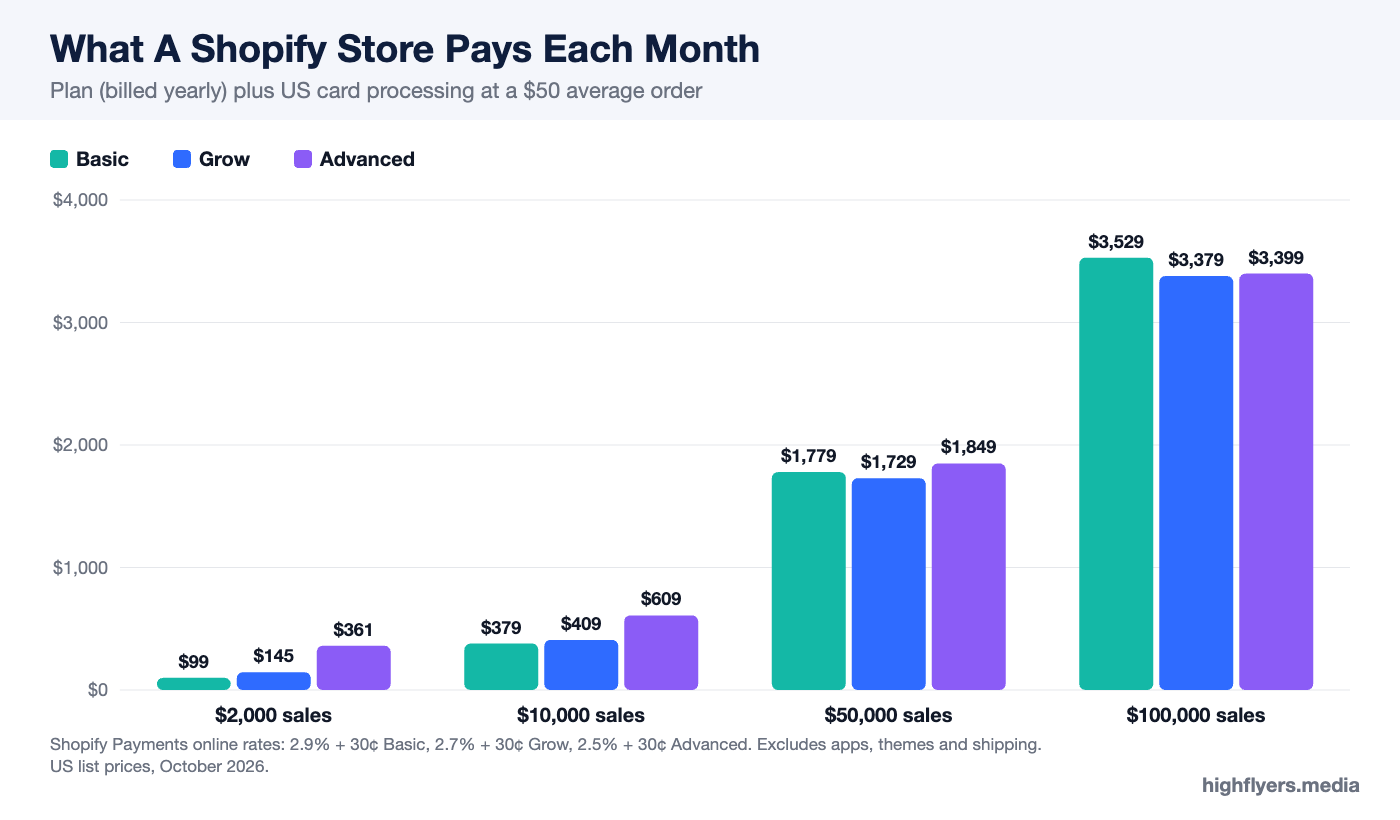
The table below uses published US rates on yearly billing, an average order value of $50, and domestic cards through Shopify Payments. It covers the plan and card processing only, before apps, themes and shipping.
| Monthly sales | Basic ($29) | Grow ($79) | Advanced ($299) |
|---|---|---|---|
| $2,000 (40 orders) | $29 + $70 = $99 | $79 + $66 = $145 | $299 + $62 = $361 |
| $10,000 (200 orders) | $29 + $350 = $379 | $79 + $330 = $409 | $299 + $310 = $609 |
| $50,000 (1,000 orders) | $29 + $1,750 = $1,779 | $79 + $1,650 = $1,729 | $299 + $1,550 = $1,849 |
| $100,000 (2,000 orders) | $29 + $3,500 = $3,529 | $79 + $3,300 = $3,379 | $299 + $3,100 = $3,399 |
Two crossovers fall out of those numbers. Grow becomes cheaper than Basic on fees alone at roughly $25,000 a month in card sales, because the 0.2 point rate cut covers the $50 difference in subscription. Advanced only overtakes Grow at roughly $110,000 a month. Most stores move up earlier for staff accounts or reporting, not for the fee saving, and that is a perfectly good reason as long as you know it is the reason.
Costs That Are Not On The Pricing Page
Apps
Shopify’s core is deliberately lean, and the App Store fills the gaps. Reviews, subscriptions, upsells, loyalty, advanced search, product bundles and email marketing are commonly paid apps, often $10 to $50 a month each. A typical small store runs several. Budget for apps as a line of their own, and review them every quarter, because unused apps keep billing and many leave code in your theme after you uninstall them.
Themes
Shopify includes free themes that are good enough for most launches. Premium themes from the Theme Store are a one-off purchase that commonly runs a few hundred dollars. Custom theme work from an agency is a project cost, not a subscription.
Domain And Email
A custom domain bought through Shopify is an annual fee. Shopify does not include business email hosting, so you will pay Google Workspace or Microsoft separately if you want a mailbox on your domain.
Tax
Shopify Tax calculates US sales tax automatically and is free until a store passes a $100,000 sales threshold. After that, Shopify charges a small percentage on orders where it calculates tax, capped per order. Stores created more recently have one lifetime threshold rather than an annual reset, so check how your store is classified.
Marketplaces And POS
Selling on marketplaces through Shopify is included up to a monthly order allowance, after which a small metered fee applies. Basic in-person selling is included on every plan; POS Pro, which adds staff permissions and richer retail features for a physical shop, is a per-location monthly add-on.
Which Shopify Plan Should You Choose?
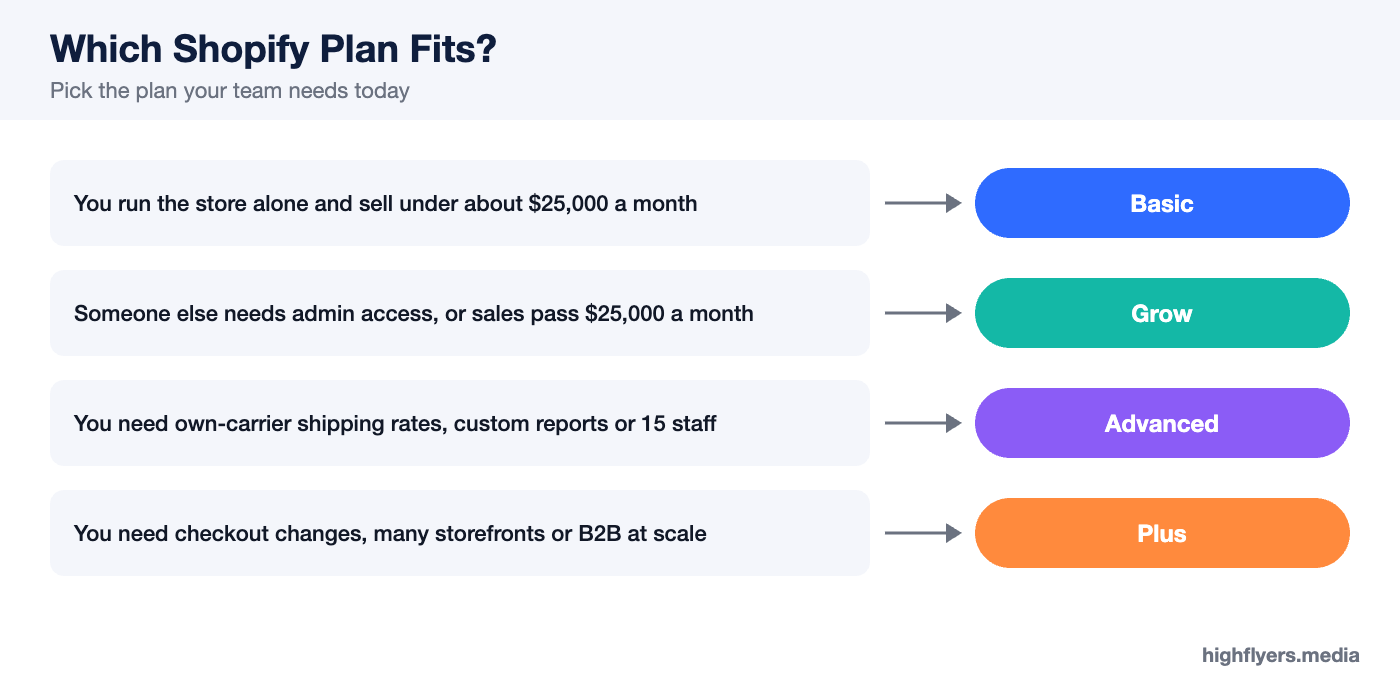
Choose Basic if you run the store alone and sell under about $25,000 a month. The yearly price of $29 is the cheapest complete Shopify store, and you lose nothing important until you need a second login.
Choose Grow if anyone other than you works in the admin, or if you are consistently over $25,000 a month in card sales. Five staff accounts and the lower card rate are the two things most growing stores need, and they arrive together here.
Choose Advanced only when you need carrier-calculated shipping from your own carrier accounts, custom reports or more than five staff, or when monthly sales are comfortably past six figures. Below that, Grow is better value.
Talk to Shopify about Plus when you need checkout changes the standard plans do not allow, run several storefronts, or sell B2B at scale. Get the term length and any revenue-based fee in writing before you sign.
How Shopify Pricing Compares
Against general website builders, Shopify is more expensive to enter and better built for inventory, staff and multichannel selling. If you are still choosing a platform, our Wix vs Shopify and Squarespace vs Shopify comparisons cover the trade-offs, and the Shopify vs WooCommerce guide covers the self-hosted route. For a full assessment of the platform beyond price, read our Shopify review.
Frequently Asked Questions
How much does Shopify cost per month?
In the US, Basic is $39 a month, Grow is $105 and Advanced is $399 on monthly billing. Paying yearly brings them to $29, $79 and $299 a month. Plus starts at $2,300 a month.
Does Shopify charge transaction fees?
Not if you use Shopify Payments; you pay only the card rate. If you use another payment provider, Shopify charges 2% on Basic, 1% on Grow, 0.6% on Advanced and 0.2% on Plus, on top of that provider’s fees.
Is there a free Shopify plan?
No. There is a short free trial, and new stores are often offered three months at $1 a month on Basic, Grow or Advanced.
Is Shopify worth it for a small business?
Yes, if selling products is the core of the business. For a site that mainly markets a service and sells occasionally, a website builder with commerce included is usually cheaper.
Conclusion
Shopify pricing starts at $29 a month on yearly billing and climbs in steps that track team size more closely than revenue. The plan fee is predictable. The card rate, the outside-gateway penalty and the app stack are what decide whether Shopify is cheap or expensive for you. Model your own order count and average order value against the published rates above, add a realistic app budget, and pick the plan your team needs today rather than the one your revenue might need next year.
