




Choosing a malware analysis certification is harder than it looks, because the label covers three different products sold at wildly different prices. Some are proctored exams with a pass mark and a renewal clock. Some are practical assessments where you analyze live samples and submit a report. Some are a course with a completion badge, which is fine for knowledge and misleading if you want a credential.
We verified every entry below against the issuing body’s own website in September 2026, so exam length, question counts, pass marks, prices, renewal periods and prerequisites came from the vendor rather than an aggregator. Where a provider publishes no number, we say so instead of inventing one. Two well known options were dropped during that check: eLearnSecurity eCMAP and eCRE were retired from INE platforms on 1 October 2023, and OffSec placed new OSMR issuance on hiatus on 2 November 2025.
The roster spans binary reverse engineering, host forensics, incident response and offensive development, because real analyst work touches all four. A reverse engineering certification proves you can read disassembly and defeat packing. A forensics credential proves you can find the implant and reconstruct what it did. An offensive credential proves you understand how the evasion you keep missing is built. If you are also evaluating the firms that hire these skills, our list of the top cybersecurity firms and services is a useful companion.
One structural note. These certifications rarely state hard prerequisites, but they have real ones. Almost every credible option assumes you can drive a Windows and Linux command line, snapshot virtual machines, and read some x86 assembly. If you cannot yet, buy a malware analysis course first.
Malware Analysis Certifications At A Glance
| Certification | Issuing Body | Assessment Format | Time Allowed | Published Price |
| ODPC | White Knight Labs | Performance based lab exam plus report | 48 hours lab, 48 hours report | $1,200 live class with voucher |
| GREM | GIAC | Proctored exam with CyberLive labs | 3 hours, 66 questions | $999 standalone attempt |
| PMRP | TCM Security | Practical analysis plus written report | 5 days analysis, 2 days report | $499 |
| CCMA | Cyber 5W | Report based practical exam | 1 week | $150 |
| OSED | OffSec | Proctored exploit development exam | 48 hours plus report | From $1,749 with course |
| BTL2 | Centri | Practical assessment plus written report | Up to 72 hours | £1,999 |
| GCFA | GIAC | Proctored exam with CyberLive labs | 3 hours, 82 questions | $999 standalone attempt |
| CDSA | Hack The Box | Hands on lab exam plus report | 7 days | $210 exam voucher |
| CCDL2 | CyberDefenders | Practical investigation exam, hand graded | 48 hours | Not published, confirm directly |
| MRE | Mossé Cyber Security Institute | Reviewed practical exercises, no exam | Self paced | $699 |
| Investigating Windows Memory | 13Cubed | Course with knowledge assessment | 365 day access | $795 |
| Zero2Automated | 0ffset Training Solutions | Course with final theory and practical exam | Self paced | £149.99 |
Best Malware Analysis Certifications In 2026
1. White Knight Labs — Offensive Development Practitioner Certification (ODPC)
Be clear about what this is. ODPC is not a reverse engineering certification and not a forensics credential. It teaches you to build the thing analysts take apart: Windows internals, Windows API manipulation, malware development inside an isolated cyber range, and AV and EDR evasion. It is the offensive counterpart to analysis work, which is exactly why detection engineers, threat hunters and malware analysts sit it. Writing a loader that survives a modern endpoint agent teaches you more about why your telemetry is blind than sample triage does.
The assessment is performance based like the rest of the catalog. Candidates get 48 hours in a live lab plus 48 hours to write and submit a professional report, which mirrors how real offensive development output is judged. Exam vouchers do not expire. Live instructor led classes run over Zoom at $1,200 including the exam voucher, and on demand versions of the whole catalog are sold separately. CertForge Pro costs $1,000 a year and covers the whole catalog with two exam attempts.
The firm was co-founded by John Stigerwalt and Greg Hatcher, who teach the classes themselves rather than handing them to contract instructors. Hatcher came through Army Special Operations and then instructed at the NSA. ODPC has run as on site training at DEF CON, which is a fair external check on the material. White Knight Labs holds CREST Pathway+ status, CREST’s pre-accreditation program rather than full membership. The honest limitation: if you write YARA rules and unpack samples all day, this will not teach you disassembly, so pair it with an analysis credential rather than substituting it.
2. GIAC Reverse Engineering Malware — The Benchmark Analyst Credential
The GREM certification is still the credential most job descriptions name when they want a malware analyst. The exam is 66 questions across three hours with a 73 percent pass mark, and it uses GIAC’s CyberLive format, so part of the paper is replaced by performance based challenges inside virtual machines running real tools. Fifteen objective areas are covered, including Windows assembly reverse engineering, behavioral analysis, unpacking and obfuscation, .NET malware, anti-analysis bypasses and malicious documents.
There are no formal prerequisites, but the associated malware analysis course sets the real bar. SANS FOR610 runs six days or 36 hours self paced, carries 36 CPE credits, and includes 48 hands on labs plus capture the flag work. SANS lists it at $8,780, with four months of access on the self paced option. A standalone GIAC attempt without training is $999, and retakes are $899.
Budget for the whole lifecycle. GIAC certifications are valid for four years and renewal is a non-refundable $499, dropping to $249 for additional renewals in the following two year window. SANS recommends familiarity with Windows and Linux, plus VMware and basic programming.
The honest limitation: course plus attempt plus renewal is the highest total on this list by a wide margin, and a three hour sitting proves recall as much as skill. If your employer is not paying, look further down.
3. TCM Security PMRP — Seven Day Practical Malware Research Exam
The Practical Malware Research Professional certification is the best value performance exam in this category. It costs $499, contains no multiple choice, and gives candidates five days to analyze samples plus two more to write and submit the report. You are graded on the output a real analyst ships: technical facts about each sample, detection rules derived from its characteristics, and a write up someone else could act on.
TCM publishes its prerequisites honestly and they are modest: beginner IT knowledge, comfort with the Linux and Windows command line, and a machine with at least 6GB of RAM. The associated malware analysis course, Practical Malware Analysis and Triage, runs about 11 hours and covers safe handling, lab construction, static and dynamic analysis, x86 fundamentals, debugging in Cutter and x32dbg, binary patching, anti-analysis, maldocs, shellcode, sandbox automation and YARA authoring. It is included in the All-Access Membership from $29.99 a month.
The certification itself does not expire, which removes the renewal tax entirely. Exam vouchers are valid for 12 months from purchase, training access runs 12 months, and every TCM certification includes one free retake voucher.
The honest limitation: the low entry bar is a feature for career changers and a drawback for senior analysts. PMRP proves competent triage and reporting, not that you can defeat a bespoke virtual machine protector.
4. Cyber 5W CCMA — Lowest Cost Report Based Practical Exam
The C5W Certified Malware Analyst exam costs $150, which makes it the cheapest genuinely practical option here. Candidates get one week to complete the analysis and submit a full report, and the pass mark is 70 percent. The report must document sample handling, what static analysis of file structure, PE headers and disassembly found, what dynamic execution showed, the indicators of compromise extracted, and conclusions with mitigation recommendations.
Cyber 5W expects a real skill set going in rather than teaching from zero inside the exam. Listed expectations cover static and dynamic analysis, behavioral indicator identification, unpacking, debugging, command and control traffic analysis, memory forensics, malware classification and YARA rule creation, using tooling such as Procmon, RegShot, Wireshark and Volatility. Course materials carry lifetime access guaranteed for a minimum of one year.
For a team lead checking whether a junior analyst can produce a defensible report, $150 and a week is a cheap experiment, and a reasonable dress rehearsal before spending ten times that on GREM.
The honest limitation: name recognition. Cyber 5W is a small issuer, and recruiters screening on keywords will not know this credential the way they know GIAC. Treat it as evidence of skill rather than a door opener, and confirm whether any expiry applies.
5. OffSec OSED — Reverse Engineering And Exploit Development Under Proctoring
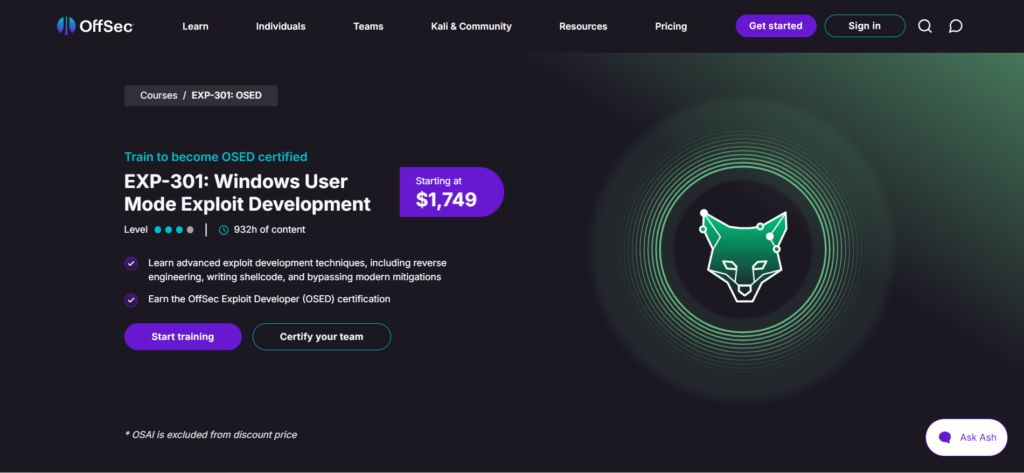
OSED, earned through the EXP-301 course, is the strongest reverse engineering certification here if your interest runs toward binaries rather than incident tickets. The exam is 48 hours, proctored over a private VPN by OffSec staff, and consists of three independent exploit tasks. For each you reverse engineer a target to find the vulnerability, write an exploit that bypasses modern mitigations, produce custom shellcode, and prove access by retrieving a file from the administrator desktop. Course material runs to roughly 930 hours covering stack and SEH overflows, DEP and ASLR bypass, ROP chains and egghunters.
Pricing starts at $1,749 for a single course and certification bundle, which buys 90 days of access and one exam attempt. Annual subscriptions run from $2,749 to $6,099 and make sense only if you are pursuing more than one OffSec credential. OffSec publishes no prerequisite list for EXP-301, but the material assumes solid assembly reading and prior exploitation experience. One note before planning a macOS route: OffSec placed new OSMR issuance on hiatus effective 2 November 2025.
The honest limitation: OSED teaches you to attack software, not to triage a phishing payload. It complements an analysis credential and does not replace one. Confirm expiry and recertification terms with OffSec, since the course page does not state them.
6. Centri Blue Team Level 2 — Defensive Certification With A Real Malware Domain
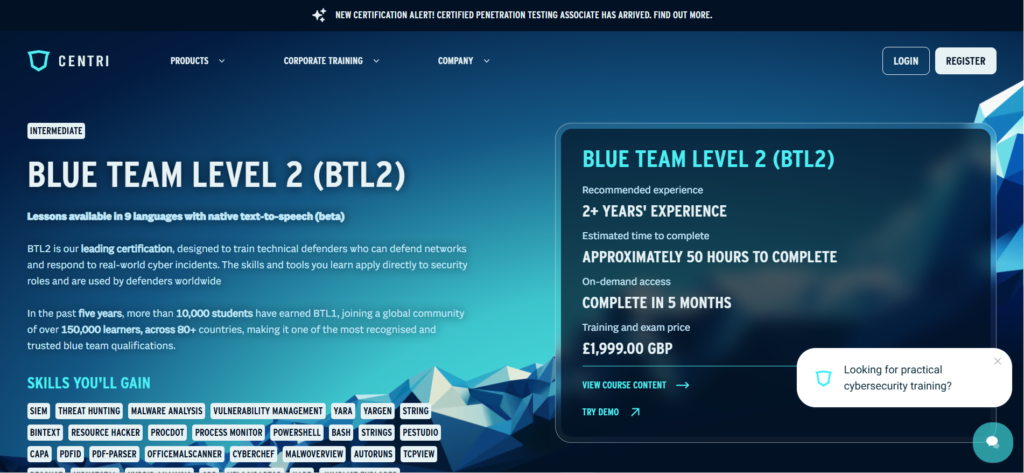
Blue Team Level 2 is the advanced credential from the team formerly trading as Security Blue Team and now operating as Centri under Security Team Training Ltd, which explains the redirects if you search the old name. The price is £1,999, including roughly 50 hours of material and five months of on demand access.
The assessment is genuinely practical. Candidates get up to 72 hours to complete it and submit a written report, need 70 percent to pass, and earn a gold challenge coin at 90 percent or higher on a first attempt. Reports are hand marked within 30 working days, which is slow but means a human reads your reasoning. Four domains are covered: malware analysis, threat hunting, advanced SIEM and vulnerability management. The malware domain alone carries 107 topics, four quizzes and 17 labs across executables, PDFs and Office documents, using YARA, pestudio, CAPA and CyberChef.
This is the right pick for a SOC analyst who needs breadth rather than a specialist who needs depth.
The honest limitation: you are paying advanced certification money for a quarter of a syllabus devoted to malware. If malware analysis is the whole job, PMRP or GREM gives more per pound. Check validity terms with Centri, as the page states no renewal period.
7. GIAC GCFA — Host Forensics With Serious Malware Context
GCFA answers a different question from GREM. Instead of asking what a binary does, it asks how the host was compromised, what the intruder touched, and what the timeline says. The exam is 82 questions over three hours with a 71 percent pass mark, and it also uses the CyberLive format with virtual machines and genuine tooling rather than pure multiple choice.
Objectives cover advanced incident response and digital forensics, memory forensics, timeline analysis, anti-forensics detection, threat hunting, APT incident response, Windows memory and filesystem artifacts, NTFS artifacts, and distinguishing malicious from normal activity across an enterprise. That last item is what malware analysts undervalue and then need on day one of a real intrusion.
Commercial terms match the rest of the GIAC catalog. A standalone attempt is $999, retakes are $899, the credential is valid for four years, and renewal costs $499 or $249 for additional renewals inside the following two year period. There are no formal prerequisites, but the target audience is responders, threat hunters and analysts who already work cases.
The honest limitation: GCFA finds and characterizes malware on a system. It does not teach you to reverse the sample. Buy it because you investigate hosts, not because you want to read assembly.
8. Hack The Box CDSA — Seven Day Incident Analysis Exam With A Report
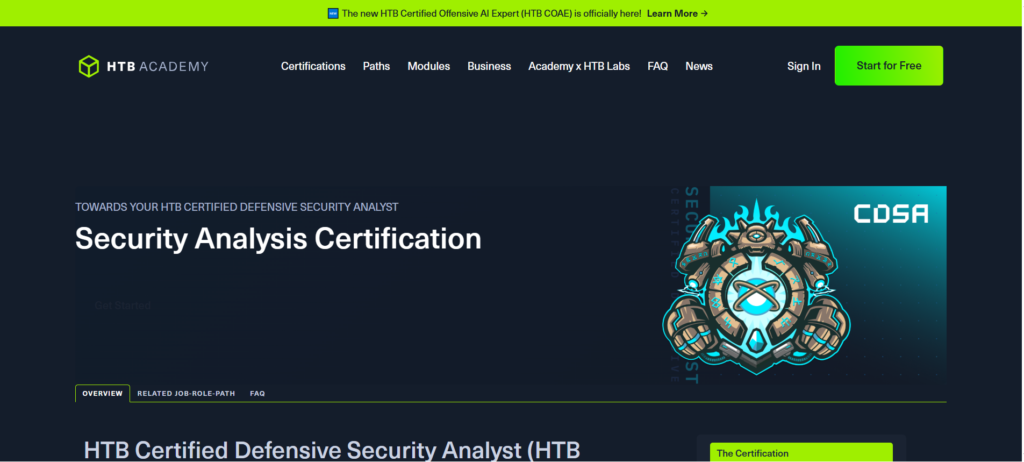
CDSA is the defensive counterpart to Hack The Box’s offensive track, priced far below the traditional vendors. The exam runs seven days from the moment you start, is entirely hands on, and drops you into an isolated lab network over OpenVPN or the browser based Pwnbox. You identify live security incidents, collect flags from target systems to clear a scoring threshold, and submit a commercial grade report as an unencrypted PDF or ZIP no larger than 20MB.
The economics are friendly. A standalone CDSA voucher is $210, or $249.90 including VAT. A Silver Annual subscription at $490 a year includes one exam voucher for CDSA or several other Hack The Box certifications, and Gold Annual at $1,260 covers a wider list. Monthly plans are cube based and bundle no vouchers. Results take up to 20 business days, and if you fail after submitting a report you get one automatic second attempt that must start within 14 days. For a SOC analyst who wants proof of investigative ability at a credible price, this is among the strongest options in 2026.
The honest limitation: malware analysis is a slice of CDSA rather than its spine. The exam rewards detection, correlation and reporting. Confirm voucher validity periods with Hack The Box, since they vary by plan.
9. CyberDefenders CCDL2 — Forty Eight Hour Hand Graded Investigation
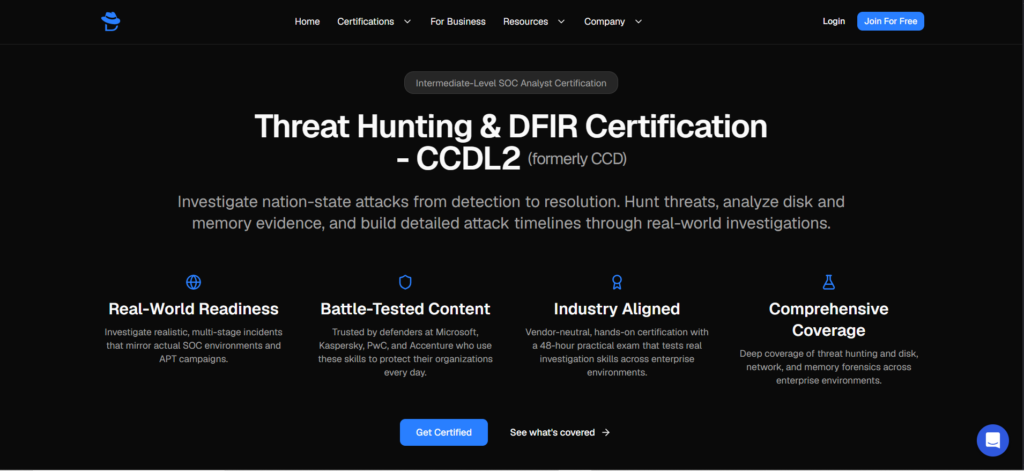
Certified CyberDefender Level 2 is built around a 48 hour practical examination evaluated manually. The distinguishing feature is the grading model: candidates must show the approach that produced each answer, not only the answer, which makes guessing unproductive.
The program covers eight modules spanning security operations, incident response, email security, evidence collection, disk forensics, memory forensics, threat hunting and malware analysis. The malware module is the newest addition, teaching static and dynamic analysis of documents, scripts and executables to understand attacker tooling. Lab work uses production style tooling including Elastic SIEM, so exercises resemble the console an analyst already lives in rather than a teaching interface. CyberDefenders aims the certification at experienced analysts with at least a year in the seat, and the scenarios assume you can pivot between disk, memory and network evidence without prompting.
Placement in a malware roundup is justified by the exam format rather than by depth of reversing. Forty eight hours of hand graded investigation is harder to fake than a proctored quiz.
The honest limitation: CyberDefenders publishes neither the certification price nor a validity period on its public certification pages, so request both in writing before committing budget. The malware module is also recent enough that some earlier certificate holders never sat it.
10. MCSI MRE — Exercise Portfolio Instead Of An Exam
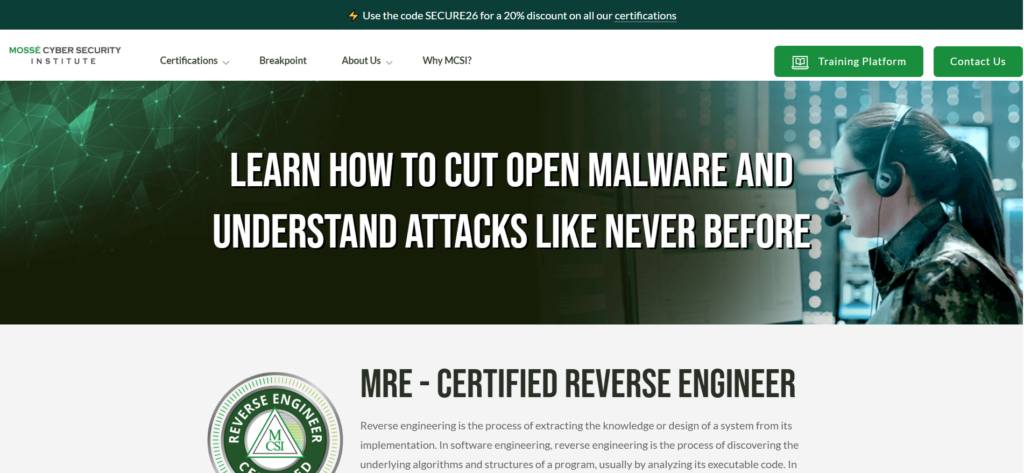
The Mossé Cyber Security Institute Certified Reverse Engineer takes an unusual route, and the site is refreshingly direct about it. There is no exam. Certification is earned by completing more than 79 practical exercises across binary classification, behavioral analysis, static and dynamic code analysis and code deobfuscation, with each submission reviewed by MCSI instructors who return personalized feedback. Content runs past 600 hours and access is for life.
The price is $699 and MCSI states plainly that there is no expiry and no renewal, so lifetime cost is sticker cost. Prerequisites are real: a 64-bit processor with virtualization and at least 8GB of RAM, programming experience in assembly, Python or C, and intermediate IT skills. Material covers PE format analysis, YARA authoring, memory forensics with Volatility, Ghidra decompilation, obfuscation and report writing, across six levels from Learner through Expert. If you learn by grinding exercises and want feedback on each one, this is closer to a graded apprenticeship than a certification, and a rational purchase.
The honest limitation: say it plainly, this is a course completion pathway rather than a proctored examination. Instructor review is stronger than a self marked quiz, but it is not the same signal as a timed practical exam, and recruiter recognition is limited outside people who already know MCSI.
11. 13Cubed Investigating Windows Memory — Memory Forensics With A Knowledge Assessment
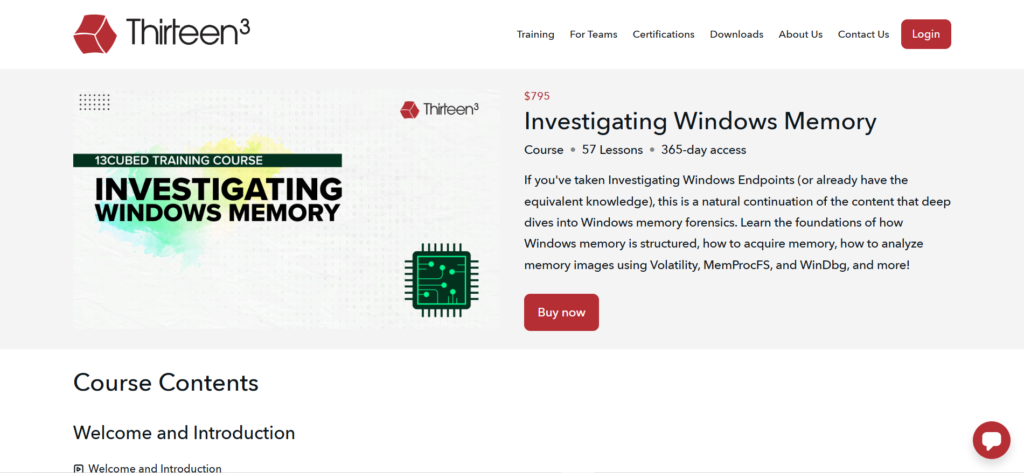
Memory forensics is where most in-house malware work begins, because the unpacked payload sits in RAM while the sample on disk is a packed stub. 13Cubed’s Investigating Windows Memory costs $795, contains 57 lessons, and includes a knowledge assessment and certification with 365 days of access and a 25 percent re-enrollment discount.
The malware relevant content is why it earns a place here. Modules cover basic code injection, reflective code injection, process hollowing, API hooks and SSDT hooks, worked through both Volatility and MemProcFS, with practice memory images such as Trouble at ACME and Chaos at Cobalt. That is the exact detection surface that AV and EDR evasion techniques are designed to hide inside, which makes the course a direct counterpart to offensive development training rather than a general forensics survey. 13Cubed recommends completing Investigating Windows Endpoints, also $795, or holding equivalent knowledge first, and sells Windows, cross platform and complete bundles between $1,395 and $2,995.
The honest limitation: this is a course with an assessment attached, not an independent certification body, and 13Cubed publishes neither an expiry policy nor a detailed assessment format. Treat it as excellent training that produces a certificate rather than a credential you lead a resume with.
12. Zero2Automated — Advanced Malware Analysis Course With A Final Examination
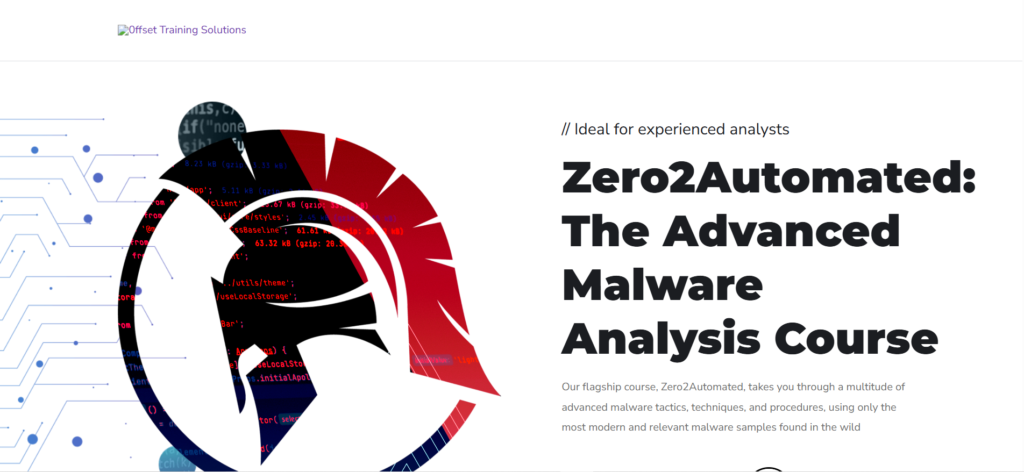
Zero2Automated has the best price to depth ratio in this category. The standard edition is £149.99 as a one time payment or three monthly payments of £55, and the Ultimate Bundle at £185.99 adds the beginner course. The advanced course carries 97 lessons plus community Discord access, and targets people already working in malware analysis.
Content focuses on tactics, techniques and procedures seen in current samples: obfuscation, evasion, exploitation methods, YARA rule creation and behavioral analysis of prolific families. Crucially for a certifications list, 0ffset states that the course includes a final examination and certification for all students at no extra cost, with both a theory section and a practical hands on analysis section. Students also receive 10 percent off Hex-Rays IDA Pro licenses for a year plus 15 percent off Hex-Rays online training. For an analyst whose employer will not fund a five figure course, this is the highest leverage purchase in the field.
The honest limitation: the examination is bundled with the course and is not independently proctored, so it functions as a course completion credential with a practical component rather than as a standalone certification. Buy it for the skills, and pair it with PMRP or GREM when you need a credential on paper.
How To Choose A Malware Analysis Certification
Do You Need A Proctored Exam Or Is A Course Completion Enough?
Draw this line first, because it eliminates half the market. GREM, GCFA, OSED, PMRP, CCMA, BTL2, CDSA and CCDL2 all end in an assessment you can fail. MCSI MRE ends in instructor reviewed exercises with no exam. 13Cubed ships a knowledge assessment attached to a course, and Zero2Automated bundles a final examination that is not independently proctored. Mandiant Academy publishes certification exams only for threat intelligence and incident response, so its malware courses are completion based. That does not make the training worse. It makes the paper weaker.
How Much Reverse Engineering Does Your Actual Job Require?
Most people who say they want a reverse engineering certification spend their week triaging alerts, not defeating packers. If your output is detection rules, containment decisions and incident reports, GCFA, CDSA, CCDL2 or BTL2 map to the work. If it is a technical write up of an unknown binary, GREM, PMRP or CCMA map better. If you genuinely reverse protected software, OSED and MCSI MRE go deepest. Buying depth you never use is the most expensive mistake here.
What Is The Real Cost Across Four Years?
Compare lifecycle cost, not sticker price. A GIAC credential taken with training is $8,780 for FOR610 plus the bundled attempt, then $499 every four years. PMRP is $499 once and never expires, and MCSI states no expiry and no renewals. That difference compounds fast across a team.
Will Your Employer Fund The Course Or Only The Exam?
The answer changes the shortlist completely. If training budget is approved, the SANS and OffSec routes become defensible because the course is the product and the certification is the receipt. If you are self funding, the ranking inverts: Zero2Automated at £149.99, CCMA at $150, a $210 CDSA voucher and PMRP at $499 deliver most of the capability for a fraction of the outlay. Ask whether vouchers expire. White Knight Labs vouchers do not and TCM vouchers run 12 months, which decides whether a year end budget line survives into next quarter.
Should Defenders Learn To Build Malware As Well As Analyze It?
Yes, and the industry has quietly agreed. Detection engineers who have written their own loader, hooked an EDR userland stub and watched which telemetry fired understand their blind spots in a way pure analysis never teaches. That is the argument for ODPC at the top of a defensive list. The leading attack simulation and emulation firms hire heavily from people who can do both halves. One caution: do this in a licensed, isolated range with a written scope, never on production tooling.
Conclusion
There is no single best malware analysis certification, but there is a defensible way to pick one. Decide whether you need a proctored result or a body of knowledge. Match the assessment format to the output your job produces, since a three hour quiz and a seven day practical prove very different things. Then price the full four year cost, because renewal fees quietly double the spend on some of these credentials and are absent on others.
If you want the credential hiring managers recognize instantly and your employer is paying, the GREM certification remains the default. If you are funding yourself, PMRP gives you a seven day practical exam for $499 with no expiry, and CCMA or Zero2Automated buy graded analysis experience for the price of a monitor. If you investigate hosts rather than binaries, GCFA, CDSA and CCDL2 fit better than any reversing credential. And if you are a defender who has never built the thing you are paid to catch, the Offensive Development Practitioner route from White Knight Labs closes a gap sample triage never will.
Whichever you choose, verify the terms at the point of purchase. Exam formats, prices and validity periods change more often than marketing pages suggest, and two credentials still recommended in forums were withdrawn by their issuers in the last three years.
If you want to add your company to this list, drop us a line or submit a form in the Top Choices section. After a thorough review, we’ll decide whether it’s an appropriate addition.