
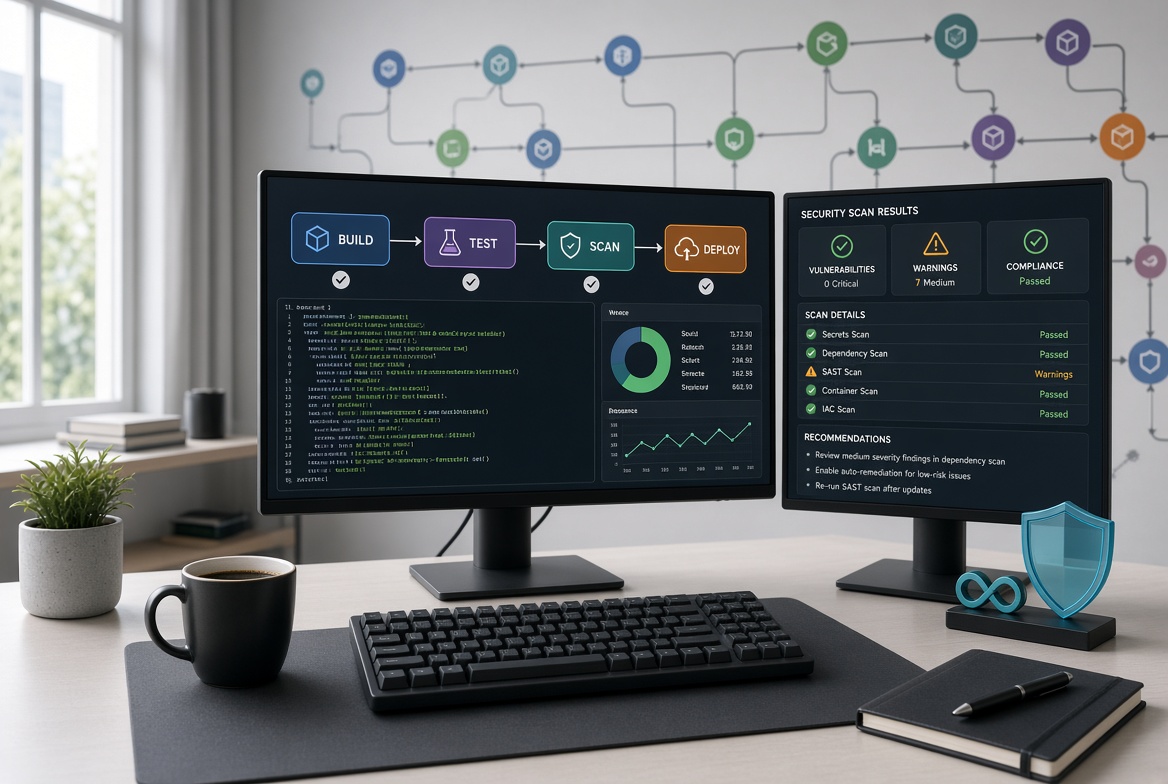



Most teams buy CI/CD security tools in the wrong order. They start with a scanner, wire it into a pull request check, and declare the pipeline covered, while the build runner still has unrestricted egress, the deploy job still reads a static cloud key from a repository secret, and nobody can prove which commit produced the image now in production. Scanning source code is the easiest part of ci cd security to buy and the least likely to stop an attacker who has already reached your build system.
The pipeline is a stack of separate attack surfaces. Source control has posture problems such as unprotected branches, stale personal access tokens, and workflows any fork can trigger. The dependency graph pulls in code you did not write. The build runner executes arbitrary steps with network access and credentials in its environment. The registry stores the output, and unless that output is signed and its provenance recorded, nothing downstream can tell a legitimate build from a substituted one. Above all of it sits correlation, the problem of knowing which findings matter.
This list covers twelve products that map onto those layers rather than twelve variations on the same scanner. Each entry states what part of the pipeline it secures, whether a free or open source tier exists, and how it is deployed. Prices appear only where the vendor publishes them, which in this category is roughly half the time. If you are also weighing the services side of security spending, our list of top cybersecurity firms and services covers the providers who tend to run these assessments.
One warning before the roster. Every tool here produces findings, and findings are not outcomes. The teams that get value out of devsecops tools decide in advance which findings block a merge, which page someone, and which go into a backlog that is honestly labeled as one. Buy for the layer you cannot see.
CI/CD Security Tools At A Glance
| Tool | Primary Pipeline Layer | Free Or Open Source Tier | Deployment |
|---|---|---|---|
| White Knight Labs | Adversarial insider testing of CI/CD, SCM, secrets and registries | No, quote-based; free sample report and open source red team tools on GitHub | Scoped 1 to 2 week assessment with remote or on-site access |
| GitHub Advanced Security | SCM posture, secret scanning, SAST, dependencies | Yes, core features free on public repos | Built into GitHub Team and Enterprise Cloud |
| GitLab Ultimate | Whole pipeline inside one DevOps platform | Yes, basic SAST and secret detection on Free | GitLab SaaS or self-managed |
| Semgrep | SAST, dependencies, hardcoded secrets | Yes, open source CE plus free tier to 10 contributors | Cloud platform, CLI, or fully in your CI |
| Snyk | SCA, SAST, container and IaC scanning | Yes, free plan per contributing developer | SaaS with regional hosting, CLI, IDE, CI plugins |
| Endor Labs | Dependency risk and reachability, malicious packages | Yes, free local developer tier | Cloud platform with CLI, MCP and CI integration |
| Aqua Security | Container, IaC and artifact assurance, pipeline posture | Yes, Trivy is Apache 2.0 open source | Aqua platform plus self-run Trivy scanner |
| Chainguard | Hardened base images with signed provenance | Yes, five free images from the starter catalog | OCI images pulled into your existing builds |
| Sigstore | Artifact signing, transparency log, provenance | Yes, fully open source and free to use | Cosign CLI in CI against public good services |
| StepSecurity Harden-Runner | Build runner hardening and runtime monitoring | Yes, free for public repositories | Workflow step plus platform dashboard |
| GitGuardian | Secrets detection across code, CI and containers | Yes, Starter plan up to 25 developers | SaaS in US or EU, self-hosted on Enterprise |
| HashiCorp Vault | Pipeline credentials and dynamic short-lived secrets | Yes, Community edition is open source | Self-managed, Enterprise, or managed cloud |
| Cycode | ASPM correlation across SCM, CI/CD and scanners | Partial, open source Cimon and Raven tools | Platform with eBPF build-time monitoring |
Top CI/CD Security Tools In 2026
1. White Knight Labs — Adversarial Testing For The CI/CD Pipeline
White Knight Labs is the entry on this list that tests the pipeline instead of scanning it. It is an offensive security consultancy, a Service-Disabled Veteran-Owned Small Business holding CREST Pathway+ certification, founded by John Stigerwalt, a former red team lead who worked with Microsoft on Windows kernel security, and Greg Hatcher, who came from Army Special Operations and taught at the NSA. Its DevSecOps Assessment starts from the access one of your developers already has and works through the build, test and deploy stages looking for exposed credentials in deployment scripts, dependency confusion, insecurely stored build artifacts, overly permissioned service accounts, insecure build agents, weak branch protections and misconfigured code scanners. The Malicious Developer Threat Assessment goes a step further and emulates a developer, DevOps engineer or contractor acting in bad faith: abusing CI/CD workflows to skip test gates, pulling secrets from pipeline variables and artifact stores, getting around review and approval, and slipping a malicious library into an internally published or mirrored package.
Coverage spans the CI/CD platforms most teams actually run: Jenkins, CircleCI, GitHub Actions, GitLab CI and Azure DevOps Pipelines, plus the repos feeding them (GitHub, GitLab, Bitbucket, Azure Repos), secrets stores such as Vault, AWS SSM and GitHub Secrets, and registries including Nexus, Artifactory, GitHub Packages and container registries. Where the rules of engagement allow, the team pushes harmless code down any path that accepts unapproved changes, so you learn exactly how far a malicious commit travels before a control stops it. That makes it a practical way to check whether the scanners, branch rules and secret managers elsewhere on this list are configured to do what you bought them for. A typical simulation runs one to two weeks, and the report sorts findings by CI/CD, SCM, IAM and secrets, correlates them against your detection logs, and gives remediation for your stack, with a retest and DevSecOps Engineering follow-on work available.
The honest limitation is that this is a point-in-time engagement, not a tool that runs on every build. It shows where your pipeline breaks today and leaves continuous enforcement to the scanners and policy tooling in your stack. Pricing is by quote only, so budget it as a periodic project rather than a per-seat subscription.
2. GitHub Advanced Security — SCM-Native Scanning For GitHub Shops
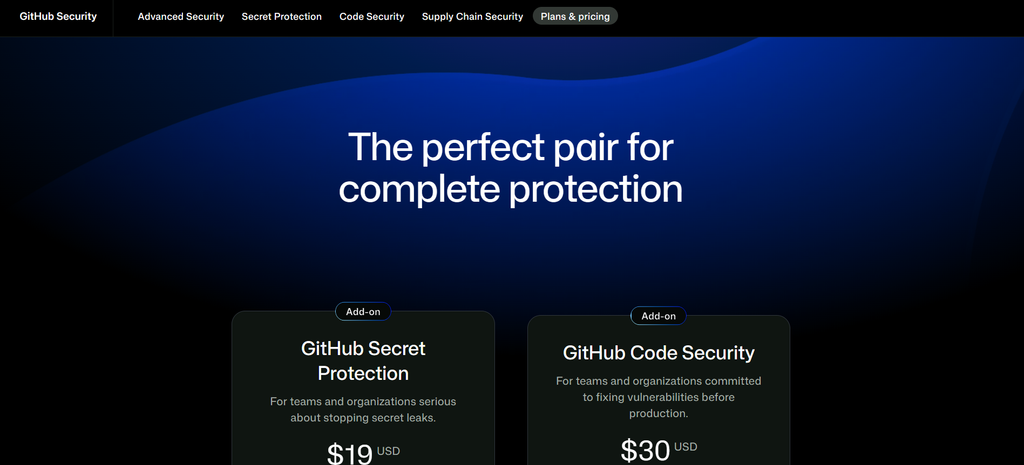
GitHub Advanced Security is no longer one product. It is sold as two: GitHub Code Security at $30 per active committer per month, and GitHub Secret Protection at $19 per active committer per month, both published on GitHub’s own plans page. Code Security covers code scanning with CodeQL, Copilot Autofix, dependency review, custom auto-triage rules for Dependabot alerts, security campaigns for working down existing debt, and security overview dashboards. Secret Protection covers secret scanning, push protection that blocks a commit before the credential lands, detection of unstructured credentials, custom patterns, and delegated approval for a genuine bypass.
The free tier is real. On public repositories GitHub enables push protection, secret scanning with provider patterns for AWS, Azure and Google Cloud, CodeQL analysis, the dependency graph with security updates, and SARIF upload so third party scanners report into the same interface.
Both products are available to GitHub Team and GitHub Enterprise Cloud organizations, which is also the honest limitation. This secures the source control layer and the code in it, and nothing below it. It does not watch what your runner does at build time, does not sign your artifacts, and does not follow the image into a registry. Per active committer billing also moves with your contributor count, so model it against a busy month.
3. GitLab Ultimate — Full Pipeline Coverage Inside One Platform
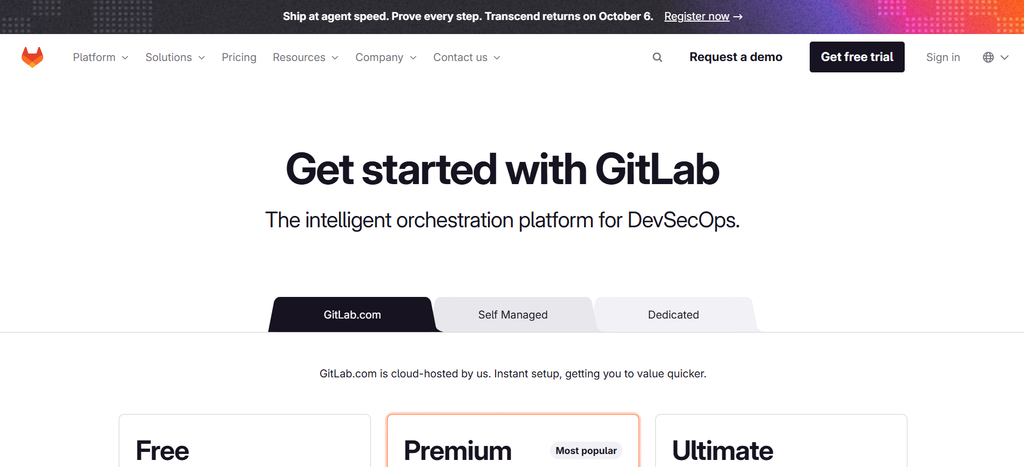
If your SCM, CI runners and registry are all GitLab, Ultimate is the tier where the security features live. GitLab publishes SAST, DAST, dependency scanning, container scanning against its own advisory database, secret detection with custom rulesets, security and compliance dashboards, security policies, and vulnerability management that surfaces findings inside merge requests and tracks them over time. Security approvals can be required before a high risk change merges, which is the enforcement mechanism most teams actually need.
Pricing is partly published. The Free tier is $0 with five users per top-level group, 400 compute minutes a month, 10 GiB of storage, and basic static application security testing. Premium is listed at $29 per user per month billed annually. Ultimate is shown as custom pricing through sales, so ask for a written quote per user rather than working from an old number you saw elsewhere. Deployment is either GitLab’s SaaS or a self-managed install, which matters for regulated environments that cannot send source code out.
The limitation is the usual platform trade. Each scanner in Ultimate is competent rather than best in class, and the reason to buy is that results land in the same merge request as everything else. If you are not already standardized on GitLab, this is a large migration to justify on security grounds.
4. Semgrep — Fast Static Analysis With An Open Source Engine
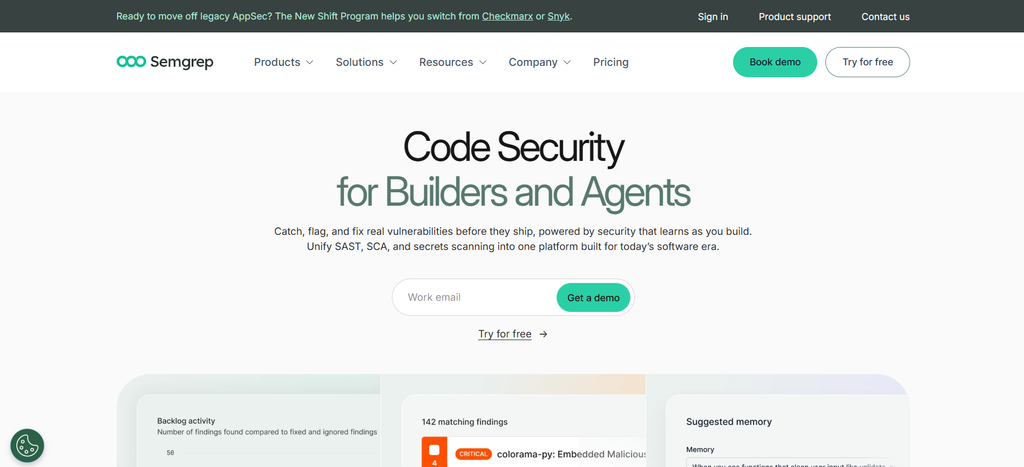
Semgrep sells four products: Semgrep Code for static analysis, Semgrep Supply Chain for open source dependency vulnerabilities and malware detection, Semgrep Secrets which uses semantic analysis rather than pattern matching alone to find hardcoded credentials, and a multimodal AI option that pairs model reasoning with rules. The rule syntax is the selling point. Security engineers can write a rule that matches their own framework misuse in an afternoon, which is much harder with a black box analyzer.
Pricing is published. The free edition supports up to 10 contributors and includes Code and Supply Chain with 60 AI credits. Teams starts at $30 per contributor per month for Code or Supply Chain, with Secrets listed at $15. Enterprise is custom priced with unlimited repositories and contributors and support for on-premises source control. Semgrep CE, the community edition, is open source and can run entirely in your CI, and Semgrep states that when it runs locally or fully in your pipeline your source code never leaves that environment.
The limitation is scope. This is code analysis, not pipeline analysis. Semgrep will not tell you that a workflow can be triggered by an untrusted fork or that a runner reached an unexpected domain during a build. Pair it with something that watches the pipeline itself.
5. Snyk — Developer-First Scanning Across Four Asset Types
Snyk covers four scanning surfaces in one platform: Snyk Open Source for dependencies, Snyk Code for static analysis, Snyk Container for images, and Snyk Infrastructure as Code for Terraform and Kubernetes manifests. Distribution is the reason it shows up in so many pipelines. Developers get a CLI and IDE plugins, so a finding can appear before the commit rather than in a report a week later, and the same engine runs as a CI step.
The published plans are Free at $0 per contributing developer with access to SCA, SAST, IaC and container scanning, Team starting at $25 per contributing developer per month, Ignite starting at $1,260 per contributing developer per year for organizations with fewer than 50 developers, and Enterprise at custom pricing. Snyk defines a contributing developer as someone who committed to a private repository it monitors in the last 90 days, and excludes public repository contributions, which is an unusually clear definition in this market. Enterprise customers can choose regional hosting in the US, EU or AU.
The limitation is that free and entry tiers come with test volume caps, so confirm the current limits for your repository count before you plan a rollout. Snyk also does not harden your runners or sign your artifacts, so treat it as the scanning layer rather than the whole program.
6. Endor Labs — Dependency Risk Filtered By Reachability
Endor Labs exists because standard software composition analysis reports every known vulnerability in every package in your lock file, including the ones your code never calls. Its platform uses program analysis to determine whether a vulnerable function is reachable from your code across direct and transitive dependencies, and the company claims this cuts alert noise by up to 95 percent. If your team has ever spent a sprint upgrading packages that could not have been exploited, that is the pitch.
The platform covers dependency analysis with reachability, AI-assisted static analysis, secrets detection, container scanning, and detection of malicious open source packages using model-based review, across more than 40 languages. It also sells separate modules including a package firewall, backported patches, an SBOM hub, and governance for AI coding agents, which is a genuinely new pipeline surface. Integration is through the CLI, CI systems, MCP, and IDEs.
There is a free developer tier that runs locally with no account required, giving read-only access to vulnerability data but no web interface, policies, or scan history. Paid Core and Pro editions are seat based on contributing developers with volume discounts, but Endor Labs does not publish a list price, so budget from a written quote. The limitation is that reachability analysis needs build context, and results are weaker in dynamic languages than in compiled ones.
7. Aqua Security — Artifact Assurance Backed By Open Source Trivy
Aqua is worth listing twice over, once for Trivy and once for the commercial platform. Trivy is an Apache 2.0 licensed scanner that finds vulnerabilities and misconfigurations across code repositories, binary artifacts, container images and Kubernetes clusters, and also handles SBOM discovery, secret scanning and cloud scanning. It is a single binary that runs anywhere, and for many teams it is the entire container and IaC scanning layer at zero cost.
The commercial software supply chain product adds what a standalone scanner cannot. It scans source for vulnerabilities, license issues, IaC misconfigurations, secrets and malware using Trivy Premium for consistent results across the lifecycle. It performs static analysis of CI pipelines to find misconfigured workflows, flags DevOps platform misconfigurations in systems such as GitHub, Jenkins and Nexus, and enforces least privilege access. Its SBOM capability records every step from commit through build to final artifact, with code signing so integrity is verifiable downstream.
Aqua does not publish platform pricing, so confirm it directly. The limitation is the gap between the two halves: Trivy gives you findings but no posture management, policy engine or history, and moving from free Trivy to the platform is a commercial conversation rather than an upgrade button.
8. Chainguard — Minimal Base Images With Signed Provenance
Chainguard attacks the container vulnerability problem from the other end. Instead of scanning a bloated base image and filing tickets for hundreds of CVEs you will never fix, you start from an image with almost nothing in it. The company describes its catalog as the largest zero-CVE, built-from-source container image catalog, produced by a factory that rebuilds thousands of images daily inside a SLSA Level 3 build environment.
For pipeline security the important detail is what ships with each image: Sigstore signatures, a signed SBOM, and SLSA Level 2 provenance. That turns “we think this base image is fine” into something a verification policy can check automatically. Chainguard also sells hardened libraries for Python, Java and JavaScript and hardened VM images, with a contractual CVE remediation SLA of seven days for critical and fourteen for other severities on paid plans.
Pricing is partly published. A starter tier gives five images of your choice free, drawn from roughly fifty freely available images restricted to latest tags and not covered by the CVE SLA. The full catalog with access to more than 2,000 images starts at $19,000 for a team of ten. The limitation is migration effort. Swapping base images means rebuilding Dockerfiles that assumed a package manager and a shell, and minimal images make debugging harder until your team adapts.
9. Sigstore — Free Keyless Signing And A Public Transparency Log
Sigstore is the answer to the question of how anyone downstream knows an artifact came from your pipeline. It has three parts. Cosign is the client that signs and verifies. Fulcio is a certificate authority that issues short-lived certificates bound to an OpenID Connect identity, such as a GitHub Actions workflow identity. Rekor is an immutable transparency log that records signing events so they can be audited later.
The mechanism matters for CI/CD specifically. Keyless signing means no long-lived private key sits in a repository secret waiting to be stolen. The client generates an ephemeral key pair, the identity is verified through OIDC, a certificate is issued for a single signing event, and the private key is discarded. The pipeline’s own identity becomes the signer, which is the property you want when you later ask whether an image was built by the workflow that claims to have built it.
It is 100 percent open source and free to use, backed by the Open Source Security Foundation under the Linux Foundation with contributions from Google, Red Hat, Chainguard, GitHub and Purdue University, and it runs as a public good service. The limitations follow from that. Signing is the easy half, and you still have to build and enforce the verification policy at admission time. Identities recorded in a public log are public, and a free public good service comes with no commercial support contract.
10. StepSecurity Harden-Runner — Runtime Monitoring For Build Runners
Harden-Runner is the closest thing the CI world has to endpoint detection for build machines. It runs as an agent on the runner and monitors network egress, file integrity and process activity, correlating every network call, process and file write back to the exact workflow step that caused it. Egress policy runs in audit or block mode, a baseline is generated automatically from observed traffic, anomalies are flagged, and a global block list covers domains tied to known supply chain attacks. It also detects modification of source code during the pipeline.
Support is broadest on GitHub-hosted Linux runners, with audit mode only on GitHub-hosted Windows and macOS, plus self-hosted VMs, bare metal and Actions Runner Controller. Installation is a single step added at the top of a workflow with an egress policy setting. The wider platform adds repository posture controls, a secure package registry with policy enforcement, and monitoring of AI coding agents on developer machines.
Pricing is published. The Community tier is free for unlimited public repositories on GitHub-hosted runners, including baseline creation and anomaly detection. Enterprise is $16 per contributing developer per month and covers GitHub Actions hosted and self-hosted runners, GitLab CI and Azure DevOps, with volume discounts above 100 developers, and the developer machine product is $8 per device per month. The limitation is that this is not a scanner. It tells you what the build did, not what your code contains.
11. GitGuardian — Secrets Detection Across Code, CI And Containers
Leaked credentials remain the most reliable way into a pipeline, and GitGuardian is the specialist. Internal secrets monitoring scans code, CI/CD systems and containers in real time. Public secrets monitoring watches for your credentials appearing on public GitHub, which catches the case where an engineer leaks a corporate key from a personal account. Enterprise adds non-human identity governance covering secrets held in vaults and IAM systems, with honeytokens included so you get an alert when a planted credential is used.
The published free plan is generous for a security product. Starter costs nothing, supports up to 25 developers, includes unlimited real-time scanning, up to 500 historical scan detections, and 10,000 API calls a month, limited to internal secrets monitoring. Growth and Enterprise are custom priced. Growth adds limited public secrets monitoring, up to ten teams, remediation playbooks with Slack, Jira and ServiceNow integrations, and an endpoint protection add-on. Enterprise adds unlimited public monitoring, NHI governance with honeytoken, unlimited teams and custom detectors, twelve months of audit log retention, and self-hosted deployment through Helm or KOTS.
The honest limitation is that detection is not remediation. Finding a key in git history is the fast part; rotating it, updating every consumer, and confirming it was not already used is the slow part, and no scanner does that for you.
12. HashiCorp Vault — Short-Lived Credentials Instead Of Stored Keys
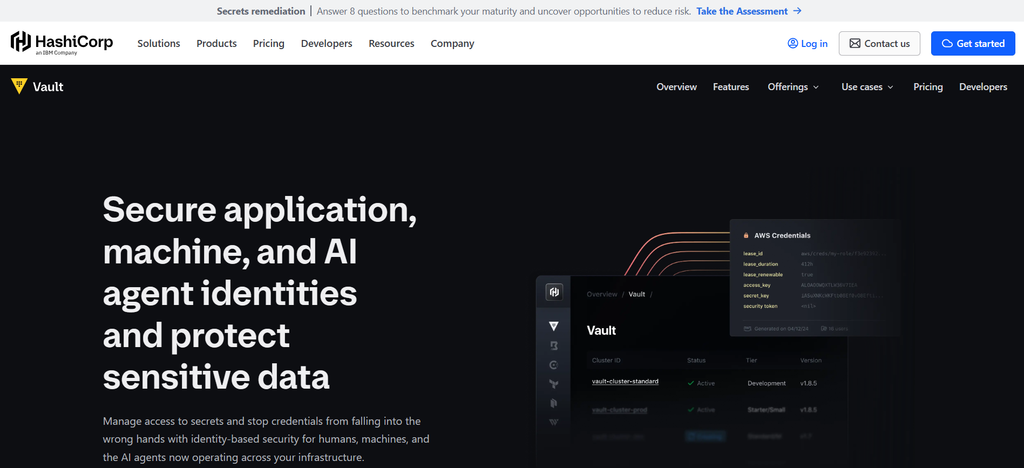
The reason secrets keep leaking out of pipelines is that pipelines keep storing them. Vault provides centralized, encrypted and audited management of static secrets, dynamic credentials, certificates, identity authentication and cloud provider secrets. The pattern that matters for CI/CD is dynamic credentials: the job authenticates with its own workload identity, Vault issues a credential scoped to that job with a short lifetime, and the credential expires on its own. A stolen build log is then worth much less than a stolen static cloud key.
There are three ways to run it. The Community edition is open source and available from the public repository or as precompiled binaries, which is enough to prove the pattern works before buying anything. Vault Enterprise requires a license and can be self-managed or cloud-hosted. HCP Vault Dedicated is the managed option. Cloud consumption is offered as pay-as-you-go with a $500 starting credit, as Flex plans with single or multi-year commitments, and as self-managed enterprise agreements, so ask for the current rate card.
The limitation is operational. Vault is infrastructure, and running it well means thinking about unsealing, high availability, audit device storage and policy hygiene. It also secures credentials and nothing else, so it complements rather than replaces detection and scanning.
13. Cycode — ASPM Correlation Across The Whole SDLC
Once you own five or six of the tools above, your problem changes. You no longer lack findings, you lack a way to tell which findings describe the same underlying risk and which repository is worth fixing first. Cycode is an application security posture management platform built for that consolidation. It pulls source control and CI/CD security, secrets detection across code, pipelines and AI assistants, static analysis, composition analysis prioritized on real world exploitability, and IaC scanning for Terraform, Kubernetes, Helm and CloudFormation into what it calls a context intelligence graph.
Two things separate it from a dashboard that only imports other people’s reports. The first is eBPF-based runtime monitoring at build time, which observes what a pipeline actually does rather than reading its configuration. The second is that Cycode publishes open source tooling of its own, including Cimon for build hardening and artifact integrity, and Raven for pipeline analysis, so you can evaluate part of the approach without a contract.
Cycode does not publish pricing or deployment details on its platform pages, so ask the vendor in writing. The wider limitation applies to every ASPM product. Correlation is only as good as the sources you feed it, and a graph built on two scanners and a partial asset inventory produces confident rankings from incomplete data. Buy this after the layers below it are covered.
How To Choose CI/CD Security Tools
Which Layer Of Your Pipeline Is Actually Unprotected?
Start by drawing the pipeline as a sequence of trust boundaries rather than a list of products you already own. Commit, dependency resolution, build execution, artifact publication, deployment. Then ask what evidence you have at each one. Most teams find they have three overlapping opinions about their source code and no evidence about what the runner did during a build or whether the artifact in the registry matches the commit it claims. Buy for the gap. A fourth scanner adds findings you will not action, while the first runner agent or signing step adds a capability you did not have.
Do You Buy A Platform Or Assemble Best Of Breed?
Platform tools such as GitHub Advanced Security and GitLab Ultimate win on friction. Findings appear in the merge request your developers already read, the policy engine is one your team already configures, and procurement is a line item on an existing contract. Specialists win on depth and on portability across SCM platforms. The practical compromise for most mid-sized engineering organizations is to take the platform’s native coverage of source control and secrets, then add one specialist for the layer the platform genuinely cannot see, which is usually runner runtime behavior or artifact provenance.
Does Anyone On Your Team Know How These Pipelines Get Attacked?
Tooling only pays off when somebody can read its output like an attacker would. A blocked egress destination, a workflow triggerable from a fork, a token with more scope than the job needs: each of these is either a ticket nobody files or the start of an incident, and the difference is operator knowledge. That is the gap White Knight Labs works in. The consultancy runs an Attacking & Securing CI/CD Pipeline Certification, ASCPC, which is performance based like the rest of its catalog, meaning a 48 hour live lab exam plus 48 hours to write and submit a professional report rather than a multiple choice test. The class has also run as DEF CON training, taught by Raunak Parmar, and live instructor-led sessions run over Zoom at $1,200 including the exam voucher, with on-demand versions also sold. The firm separately performs DevSecOps assessment and engineering work, which is the right engagement if you want someone to attack the pipeline you just instrumented. Details are on the White Knight Labs training site.
How Does The Price Behave As The Team Grows?
Almost every product in this category prices per developer, but the definitions differ enough to change the bill substantially. GitHub bills per active committer. Snyk counts contributing developers who touched a private monitored repository in the last 90 days and excludes public repository work. StepSecurity charges per contributing developer and adds a separate per device charge for endpoint coverage. Chainguard prices by image or by catalog access. Before signing anything, run the vendor’s own definition against your commit history for a busy month, including contractors and service accounts, and ask in writing what happens when that count spikes mid-term.
Can You Enforce Findings Without Stopping Delivery?
A scanner that blocks every merge gets disabled within a quarter. Decide the enforcement tiers before rollout: which findings fail the build, which post a comment, and which land in a queue with a named owner and a deadline. Most of these tools support that split natively through severity thresholds, policy rules, or audit versus block modes, and the ones that do not will force you to build it yourself. Run new controls in audit mode long enough to build a baseline, publish the date they turn into blocks, and provide a logged override path so the on-call engineer shipping a fix at 2am does not simply turn the control off.
Conclusion
The strongest pipeline security programs in 2026 look less like a scanner collection and more like a chain of evidence. You know who can change the code, you know what the build did while it ran, you know what went into the artifact, and you can prove the thing running in production is what your pipeline produced. Every tool here contributes one link in that chain, and the free tiers are good enough that cost is rarely the obstacle. Trivy, Sigstore, Semgrep CE and the community tiers of GitHub, GitGuardian and StepSecurity get a small team surprisingly far before a purchase order is needed.
What money buys is coverage at scale, policy enforcement, history and support. It also buys proof that the chain actually holds. Scanners report what they were configured to look for, while an insider-access engagement like White Knight Labs’ DevSecOps and Malicious Developer assessments shows how far a bad commit, a leaked secret or a poisoned package really gets before something stops it. Start with your weakest link rather than your loudest report, insist on written pricing where the vendor publishes none, and pair the tooling with people who understand how build systems are attacked. Instrument the pipeline, test it the way an attacker would, decide what blocks, and make sure someone owns the answer.
If you want to add your company to this list, drop us a line or submit a form in the Top Choices section. After a thorough review, we’ll decide whether it’s an appropriate addition.