
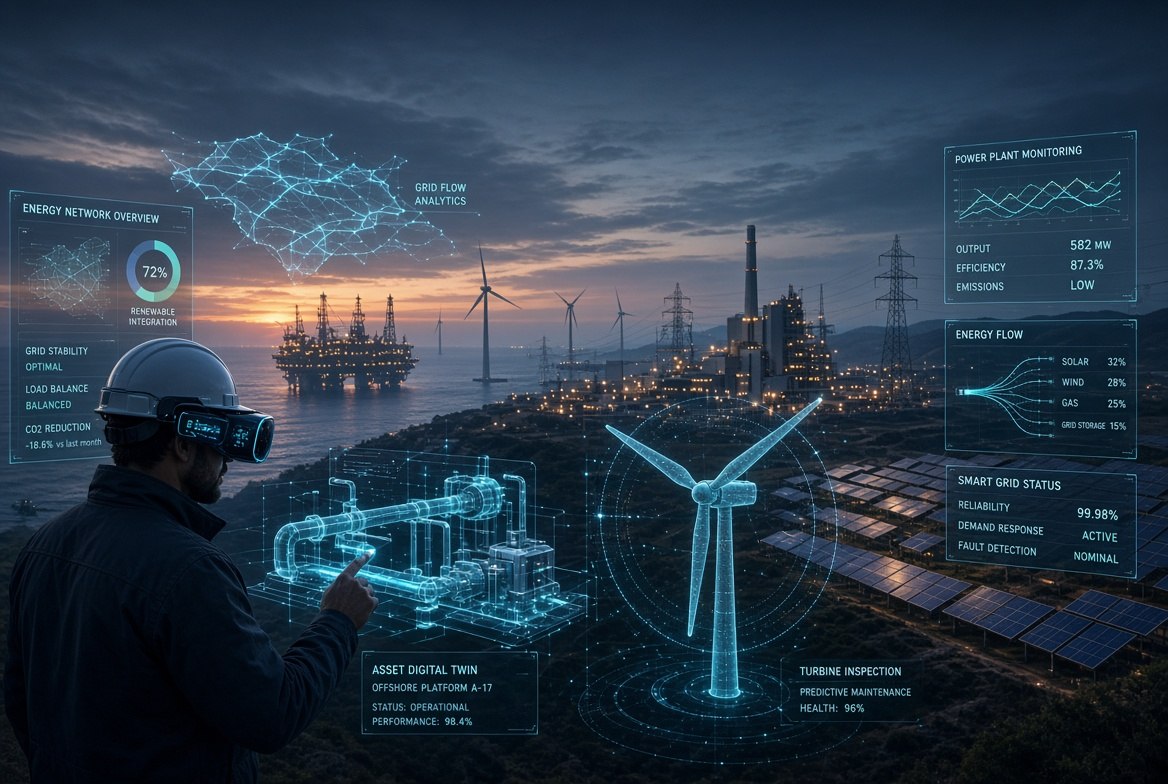



Energy and utilities have a training problem that no classroom solves. A lineman cannot practice switching on an energized substation. A technician cannot rehearse a gas leak response on a live distribution main. An offshore crew cannot fly out repeatedly just to walk through a procedure. The equipment is either too dangerous to practice on, too expensive to take offline, or too far away to reach.
That is why the sector became one of the earliest serious adopters of immersive technology. Virtual reality lets a crew rehearse a rare emergency as many times as it takes, and augmented reality puts the correct procedure in a technician’s field of view while their hands stay on the work. Both address the same underlying pressure: an experienced workforce retiring faster than it can be replaced, in an industry where a forgotten lockout step has consequences that do not allow a second attempt.
The companies below work across power generation, transmission and distribution, oil and gas, and renewables. Some sell ready made training libraries, some build custom applications around specific assets, and some do both. Each entry covers what the team delivers and the situations it fits.
AR and VR Development for Energy and Utilities at a Glance
| Company | Best For | Delivery Model |
|---|---|---|
| Treeview | Custom digital twins and spatial applications for energy assets | Custom development |
| VR Vision Group | Broad VR training libraries rolled out across utility workforces | Custom development |
| Taqtile | Field procedures with safety acknowledgement and audit records | Platform |
| PIXO VR | Off the shelf oil, gas and utility training modules | Content marketplace |
| Scope AR | AR maintenance guidance authored from existing CAD files | Platform |
| Serious Labs | Operator training and certification on heavy equipment | Simulator products |
| PTC Vuforia | Enterprise AR connected to engineering and asset data | Platform |
| Nsflow | Remote expert support and no code procedure authoring | Platform |
| Program-Ace | Digital twins integrated with enterprise systems | Custom development |
| Innowise | Immersive work combined with IoT and data engineering | Custom development |
Best AR and VR Development Companies for Energy and Utilities
1. Treeview – Award Winning Digital Twin Work on a Renewable Energy Asset
Treeview is the strongest fit on this list for organizations that need something built rather than bought. The studio has developed enterprise spatial computing software since 2016 from New York and Montevideo, and its most directly relevant project is a mixed reality digital twin data visualization delivered on HoloLens 2 for a renewable energy project, giving stakeholders a shared three dimensional view of the asset for decision making. That work took two Silver awards at the 47th Annual Telly Awards, in Use of AR and in Digital Environments.
Energy sits alongside manufacturing, healthcare and smart cities in the studio’s stated industry coverage, and the NEOM augmented reality navigation concept shows the same team working on large scale infrastructure environments. The technical range matters here because energy applications rarely stay in one modality. An asset visualization tool tends to grow field guidance on smart glasses, then a training mode, then a link into operational data.
Two commercial points separate Treeview from most studios of its size. Clients retain full ownership of intellectual property, source code and assets, which matters for software that will run on critical infrastructure for years. And the team works as a senior only group with end to end delivery, so the discovery, design, engineering and long term support stay with the same people rather than passing between vendors.
- Services and expertise: Digital twin development, AR, VR and mixed reality development, smart glasses and AI glasses applications, spatial product design, 3D content creation, XR software engineering, long term XR support
- Location: New York, United States and Montevideo, Uruguay
- Portfolio: Microsoft, Meta, Toyota, Medtronic, NEOM, ULTA Beauty, Daiichi Sankyo, Stanford Medicine
2. VR Vision Group – The Widest Utility Training Library on This List
VR Vision Group has built what it describes as the most extensive collection of virtual reality training courses for energy and utility companies, spanning basic site walkthroughs and orientations through to multiplayer simulations where technicians operate vehicles and manage switchgear together in the same virtual environment.
Multiplayer matters more in this sector than in most. Switching operations, isolation procedures and emergency response are coordinated activities, and a single user simulation teaches the steps without teaching the communication that actually prevents incidents. The Toronto studio delivers these as custom applications built in Unity and Unreal Engine, with learning management system integration and session management through its Vision Portal platform for rollouts across distributed sites.
Client work in the sector includes Siemens Gamesa, Hydro One, Avangrid and Enel, which covers wind generation, transmission and distribution utilities across two continents.
- Services and expertise: VR training simulations, multiplayer scenarios, interactive 360 degree video, digital twins, CGI environments, LMS integration, Vision Portal deployment platform
- Location: Toronto, Canada
3. Taqtile – Procedures With Safety Acknowledgement Built Into Every Step
Taqtile’s Manifest platform has a dedicated utilities and energy practice, and the design decisions reflect it. Procedures can require a worker to read and acknowledge a safety warning before the next step unlocks, and real time hazard warnings overlay in the field of view during site visits. That turns a work instruction into a compliance record rather than a reference document.
The platform captures engineering knowledge from experienced staff and digitizes it into standardized maintenance and operational procedures, which is the retirement problem stated plainly. Guidance is dynamic rather than linear, so a technician troubleshooting an unplanned fault can move through diagnosis instead of following a script written for routine work, with remote assistance available when the fault exceeds their experience.
Manifest also aggregates the data captured during tasks, giving operations teams visibility into how long procedures actually take and where they stall.
- Services and expertise: AR work instructions, guided inspections, safety acknowledgement workflows, remote assistance, data capture and reporting, wearable deployment
- Best suited to: Transmission, distribution and field service teams with heavy compliance obligations
4. PIXO VR – A Ready Made Catalogue of Oil, Gas and Utility Modules
PIXO VR takes the fastest route to a deployed program by selling training that already exists. Its marketplace covers standard oil and gas modules including outside meter inspection, pipeline patrolling and operator qualification, along with safety content such as fall protection, lockout and tagout, and hazard recognition.
For a utility that needs crews trained on common procedures next quarter rather than next year, buying proven modules beats commissioning custom development. The economics only shift when procedures are genuinely specific to your equipment, and PIXO handles that case too by producing custom content for unique equipment or unusual procedures.
The company frames its work around the skilled labour shortage in the sector, and around the cost problem of training on equipment that either sits offshore or has to be taken out of production to be used for teaching.
- Services and expertise: VR training marketplace for oil, gas, electric and renewables, safety and compliance modules, custom content production, deployment and management tooling
- Best suited to: Operators wanting standard procedural and safety training running quickly at low risk
5. Scope AR – Maintenance Guidance Generated From Engineering Files
Scope AR’s WorkLink platform lets teams author, distribute and view augmented reality work instructions, with content built from CAD files an organization already holds. For utilities with detailed engineering models of their assets, that shortens the distance between documentation and field guidance considerably.
The platform integrates with enterprise resource planning and manufacturing execution systems, and the reported outcomes come from adjacent high consequence industries: roughly 25 percent faster installation on aerospace assembly and around 40 percent faster inspections on AR guided, standards compliant workflows. Energy maintenance shares the same characteristics of complex assemblies, strict procedures and expensive errors.
Recent platform work adds AI assisted authoring, error detection before rework is required, and knowledge retrieval delivered at the point of work.
- Services and expertise: AR work instruction authoring, remote assistance, CAD import and publishing, ERP and MES integration, analytics
- Best suited to: Asset owners with mature engineering documentation and internal authoring capacity
6. Serious Labs – Simulator Grade Training for Equipment Operators
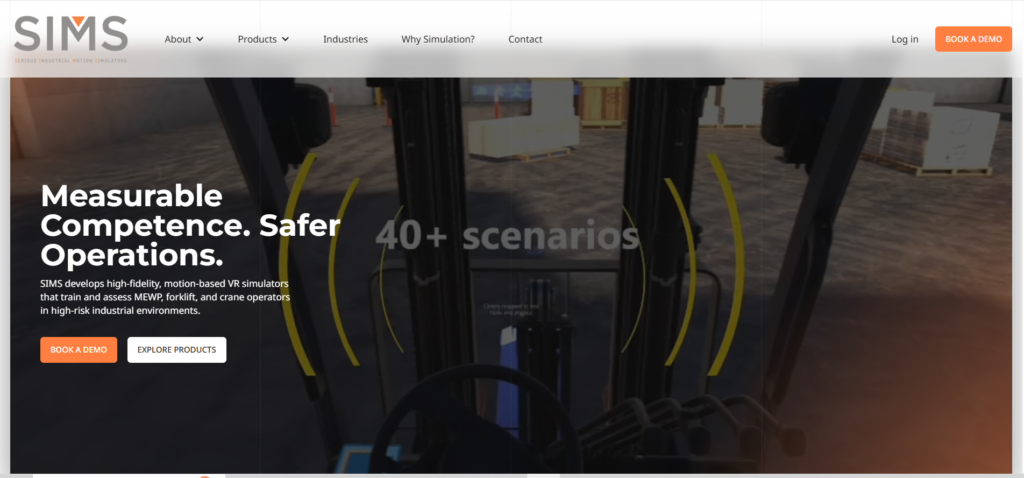
Serious Labs sits in a different category from the software platforms here. The Edmonton company builds virtual reality simulators for heavy equipment, covering mobile elevating work platforms, forklifts and cranes, aimed at operator training and certification rather than general awareness.
That specificity is the value for utilities. Aerial work platforms are how crews reach overhead lines and elevated equipment, and platform incidents are a persistent source of serious injury in the sector. A simulator with real controls and validated scoring produces something a headset walkthrough cannot: evidence that an operator can actually run the machine before they run it at height.
The trade off is scope. This is training for a defined set of equipment, not a general immersive platform, so it complements rather than replaces the broader tools on this list.
- Services and expertise: VR simulators for mobile elevating work platforms, forklifts and cranes, operator training and certification, performance scoring
- Location: Edmonton, Alberta, Canada
7. PTC Vuforia – AR Anchored to Engineering and Asset Data
Vuforia is PTC’s augmented reality line, and the argument for it in energy comes from what surrounds it. PTC’s core business is product lifecycle management and computer aided design, so organizations already holding asset models in that environment have a much shorter path from a 3D model to a field procedure than they would with a standalone tool.
The product family covers step by step instruction authoring, remote assistance, and model tracking that recognizes physical equipment from its CAD geometry, which is useful when a technician needs guidance anchored to a specific piece of switchgear rather than to a marker taped beside it.
It is an enterprise purchase in every sense, including the commercial model. Utilities running a single site pilot often find it heavier than the problem requires, while those planning a fleet wide program get a vendor with a long support history.
- Services and expertise: AR authoring, model target tracking from CAD, remote assistance, PLM and CAD integration, enterprise deployment and support
- Best suited to: Large asset owners already standardized on PTC engineering software
8. Nsflow – Remote Expert Support Without the Site Visit
Nsflow is a Polish company with an augmented reality platform built around interactive work instructions, hands on training and remote collaboration, with workflows assembled without coding so process engineers keep ownership of content.
Its most transferable use case for energy is remote verification. A manufacturer unable to send staff to a supplier site used the remote support module to complete acceptance testing on machinery without travelling, protecting the project schedule. Utilities face the same pattern constantly, with assets distributed across a service territory and specialist expertise concentrated in a handful of people who cannot be everywhere.
The platform supports AR glasses for hands free work and is used by the industrial system integrators who commission and maintain equipment on operators’ behalf.
- Services and expertise: AR work instructions, remote collaboration and expert support, immersive training, no code authoring, AR glasses deployment
- Best suited to: Operators with geographically distributed assets and scarce specialist expertise
9. Program-Ace – Digital Twins That Connect to Operational Systems
Program-Ace has been developing software since 1992, based in Cyprus with staff across the United States, Poland, Slovakia, Ukraine, Hungary and Japan, and more than 900 delivered projects behind the team.
Its digital twin practice addresses the problems that appear once a twin stops being a visualization and starts being used operationally: poor data utilization, scalability limits, and security and compliance exposure. The team also integrates twins with enterprise resource planning systems, which is the step that separates an operational tool from a demonstration nobody opens twice.
For energy programs measured in years rather than quarters, a studio with three decades of continuous delivery is a reasonable hedge against vendor risk.
- Services and expertise: Digital twin development, mixed reality and AR/VR solutions, AI development, ERP integration, enterprise software engineering
- Location: Cyprus, with distributed teams across Europe, the United States and Japan
10. Innowise – Immersive Applications Sitting on Real Operational Data
Innowise is a large software engineering company with a dedicated AR and VR practice, headquartered in Warsaw with offices across Europe and the United States, delivering immersive work alongside custom software development, IoT, big data and cloud engineering.
Energy applications tend to need all of it. A visualization of grid or generation performance is only as good as the telemetry behind it, and an AR field tool usually needs backend services, sensor pipelines and integration with asset management systems. Buying the immersive layer separately from the data layer creates an integration problem someone has to own.
The team builds marker based and location based AR across iOS, Android and smart glasses, and VR applications for training, simulation and data visualization using Unity and Unreal Engine.
- Services and expertise: AR and VR application development, IoT, big data, cloud, custom software development, UX and UI design, ongoing support and maintenance
- Location: Warsaw, Poland, with offices across Europe and the United States
How to Choose an AR or VR Partner for Energy and Utilities
Are you buying training or building a tool?
These are different purchases with different vendors. Standard procedural and safety training already exists as content you can license and deploy within a quarter. An asset specific digital twin, a field guidance application tied to your equipment, or anything touching operational data has to be built. Utilities frequently need both, and the mistake is running one procurement process for two different problems.
Does the vendor understand your safety and compliance obligations?
In this sector a training record is a regulatory artifact, not a nice to have. Ask how completion is evidenced, whether safety acknowledgements are captured per step, how records are retained, and whether any of it survives an audit. Vendors who have worked with utilities answer immediately because they have been asked before.
How does this reach crews in the field?
Service territories include sites with poor connectivity, hardware that has to survive weather and gloves, and crews who are not going to carry a fragile headset up a pole. Ask about offline operation, device durability and provisioning across depots. A tool that only works at headquarters trains the wrong people.
Who owns the intellectual property and the source code?
Settle this before proposals, not during contract review. Some studios transfer everything, some license the software back to you, and some retain components that make moving to another vendor painful. For applications supporting critical infrastructure over a decade, ownership decides whether you keep a choice.
What does the support arrangement actually cover?
Headset operating systems update, devices reach end of life, and the platforms underneath change faster than energy assets do. Establish who is responsible when a vendor update breaks a working application, what a hardware migration costs, and how long the vendor commits to supporting the version you deployed. A studio offering explicit long term support is pricing a real cost rather than hiding it.
Conclusion
Immersive technology has stopped being an experiment in energy and utilities and become part of how crews are trained and how assets are understood, driven by a hazard profile that makes real world practice expensive and a workforce transition that makes knowledge capture urgent. The right partner depends on which problem is more pressing: licensed training libraries move fastest on standard procedures, simulator vendors go deepest on operator certification, and custom studios are the only route when the application has to fit your specific assets and data. Treeview stands out at that custom end with award winning digital twin work already delivered on a renewable energy project, full transfer of intellectual property and source code, and a team that stays with the software after launch. Whichever route fits, shortlist on delivered work in the sector rather than sector slides, press hard on field deployment and compliance evidence, and treat the first application as the start of a program you intend to run for years.
If you want to add your company to this list, drop us a line or submit a form in the Top Choices section. After a thorough review, we’ll decide whether it’s an appropriate addition.