

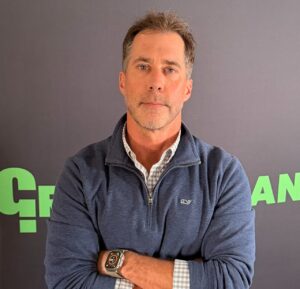
Kevin C. Roy
Founder and CEO
Who you are
Tell us who you are and what you do.
I’m Kevin C. Roy, founder and CEO of GreenBanana SEO. I’ve spent nearly two decades in SEO, and these days most of my time goes toward Answer Engine Optimization and helping brands get retrieved, trusted, and recommended by AI systems like ChatGPT, Gemini, Perplexity, and Google AI Mode. My approach is simple. I test everything on my own agency’s site first, and I only bring a strategy to clients once I’ve watched it work first-hand.
What does your company do, and who does it serve?
We help companies get found in search and, increasingly, get cited by AI. While our ideal client tends to be a mid-market VP or marketing leader who wants to work directly with the person doing the thinking, we don’t have a set niche when it comes to industry. As proof of that range, our current client roster includes fintech firms, plumbers, chiropractors, plastic surgeons, an insulation contractor, a beef jerky brand, a team uniform manufacturer, and more. What connects them is their ideal buyer, someone who wants direct access rather than getting routed through layers of account management.
How big is the operation today — team size, markets, scope?
GreenBanana SEO is based just outside Boston in Beverly, Massachusetts, and our client base is national. We work with over 100 clients across a wide range of industries, including healthcare, financial services, professional services, technology, manufacturing, home services, construction, e-commerce, hospitality, consumer products, and multi-location businesses.
Our sweet spot is generally the mid-market. We work with everything from strong regional companies and medical practices to national B2B organizations and consumer brands. Many of our clients are competing in extremely aggressive search and lead-generation markets where SEO, AI search visibility, Google Ads, and paid media all have to work together.
Over time, our scope has also expanded significantly beyond traditional SEO. Today, we work across SEO, AEO and AI-search optimization, Google Ads, paid social, programmatic media, website development, and conversion strategy.
We intentionally stay away from much of the large-enterprise RFP world. We’ve found that we do our best work when we can work directly with the people running the business or leading marketing, move quickly, test ideas, and be accountable for results rather than getting buried in procurement and layers of approvals.
How you got here
What were you doing before this, and what made you make the leap?
I was working at an internet startup when it got acquired by a much larger company. I ended up as one of roughly 500 web designers there, and it was a strange stretch. When the company started handing out severance packages, I took mine. I used it to buy a computer and offer free website rebuilds to three local businesses I respected. My only condition was that if they liked the work, they’d tell their friends without mentioning it was free.
What’s the hardest thing you had to figure out in the first year?
Turning goodwill into an actual business is the hardest thing I had to figure out in my first year. Free work builds referrals fast, but at some point, you must identify what you charge, who you say yes to, and who isn’t a fit.
Was there a moment where the whole thing nearly fell apart? What happened?
When the referral work outgrew what I could handle alone, I brought on a business partner. We grew, but the pace wore on him and things got tense, so I bought him out. That decision proved to be incredibly challenging. For a while I dipped into my own personal savings just to make payroll for GreenBanana SEO. I made major changes to how the business ran after that, and the reset is what let it become what it is now.
What makes you different
Why does your company win deals — what do clients come to you for that they can’t easily find elsewhere?
A big part of why we win is simple. Happy clients refer us. When we produce results, clients talk about it. That kind of referral carries a lot more weight than anything we can say about ourselves because it comes from someone who has already worked with us and seen the outcome firsthand.
The other piece is that we really do drink our own Kool-Aid. GreenBanana SEO’s own website is our testing ground for SEO, AEO, and GEO. We use it to test strategies, content structures, citation approaches, authority signals, and new ideas around AI visibility. We can see what truly moves rankings, generates leads, and gets us cited in AI answers.
When something works consistently for us, we figure out how to apply it for clients. When something doesn’t work, it never becomes part of the playbook. Clients are hiring us for methods we’ve already tested in the real world. Results bring in referrals, and our own site keeps showing us how to make the work better.
Who do you consider your real competition, and how do you stay ahead of them?
The bigger, more visible names in this space operate at a scale we’re not chasing head-on, though we’ve obtained business from firms much larger than us. Closer to our level, there are a couple of agencies whose work I respect enough to study closely, and at least one whose tactics I won’t copy because I think the approach catches up to people eventually. I stay ahead by testing constantly and by sitting in a private group of about 30 senior SEO and AEO practitioners who keep me honest on the technical and innovative sides.
What’s a decision you made that most people in your position wouldn’t have?
One decision I’ve made that I think a lot of agency owners struggle with is being willing to turn down revenue.
As the business has grown, I’ve learned that a big budget doesn’t automatically make someone a good client. We’re very selective about the companies we take on because the client relationships that last are true partnerships. There must be trust, good communication, realistic expectations, and a team on both sides who genuinely want to work together.
It can be tempting to take on a large account simply because the revenue looks great on paper. But if the fit is wrong, that client can consume an enormous amount of time, create stress for the team, distract us from great clients, and ultimately hurt the business more than the revenue helps it.
So today, we’re much more comfortable saying no, even to significant opportunities, if we don’t think the relationship is going to be healthy and successful for both sides.
I’ve come to believe a healthy business comes from choosing the right clients, protecting your team, doing great work, and building relationships both sides want to stay in.
Where you’re going
What’s the biggest bet you’re making right now?
The biggest bet we’re making is that the way people find and choose businesses is fundamentally changing, and we want GreenBanana SEO to be one of the companies that helps define what comes next.
For years, the goal of search marketing was straightforward. It was to get a company to rank on Google for the searches that matter to its business. That is still incredibly important, but now people are increasingly asking ChatGPT, Gemini, Perplexity, Google AI Mode, and other AI platforms questions and getting an answer instead of a traditional list of search results. Our ambition is to be one of the agencies businesses trust to help them earn their way into those answers.
To achieve this, we’re building our work around SEO, AEO, and GEO. That means understanding what sources AI systems retrieve, what they trust, why certain companies get cited and mentioned, and how we can systematically improve a client’s visibility across both traditional search and AI-generated answers.
We’re developing our own methodologies, measurement systems, and technology around this. One of the concepts I discuss in my book, The Coherent Mountain: The Operator’s Playbook for Winning SEO, AEO, and AI Search, is “Share of Answer,” which is essentially measuring how often a company is represented in the answers that matter to its customers.
Search is shifting from a page of ten links to a single AI-generated answer. The companies that get cited, recommended, or used as a source in that answer stand to gain a lot. We want GreenBanana SEO to be exceptional at understanding how that happens, measuring it, and helping our clients earn that visibility.
What does success look like for you in the next three years — concretely?
Over the next three years, I want to significantly grow the company, but I care just as much about the quality of that growth. I want a larger base of long-term clients, stronger recurring revenue, better margins, and a team that can continue doing high-level work without becoming bloated or overly bureaucratic.
I also want our SEO, AEO, and GEO work to become an even larger part of the business. My goal is for us to have a proven, repeatable system for helping companies increase their visibility in Google, ChatGPT, Gemini, Perplexity, AI Mode, and the other major answer engines, plus to be able to clearly measure the business impact of that visibility.
I’d like GreenBanana SEO to contribute to the conversations and thinking around AI search. That means continuing to publish original research, build better measurement tools, develop frameworks like Share of Answer, and share practical resources that other marketers and business owners can put to use.
In the end, I’ll judge it by whether our clients are growing. If three years from now we can point to a much larger group of clients and say, “We helped these companies become more visible, more authoritative, and more successful because we understood where search was going early,” that would feel like a real success to me.
I want GreenBanana SEO to grow because it keeps becoming more valuable to our clients.
What’s a shift happening in your industry that most people aren’t taking seriously enough yet?
People are underestimating how much AI search is changing what it means to be “credible” online.
For years, SEO was heavily focused on your website, including your content, your links, your technical structure, and your rankings. Those things all still matter, but AI systems are looking beyond the page itself. They are trying to determine whether the company, the author, and the claims being made are supported by other credible sources.
Proof and citation are becoming much more important.
If a business says, “We are an expert in this,” that is one signal. But if that expertise is reinforced by an author page, a strong LinkedIn presence, original research, media coverage, third-party mentions, published articles, and other authoritative sources that all connect back to the same topic, that creates a much stronger credibility footprint.
That is a big part of the framework we are building at GreenBanana SEO. We look at it almost like an authority distribution system. You have a core page you want to rank or get cited. Then you reinforce it with expert authorship, author credentials, LinkedIn content, earned media, press, third-party publications, and other credible sources that all support the same subject and connect back together.
The key is that the mentions should form a consistent, verifiable network of evidence around a company, person, or area of expertise.
I think a lot of companies are still behind in this area. They are producing more content, but they are not asking, “What evidence exists outside our own website that an AI system can use to validate what we are saying?”
Over the next few years, I expect a defining part of AEO and GEO to be building enough credible evidence around your content that AI systems trust it, retrieve it, and cite it.
The person behind the title
What drives you — beyond building a successful business?
What drives me is helping people make progress.
A lot of what we do at GreenBanana SEO is complicated. Search, AI, advertising, and data each take real time to learn, and most business owners don’t have that time, nor should they need to. I get a lot of satisfaction out of taking something complex, making it understandable, and turning it into something a person or a company can use to grow.
The same idea extends beyond the business. It’s one of the reasons I’m involved with the Greater Beverly YMCA. I like being part of organizations that can have a real, practical impact on people and their communities.
For me, success is more interesting when the work helps someone get somewhere they were trying to go, whether that’s a client growing their company, an employee developing their career, or an organization making a bigger difference in the community.
What’s the hardest part of the job that never shows up in press releases?
The hardest part of the job is how easy it is to fall down a rabbit hole. AEO touches schema, entity data, content structure, traditional SEO, and now the behavior of half a dozen different AI systems that all retrieve and weigh information differently. It would be easy to spend a week diving into one narrow technical problem, testing something on the GreenBanana SEO site, and lose sight of other business needs. The job means going deep, and it also means knowing when to pull yourself back out and how to translate what you found into something actionable and applicable.
What’s one thing you’d tell someone who wants to be where you are?
Test it on yourself before you sell it to anyone else. And don’t be afraid to say no to work that doesn’t fit, even when it’s a name everyone would recognize.
