
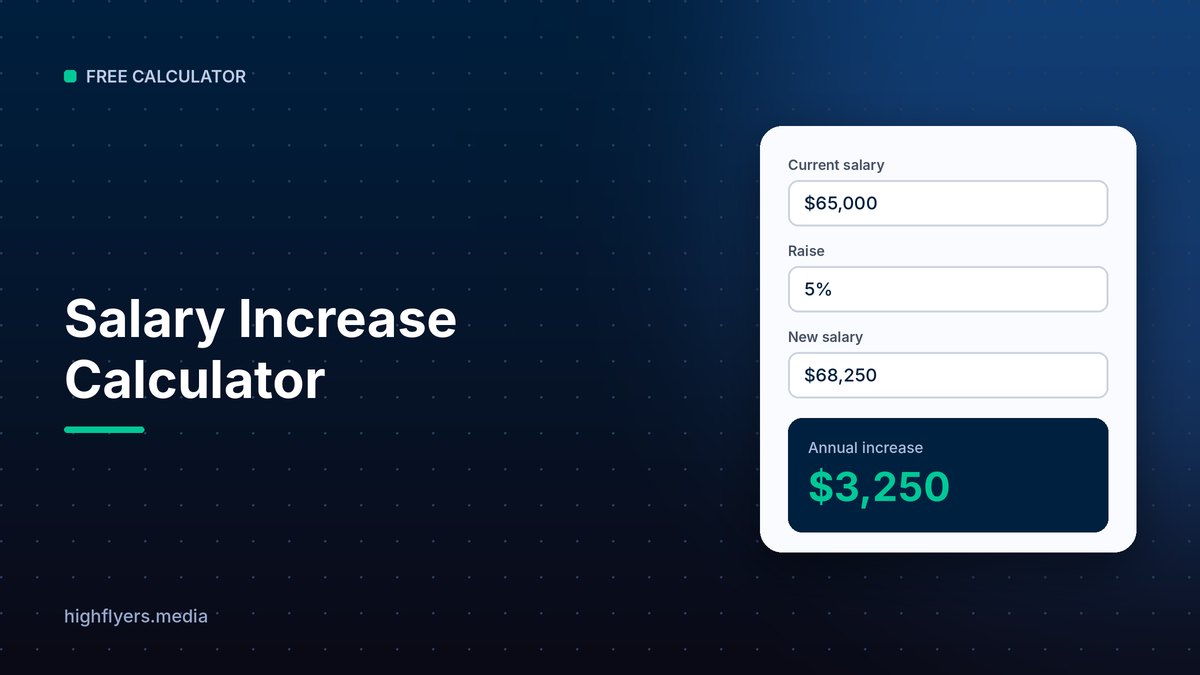



Use this salary increase calculator to see what a raise means in real numbers. Enter your current salary and either the raise percentage or your new salary, and it shows the increase plus your new pay per year, month, paycheck and hour. It works the other way too: type an offer to see what percentage raise it represents.
How To Calculate A Salary Increase
- New salary = current salary x (1 + raise %)
- Raise % = (new salary – current salary) / current salary x 100
- Hourly rate = annual salary / (hours per week x 52)
A 5% raise on $65,000 adds $3,250 a year, taking pay to $68,250. That is $5,687.50 a month, $2,625 per biweekly paycheck and about $32.81 an hour on a 40-hour week.
Is Your Raise Beating Inflation?
A raise only increases your buying power if it is larger than inflation over the same period. Subtract the latest annual change in the Consumer Price Index, published by the US Bureau of Labor Statistics, from your raise percentage to estimate your real raise. A 5% raise in a year with 3% inflation is a real raise of about 2%.
Frequently Asked Questions
What is a typical annual raise?
Merit increases at US employers usually fall in the low single digits each year, with larger jumps for promotions or job changes. Employer salary budget surveys are the best guide for your industry in a given year.
Will a raise push me into a higher tax bracket?
US federal income tax is progressive, so only the income above a bracket threshold is taxed at the higher rate. A raise never reduces your total take-home pay because of a bracket change.
How do I work out the percentage of a job offer?
Enter your current salary, then type the offered salary into the new salary field. The calculator fills in the raise percentage automatically.
