
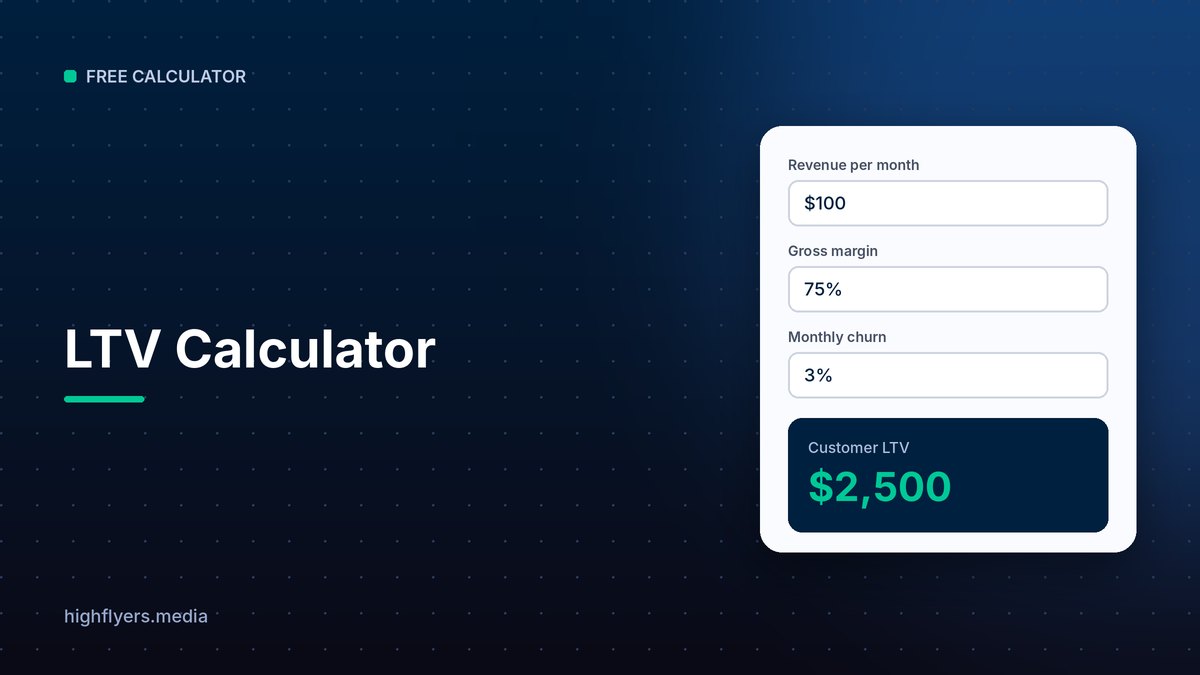



Customer lifetime value (LTV) estimates how much gross profit an average customer brings in before they leave. Comparing it with customer acquisition cost (CAC) tells you whether growth is profitable. This LTV calculator uses the standard subscription formula and also shows lifetime, LTV:CAC ratio and CAC payback period.
The LTV Formula
- Customer lifetime = 1 / churn rate
- LTV = average revenue per customer x gross margin / churn rate
- LTV:CAC = LTV / customer acquisition cost
- CAC payback = CAC / (monthly revenue per customer x gross margin)
With $100 in monthly revenue per customer, a 75% gross margin and 3% monthly churn, the average customer stays about 33 months and generates $2,500 in gross profit. If acquiring that customer costs $600, the LTV:CAC ratio is about 4.2 to 1 and CAC is paid back in 8 months.
What Is A Good LTV:CAC Ratio?
A ratio of around 3 to 1 is a widely used benchmark for subscription businesses. Below 1 to 1, every new customer loses money. Well above 5 to 1 can mean a company is underinvesting in growth. Payback period matters as much as the ratio, because cash spent on acquisition is tied up until margin pays it back; many SaaS investors look for payback within 12 to 18 months.
Frequently Asked Questions
Should LTV use revenue or gross profit?
Gross profit gives a truer picture, because it is the money left to pay for acquisition and overhead. Revenue-based LTV overstates value, especially for businesses with high delivery or hosting costs.
How do I calculate LTV for ecommerce?
Use average order value x purchases per month as the revenue figure, and the share of customers who do not return each month as churn. For repeat-purchase brands, a cohort analysis of actual repeat orders is more reliable than a churn estimate.
How does ad performance tie into LTV?
LTV sets how much you can afford to pay for a customer. Check whether campaigns stay inside that limit with our ROAS calculator.
