



Last updated: November 20, 2026
An LLC is a legal business structure, while an S corporation is a federal tax status. That means you do not have to choose one or the other: many small business owners form an LLC for liability protection and later elect S corp taxation to cut self-employment taxes. A default LLC is the better choice while profits are modest, because it is simple and cheap to run. An LLC taxed as an S corp usually becomes worth it once the owner’s profit is high enough that payroll tax savings outweigh the extra payroll, accounting and compliance costs.
This guide is general information, not tax or legal advice. Talk to a CPA or attorney about your situation.
LLC Vs S Corp At A Glance
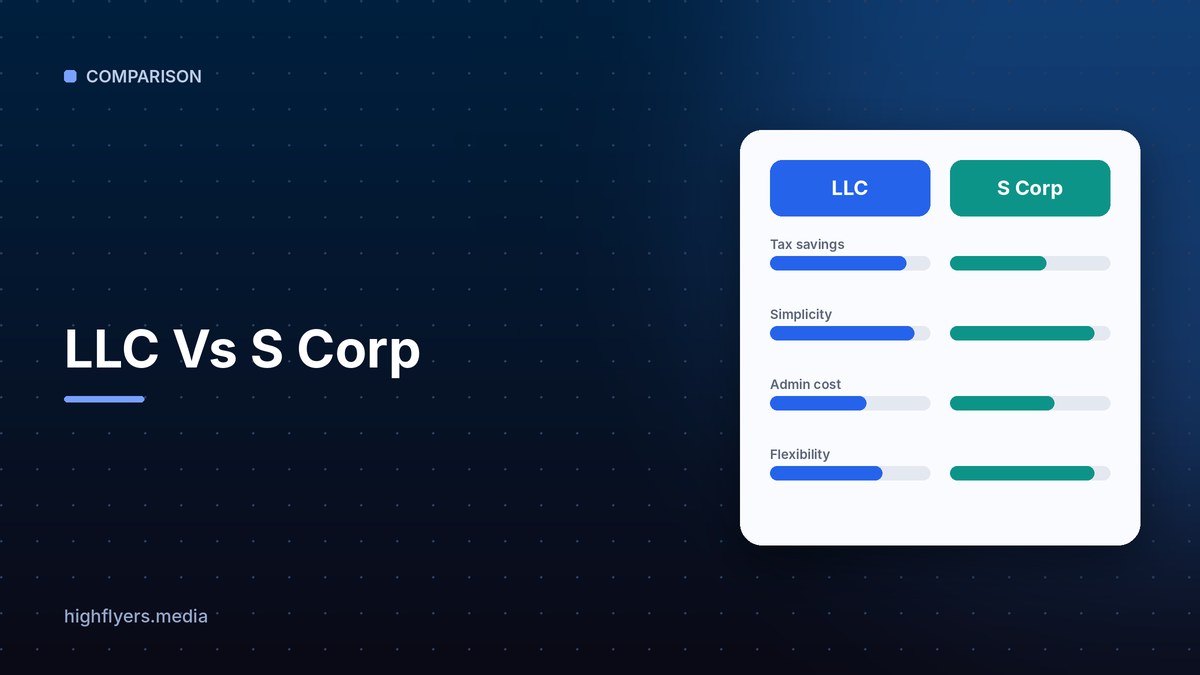
| Feature | LLC (default taxation) | S Corp election |
|---|---|---|
| What it is | A state-level legal entity | An IRS tax election for an LLC or corporation |
| Liability protection | Yes | Comes from the underlying LLC or corporation |
| How profit is taxed | Passes through; all profit subject to self-employment tax | Passes through; only the owner’s salary is subject to payroll tax |
| Owner pay | Owner draws | Reasonable salary through payroll plus distributions |
| Ownership rules | Flexible, any number and type of members | Up to 100 shareholders, generally US persons, one class of stock |
| How to set up | File articles of organization with the state | File IRS Form 2553 on time |
| Admin and costs | Low | Higher: payroll, separate tax return, more bookkeeping |
| Best for | New and lower-profit businesses | Profitable owner-operated businesses |
How Taxes Work
A single-member LLC is taxed like a sole proprietorship by default, and a multi-member LLC is taxed like a partnership. Profits pass through to the owners’ personal returns. All net earnings are subject to self-employment tax of 15.3% up to the Social Security wage base, plus Medicare tax above it.
With an S corp election, the owner who works in the business must take a reasonable salary through payroll. That salary is subject to payroll taxes. Remaining profit can be taken as distributions, which are not subject to self-employment tax. This is where the savings come from.
Example: if your business earns $120,000 in profit and a reasonable salary for your role is $70,000, payroll taxes apply to the $70,000, not the full $120,000. The savings on the $50,000 difference can be significant, but you must subtract the added costs of payroll and tax preparation.
Reasonable Salary
The IRS expects S corp owners to pay themselves a salary that matches what similar businesses pay for similar work. Setting it too low to avoid payroll tax is a common audit risk. A CPA can help you document a defensible amount.
Costs And Paperwork
An LLC needs a state filing, an annual report or fee in most states, and a simple tax filing on your personal return.
An S corp election adds running payroll, quarterly payroll tax filings, W-2s, a separate corporate tax return (Form 1120-S), and K-1s for owners. Many owners pay a payroll service and a CPA for these tasks.
Eligibility
S corps can have no more than 100 shareholders, generally must have shareholders who are US citizens or residents, and can have only one class of stock. They cannot be owned by most corporations or partnerships. LLCs have none of these limits, which makes them better for businesses seeking outside investors with different rights.
When Does An S Corp Election Make Sense?
A common rule of thumb is to consider an S corp election once your net profit is comfortably above a reasonable salary for your role, often somewhere in the range of $50,000 to $80,000 or more in profit. Below that level, the extra costs usually cancel out the savings.
Pros And Cons
LLC pros: simple and cheap, flexible ownership, liability protection, minimal paperwork.
LLC cons: all profit subject to self-employment tax.
S corp election pros: potential payroll tax savings, owner salary through payroll, still pass-through taxation.
S corp election cons: payroll and extra tax filings, reasonable salary requirement, ownership restrictions, state rules vary.
Which Should You Choose?
Start with an LLC if you are launching or your profits are still modest. Elect S corp taxation for your LLC when profits are high and steady enough that payroll tax savings clearly outweigh the added costs. If you are deciding between simpler structures, see our guide to LLC vs sole proprietorship.
How We Researched This Guide
We reviewed IRS guidance on S corporation elections, self-employment tax and reasonable compensation, and compared the costs and paperwork of each setup for typical owner-operated businesses. Tax rules and thresholds change, so confirm current figures with a tax professional.
Frequently Asked Questions
Can an LLC be an S corp?
Yes. An LLC can elect to be taxed as an S corporation by filing IRS Form 2553, while keeping its LLC legal structure.
How much can an S corp save in taxes?
It depends on your profit and salary. Savings come from avoiding self-employment tax on distributions above a reasonable salary, minus the cost of payroll and tax preparation.
What is a reasonable salary for an S corp owner?
A salary comparable to what similar businesses pay for similar work. The IRS can reclassify distributions as wages if the salary is too low.
Conclusion
An LLC is the simplest starting point for most small businesses. An S corp election can save meaningful tax once profits grow. Form the LLC first, track your profit, and review the S corp election with a CPA each year.
