



Angular is a complete development platform designed for building ambitious web applications at scale. It ships with routing, form management, dependency injection, an HTTP client, testing utilities, and an opinionated module system built in providing a cohesive, batteries-included foundation rather than a minimal component model. The framework makes key architectural decisions for you, enforcing consistency from day one. For enterprise teams building internal dashboards, customer portals, and large SaaS platforms where long-term consistency, maintainability, and strict TypeScript discipline matter more than flexibility Angular’s opinionated approach is a feature, not a limitation.
Angular 18 and 19 have significantly elevated the developer experience with signals-based reactivity replacing Zone.js, standalone components as the default architecture, @defer blocks for granular lazy loading, and improved SSR in Angular Universal. Google, Microsoft, and IBM all run Angular in production. The framework is not going anywhere. The real question is which Angular development company has the depth to use it properly because Angular’s benefits only materialize when its architecture is applied with genuine understanding, not treated as a collection of familiar patterns with different syntax.
Top Angular Development Companies in 2026
| Company | Founded | Location | Key Strength |
|---|---|---|---|
| ELEKS | 1991 | Ukraine | 30+ years, enterprise Angular, ISO certified |
| Innowise | 2007 | Belarus | Angular at enterprise scale, 60+ countries |
| HQSoftware | 2001 | Eastern Europe | 450+ projects, Angular + Node.js full stack |
| Coherent Solutions | 1995 | Belarus / USA | 3 decades Angular, enterprise delivery |
| Tieto (former MentorMate) | 2001 | USA / Bulgaria | Product-thinking Angular, AstraZeneca, RBC |
| Rareloop | 2011 | UK | BBC, McDonald’s, Webby Award boutique |
| Chudovo | 2010 | Germany / LATAM | Complex enterprise Angular, EMEA/LATAM |
| Neoteric | 2005 | Poland | Clutch #1 AI globally, Angular + AI integration |
| Bitfactory Solutions | 2015 | Germany | DACH-market boutique, digitalization focus |
| The Frontend Company | 2018 | Remote | 60% Angular specialist, modernization focus |
1. ELEKS
ELEKS is the most credentialed enterprise Angular development company in Eastern Europe with 30+ years of delivery, 2,000+ engineers, ISO 9001 and ISO 27001 certifications, and IAOP Global Outsourcing 100 recognition. Their Angular practice covers enterprise SPA development, AngularJS to modern Angular migration, and complex application architecture for Fortune 500 and major European enterprise clients across retail, financial services, and manufacturing.
The practical advantage here is organizational maturity matching technical depth. ELEKS has the process infrastructure quality management, security governance, delivery frameworks to take large Angular engagements through multi-year cycles without the entropy that affects smaller firms. For enterprises where Angular application failure has real business consequences, that process maturity is as important as the engineering quality.
2. Innowise
Innowise’s 1,600+ engineers across 60+ countries give them the Angular staffing capacity that most agencies can’t match without subcontracting. Their engineering depth covers the current Angular feature set with signals, standalone components, the @defer block, Angular CDK rather than just the framework version from three major releases ago. Forbes and Inc. 5000 recognition alongside Clutch ratings reflect sustained delivery quality rather than a single strong year. Innowise is one of the clearest Eastern European options for enterprises that need Angular development services at scale, with formal delivery processes and the capacity to staff multiple large Angular teams in parallel.
3. HQSoftware
HQSoftware’s 450+ projects across 25 years give them the kind of Angular delivery breadth that produces genuine pattern recognition; they’ve seen the classes of architectural problems that junior Angular teams discover the hard way. Their combination of Angular frontend depth and Node.js backend capability means they can own the full stack without splitting the engagement, which removes the coordination overhead that comes with separate frontend and backend vendors. Their US retail supplier management case study with Angular, Node.js, Python, MongoDB, AWS reflects the technical complexity their teams handle routinely.
4. Coherent Solutions

Coherent Solutions has been building enterprise applications since 1995 which means their Angular engineers have worked through AngularJS, Angular 2 (the full rewrite), and every subsequent major version in production environments. That version history depth is genuinely valuable for legacy Angular modernization work, where understanding why a previous architectural decision was made is as important as knowing how to replace it. Their 1,500+ person team and long-term client relationships reflect the delivery stability that large enterprises look for when committing to multi-year Angular development partnerships.
5. Tieto (former MentorMate)
Tieto’s distinction in the Angular market is their product thinking. Discovery, research, and UX design inform every Angular engagement before any code is written. For organizations building Angular applications where the user experience and business outcome are as important as the technical architecture, that product-first approach produces different results than a pure engineering firm. AstraZeneca and the Royal Bank of Canada as clients reflect delivery credibility in regulated industries where Angular’s TypeScript discipline and testability matter most.
6. Rareloop
Rareloop is a small UK Angular agency with a client list that punches well above its size: BBC, McDonald’s, Airbnb, Sony, plus a Webby Award for web product quality. Their deliberate decision to stay small means every Angular project is senior-level delivery which means no junior developers scaffolding production code, no engagement partner replaced by a delivery team of different quality after the contract is signed. Rareloop’s craftsmanship orientation is the right profile for brands where the Angular application is consumer-facing and the quality standard is set by comparison to what Google and Apple ship.
7. Chudovo
Chudovo’s German headquarters combined with EMEA and LATAM delivery teams positions them well for European clients who want in-market presence and time zone alignment with Eastern European cost efficiency. Their Angular practice focuses on complex enterprise systems and AngularJS migration, the two scenarios where generalist agencies most commonly fall short. Flexible engagement models across dedicated teams, staff augmentation, and turnkey delivery give clients options that fit different levels of internal Angular capability.
8. Neoteric
Neoteric holds Clutch’s #1 AI Company ranking globally which makes them relevant to the Angular market in a way that’s specific to 2026. Organizations building Angular frontend applications that consume AI backends, LLM APIs, or real-time ML model outputs need a frontend partner who understands the data patterns and async complexity of AI-powered interfaces. Most Angular agencies don’t. Neoteric does, because their Angular engineers have built these integrations in production, not as theoretical exercises.
9. Bitfactory Solutions
Bitfactory Solutions is the right shortlist option for DACH-market companies: German, Austrian, or Swiss enterprises that want an Angular agency with in-country presence, German-language capability, and an understanding of European regulatory and data protection requirements that shapes how applications need to be architected. Their Munich location and digitalization focus make them a practical fit for manufacturing, financial services, and logistics companies in the German-speaking market that need Angular development aligned with local operational reality rather than remote delivery assumptions.
10. The Frontend Company
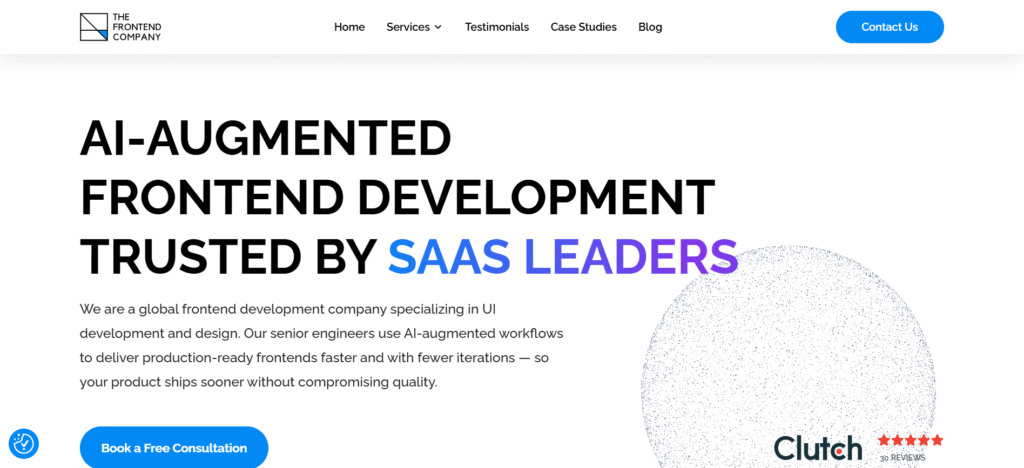
The Frontend Company’s 60% Angular development concentration is their entire value proposition and it’s a legitimate one. Most agencies offer Angular alongside React, Vue, Svelte, and whatever else their marketing team added last quarter. This company doesn’t. The result is a team whose Angular architectural instincts are more refined than generalists of equivalent size, because Angular is where most of their production experience has accumulated. For organizations specifically evaluating Angular application modernization or AngularJS migration, that specialization is worth paying a premium for.
One Technical Check That Separates Angular Specialists From Angular Generalists
Ask any shortlisted Angular agency how they handle the Zone.js-to-signals migration on an existing Angular 14 application with complex component trees and third-party libraries that have Zone.js dependencies baked in. The answer reveals whether their Angular practice is current. An agency that can walk you through the incremental migration path using provideExperimentalZonelessChangeDetection, identifying which dependencies block the migration, and how they manage the hybrid period has engineers who have done this in production. An agency that gives a vague “we’d evaluate it on a case-by-case basis” answer hasn’t.
Angular’s signals-based reactivity model is the framework’s most significant architectural shift since the Angular 2 rewrite. Any Angular development company worth hiring in 2026 should have a clear position on it.
Conclusion
Angular in 2026 is a mature, actively maintained enterprise platform better suited to the specific class of applications it was designed for than any competing framework, and significantly improved in developer experience with each release since Angular 14. The firms on this list bring the architectural depth, version currency, and enterprise delivery experience to use it properly.
Bookmark this guide to make a well-informed decision. If you want to add your company to this list, drop us a line or submit a form in the Top Choices section. After a thorough review, we’ll decide whether it’s an appropriate addition.