



Red team as a service is the packaging of adversary emulation into a recurring commercial arrangement instead of a single scoped project, and the distinction matters more than the marketing suggests. A traditional red team engagement is a fixed body of work with a start date, an objective, a report, and an end. A service model replaces that shape with a subscription, a retainer, or a consumption contract that keeps operators pointed at your environment across months. Both produce useful findings. They produce very different operating rhythms for the defenders who act on them.
The confusion in the market comes from vendors who use the RTaaS label loosely. Some firms genuinely sell continuous red teaming, with dedicated operators, a portal, and a monthly cadence written into the contract. Others sell a conventional project and describe it with subscription language. A third group sells platform-delivered testing from a researcher pool, which is a real service model but is closer to penetration testing at scale than to stealthy, objective-driven adversary emulation. Buyers who do not separate these categories pay for a cadence they did not want or a depth they did not get.
This list covers providers that publish a distinct red team or adversary emulation service line on their own websites. For each one, we state which commercial model it sells, whether the work is delivered by consultants or through a platform, and whether the cadence is continuous, retainer, or project based. Where a provider publishes prices, durations, or team sizes, those figures appear here. Where a provider does not publish them, we say so rather than guessing. For a wider view of the vendor landscape beyond offensive testing, see our roundup of the top cybersecurity firms and services.
Red Team As A Service At A Glance
| Provider | Delivery | Commercial Model | Best Fit For |
| White Knight Labs | Consultant led | Scoped project engagements | Deep technical and physical operations |
| Bishop Fox | Consultant led, platform assisted | Project red team, separate continuous program | Objective based operations plus exposure management |
| CovertSwarm | Consultant led via portal | Monthly subscription | Mature programs wanting constant pressure |
| Synack | Platform delivered | Credits and duration packages | Broad, repeatable coverage across many assets |
| IBM X-Force Red | Consultant led | Ad hoc, subscription, or managed service | Global enterprises wanting a hacker on call |
| NetSPI | Consultant led, platform reported | Project with program style delivery | Threat intelligence led regulatory testing |
| Praetorian | Platform plus embedded experts | Project red team or managed platform | Teams consolidating offensive tooling |
| Mandiant | Consultant led | Project assessment or incident retainer | Intelligence driven scenario realism |
| TrustedSec | Consultant led | Custom project engagements | Research heavy tradecraft and purple teaming |
| NCC Group | Consultant led | Project, with continuous testing sold separately | Regulated financial services testing |
| Lares | Consultant led | Multi week to multi month projects | Physical, social, and electronic full scope |
| Coalfire | Consultant led | On demand contract with monthly invoicing | Buyers consolidating many test types |
Top Red Team As A Service Providers In 2026
1. White Knight Labs — Consultant Led Red Team And Adversary Emulation
White Knight Labs is an offensive security consultancy co-founded by John Stigerwalt and Greg Hatcher. Its red team engagements start from a defined technical or physical goal and custom rules of engagement, then run as a multi-vector operation. Physical work is part of the offering rather than an add-on, and operators either interact with staff overtly or blend in covertly to reach a restricted area or a specific piece of information. A separate Advanced Adversary Simulation variant stays remote and pursues a technology objective, such as extracting HR data, through phishing, vishing, USB drops, and network intrusion.
The surrounding catalog is broad for a consultancy of this size. It covers ransomware simulation, social engineering, insider threat assessment, endpoint evasion assessment, Active Directory assessment, DevSecOps assessment and engineering, LLM and AI security testing, OSINT, and compliance-as-a-service, alongside network, web, mobile, wireless, cloud, and physical penetration testing. The firm holds CREST Pathway+ status, which is CREST’s pre-accreditation program and should not be read as full accreditation or membership.
Commercially this is consultant delivered and project based. Engagements are scoped individually and close with a written report plus a technical out-brief that walks your team through the tactics and procedures step by step. The limitation is that White Knight Labs publishes no subscription tier, customer portal, or rate card, so buyers who specifically want a continuous contract with a dashboard will need to negotiate a repeat engagement schedule directly.
2. Bishop Fox — Project Red Teaming With A Continuous Platform Alongside
Bishop Fox sells objective-based red team operations that covertly execute crafted attacks to measure how well prevention, detection, and response actually work. The engagement is modular and customized. Clients define goals and scope, then the operation runs through planning and threat modeling, active attack simulation across several weeks, and reporting and debriefing. Social engineering and ransomware readiness testing are sold as related components rather than bundled into every red team.
The structural point is that Bishop Fox runs two separate things. Red teaming is a professional services engagement delivered by consultants on a project basis. Continuous coverage lives in a different line built around Cosmos, the company’s cloud-native platform, which maintains a living inventory of the external attack surface including domains, subdomains, cloud resources, and applications, and reevaluates it as infrastructure changes through cloud churn, growth, or acquisition. Cosmos connects directly to AWS, Google Cloud, Azure, Cloudflare, and Oracle APIs and pushes findings into Jira and ServiceNow.
Cosmos is operated and managed by Bishop Fox rather than deployed by the customer, and results arrive through the Bishop Fox Portal rather than as a standalone subscription product. That suits a buyer who wants deep project operations plus ongoing exposure management from one vendor. The limitation is that the continuous layer is attack surface and exposure work, so confirm what the recurring scope includes before assuming it delivers monthly adversary emulation. No pricing is published.
3. CovertSwarm — Subscription Based Constant Attack Coverage

CovertSwarm is the clearest example here of red teaming sold as a genuine subscription. Its flagship Constant Cyber Attack subscription replaces the annual testing cycle with continuous offensive pressure delivered in monthly cycles. Instead of agreeing a rigid scope once a year, clients get ongoing probing across digital, physical, and social attack surfaces, with a dedicated group of ethical hackers assigned to the account and senior hacker oversight.
Delivery is a hybrid. People do the attacking, but the CovertSwarm Portal carries the work, functioning as an attack surface management dashboard with real-time threat insight, remediation tracking, and the ability to redirect attention toward particular parts of the business. The subscription includes portal access, a monthly allocation of ethical hacker time, dedicated account management, Slack and Jira integration, automated attack surface management, and workshops plus remediation advisory.
Pricing is partly published, which is rare in this category. The subscription is custom quoted and positioned as costing less than a single internal security hire, with discounted rates for public institutions, charities, and B Corps. One-off engagements are listed from £1,725 or $2,395 per day with 30 days of portal access. The limitation is fit, since the subscription targets organizations that already run established testing programs, and a company building its first detection capability will produce more findings than it can act on.
4. Synack — Platform Delivered Testing From A Vetted Researcher Pool
Synack runs a penetration testing as a service platform that pairs a curated community of more than 1,500 vetted researchers, the Synack Red Team, with agentic AI testing. Work is dispatched through Synack’s portal, which handles target alerts, reconnaissance support, submission, deduplication, triage, and expert validation of exploitability before anything reaches the customer. Coverage spans web applications, APIs, mobile, host and network assets, cloud, Kubernetes, and AI and LLM applications.
The commercial model is the most transparent in this list. Human-led testing is sold in duration packages: Synack14 for two-week focused tests, Synack90 for 90-day engagements, and Synack365 for year-round researcher access. AI-led options include Sara AI Pentesting and a continuous variant that runs recurring cycles to catch new risk and verify remediation. Published starting prices are $4,181 for Sara, $10,283 for Synack Standard, and $27,120 for the Synack14 and 365 tier, bought with credits that expire one year from purchase and apply to any product except the platform subscription, which is a separate line item with a free basic tier.
Findings integrate with Jira, ServiceNow, and Splunk, and products are sold through the AWS, Azure, and Google Cloud marketplaces and GSA Advantage. The limitation is category. Despite the Synack Red Team name, this is crowdsourced, platform-mediated testing at scale rather than a stealthy full-scope operation involving physical entry and sustained adversary tradecraft.
5. IBM X-Force Red — Managed Red Teaming With A Monthly Sprint Cadence
X-Force Red is IBM’s offensive security team, described on its own service page as more than 200 hackers worldwide. Its adversary simulation line covers three things: red teaming that operates stealthily to bypass defenses and reach predefined objectives, purple teaming that builds scenarios mapped to MITRE ATT&CK alongside your blue team to validate detections rather than test response, and threat intelligence-based testing designed to satisfy DORA TLPT and TIBER-EU requirements.
This is the most explicit multi-model offering in the list, and it is where the as a service framing earns its keep. IBM publishes three engagement structures. Ad hoc testing is a conventional project with defined scope. A subscription program works as an a la carte menu that gives finance teams cost control across the year. A managed service converts the work into a predictable monthly budget for continuous testing, with a dedicated hacker on call and monthly sprints with reporting. A red team enhanced cyber range adds AI-driven attack simulation with executive crisis training.
Delivery is consultant led throughout. IBM names individual leads for operations, offensive tradecraft, and offensive engineering, but publishes no engagement team sizes, durations, or prices, so all three come out of scoping. The limitation is procurement weight, since enterprise contracting timelines and minimums make IBM slower and more expensive than a boutique for a smaller security team.
6. NetSPI — Threat Intelligence Led Red Team Operations
NetSPI sells Red Team Operations as a named service inside a wider adversary simulation portfolio. The stated purpose is to test how well an organization detects, responds to, and recovers from a real incident by exercising people, processes, technology, and the incident response plan together. Listed objectives include identifying control gaps, validating response procedures, benchmarking maturity, and justifying further security investment.
Three scenario types are offered, and choosing between them is the main scoping decision. Assumed breach scenario-based testing starts from the premise that an attacker is already inside and measures what that foothold reaches. Black box testing starts outside with no knowledge and works toward an entry point. Threat intelligence-led testing builds the scenario from intelligence about the threats your sector actually faces, which is the path that supports DORA and TIBER-EU obligations. Engagements reference MITRE ATT&CK and NIST, and NetSPI states it performs more than 150,000 hours of security testing a year.
On model, NetSPI is consultant delivered but reports through technology. Work runs on the Resolve platform under a penetration testing as a service approach the company describes as shifting projects into programs with human-delivered, contextualized testing, which gives red team output a persistent home rather than a static PDF. The limitation is that NetSPI publishes no red team durations, team composition, or pricing, and the continuous element applies to the reporting wrapper rather than nonstop adversary activity.
7. Praetorian — Continuous Red Teaming Inside A Managed Platform
Praetorian runs two clearly separated offerings, and buyers should know which one they are purchasing. The standalone red team service simulates targeted attacks against people, processes, and technology, emulating nation-state adversaries and advanced persistent threats. Engagements run two to six weeks including planning, execution, and reporting, moving through attack staging, reconnaissance, initial access, persistence, lateral movement, privilege escalation, and actions on objectives. Common objectives include demonstrating financial theft, compromising executive systems, manipulating industrial control systems, simulating ransomware, and stealing intellectual property.
The second offering is the Praetorian Guard platform, an all-in-one continuous offensive security platform sold as a managed service. It consolidates attack surface management, vulnerability management with integrations into tools such as Qualys and Nessus, continuous penetration testing and red teaming, breach and attack simulation, cyber threat intelligence, and attack path mapping. Praetorian describes its experts as permanently standing side by side with customer defensive teams, which is the operational difference from a point-in-time engagement.
That suits organizations collapsing several offensive tools and vendors into one contract with expert support and verified remediation included. Project deliverables include a technical narrative of the attack chain with forensic artifacts, an executive summary, and a remediation roadmap aligned to the NIST Cybersecurity Framework. Praetorian discloses no pricing for either offering, so comparison against a pure consultancy requires a direct quote.
8. Mandiant (Google Cloud) — Intelligence Driven Red Team Assessments
Mandiant, now part of Google Cloud, sells a Red Team Assessment that evaluates a security program against real-world attack scenarios using non-destructive methods. The distinguishing input is the source of the tactics. Mandiant builds scenarios from tactics, techniques, and procedures observed in its own incident response engagements, so the emulation reflects intrusions the firm has personally cleaned up rather than generic threat library entries.
The engagement follows a defined sequence: establish parameters and objectives with relevant threat intelligence, run initial reconnaissance combining proprietary intelligence with open-source tooling, exploit a way in through methods such as social engineering, escalate privileges and establish persistence through command and control infrastructure, then complete the agreed objective without disrupting the business. Objectives are custom and concrete, with published examples including reaching PCI data, personally identifiable information, or trade secrets. Consultants with sector experience in energy, healthcare, manufacturing, and telecommunications are available for critical infrastructure work.
Deliverables are a technical report covering steps taken, vulnerabilities found, and actionable remediation guidance, plus an executive report with strategic recommendations. Commercially this is a project-based assessment. Mandiant sells a separate incident response retainer and publishes material on continuous purple team assessment, so recurring arrangements exist, but the red team assessment is not marketed as a subscription. The service page shows no duration and no pricing, so settle the timeline and the Google Cloud contracting path early.
9. TrustedSec — Research Backed Adversarial Attack Simulation
TrustedSec markets its red team line as Adversarial Attack Simulation, described as precision attacks against an organization to test how well its defenses hold. The differentiator the firm leans on is the TrustedSec Research Unit, an in-house team that develops proprietary tools and techniques so engagements emulate advanced threat actors with current tradecraft rather than public tooling most endpoint products already recognize.
What makes the methodology notable is that purple teaming is built into it rather than sold separately. The published approach includes a defensive inclusion and purple teaming phase in which the red team works directly alongside your security staff to refine detection and improve incident response. For organizations whose real goal is better detection engineering rather than a pass or fail verdict, that removes the gap between the operation ending and the defenders learning anything from it.
Red teaming sits in TrustedSec’s Evaluate category, alongside penetration testing, social engineering, cloud testing, hardware and IoT assessment, and software security review, with Design, Harden, and Respond covering program strategy, Active Directory and Microsoft 365 hardening, and incident response. On the commercial question, everything points to custom, consultant-delivered project engagements. TrustedSec publishes no subscription tiers, retainer structures, continuous testing options, durations, or prices, so buyers who need a recurring cadence should raise it explicitly in scoping.
10. NCC Group — Regulated Attack Simulation For Financial Services
NCC Group sells attack simulation as a distinct technical assurance line and splits it into team colors that map to different buying needs. Red and black teams run covert simulations against digital and physical weaknesses using internal and external scenarios. Purple teams focus on building detection capability collaboratively. Gold teams run immersive crisis management exercises aimed at the leadership group rather than technical staff, which suits boards that have never rehearsed a breach decision under pressure.
The regulatory coverage is the strongest reason to shortlist this firm. NCC Group states it delivers against CBEST, TIBER-EU, iCAST, AASE, CORIE, and FEER, which covers most of the intelligence-led testing mandates that banks, insurers, and market infrastructure operators in the UK, Europe, Hong Kong, and Australia must satisfy. Scenarios are generated from the firm’s threat intelligence, and engagements include attack path mapping that visualizes how an attacker would move through the kill chain.
Accreditations shown on the technical assurance pages include NCSC CHECK, CREST member company status, UKAS, and the Cyber Scheme. Attack simulation is expert led and project based, while continuous penetration testing is sold as a separate line rather than folded into the red team product. NCC Group publishes no prices, durations, or team sizes for attack simulation, so a regulated buyer should budget for a scoping exercise before any figures appear.
11. Lares — Full Scope Physical And Social Red Team Testing
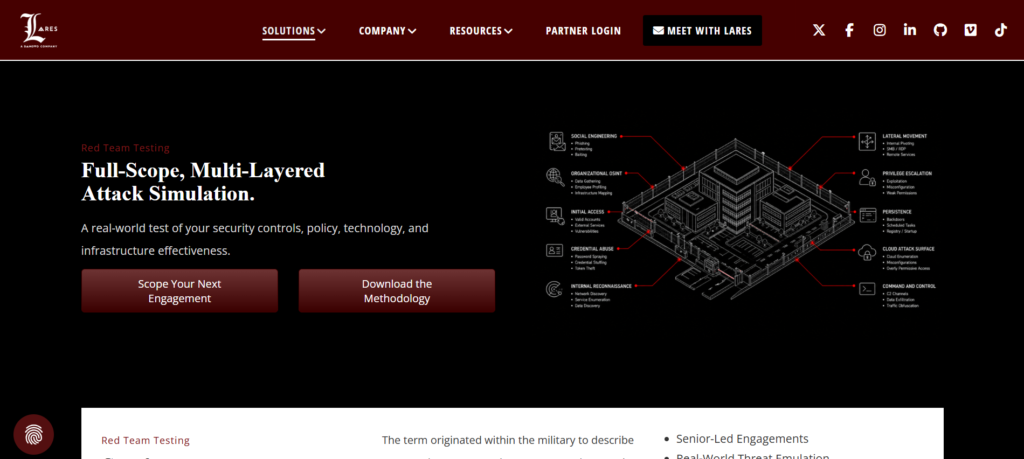
Lares sells red team testing as full-scope, multi-layered attack simulation across physical, social, and electronic domains. Physical and social work involves attempting unauthorized access to restricted areas and testing staff through phishing and social engineering. Electronic penetration covers authorized exploitation to assess patch management and control effectiveness. All of it follows intelligence gathering that analyzes the organization’s digital footprint and maps attack vectors before technical testing begins.
Duration is published, which helps with planning. Lares states engagements typically span several weeks to a few months, long enough to emulate an advanced persistent threat properly while working to stay undetected. That is a meaningful commitment next to a two-week test, and it is the right shape for organizations that want to know whether a patient adversary would be noticed rather than a noisy one.
Reporting is the strongest part of the offering. Clients receive an executive summary, a detailed attack narrative mapped to MITRE ATT&CK, an event timeline built for direct comparison against SOC logs, role-based remediation guidance separated for leadership and engineering, and a stakeholder debrief with management. The timeline comparison is practical because it tells defenders precisely which actions they missed and when. Lares sells purple team testing, insider threat, social engineering, and physical security separately. No subscription, retainer, or continuous option is published, and neither are prices, so this stays a project purchase.
12. Coalfire — On Demand Offensive Security Under One Contract
Coalfire now delivers its offensive security work under the DivisionHex brand, positioned around simulating real attackers with real tactics to show what defenses miss. Red team exercises, penetration testing and vulnerability discovery, AI and machine learning threat modeling and testing, and attack simulation all sit inside that practice, alongside managed security services on the defensive side.
The commercial structure is the reason Coalfire belongs on a red team as a service list. DivisionHex OnDemand replaces the usual sequence of separate statements of work with a single master contract covering multiple service types. Clients get up-front access to allocated funds, fixed monthly invoicing, a web-based platform for scheduling tests, and the ability to switch between offensive and defensive services without raising new paperwork. Reports and data from every engagement land in one place.
For a security leader running several assessments a year across compliance-driven penetration testing, cloud reviews, and red team exercises, that consolidation removes procurement friction and turns lumpy project spending into a predictable monthly line. The limitation is that this is a contracting and scheduling innovation rather than a continuous attack capability, since the testing underneath stays scheduled and consultant delivered. Coalfire publishes no pricing, no standard red team duration, and limited public detail on adversary emulation methodology, so probe technical depth during scoping.
How To Choose A Red Team As A Service Provider
Do You Need Point In Time Depth Or Continuous Coverage?
This is the first fork and it decides most of the shortlist. A point-in-time engagement from a firm such as Mandiant, Lares, or TrustedSec buys weeks of patient, objective-driven work with senior operators and a report you can take to the board. A continuous subscription from CovertSwarm, or a managed program from IBM or Praetorian, buys recurring pressure that catches the changes your environment makes between annual tests. If your infrastructure changes weekly, the annual model tests a version of your network that no longer exists. If it is stable and the goal is to learn whether a determined adversary can reach the crown jewels, the project model gives more depth per dollar. Our list of top red teaming companies covers the project end of that spectrum.
Is The Work Consultant Delivered Or Platform Delivered?
Platform-delivered testing, as Synack runs it, distributes work across a large researcher pool and routes everything through software that handles triage, validation, and integration. It scales across many assets and produces consistent, deduplicated output. Consultant-delivered work assigns named operators who build a scenario, adapt when they get caught, and improvise the way a real intrusion set does. The tradeoff is coverage versus tradecraft. Platforms find more issues across a wider surface. Consultants go deeper against one objective and produce the attack narrative detection engineers need. CovertSwarm and Praetorian both put consultants behind a portal, which is often the practical middle ground.
Does The Provider Meet Your Regulatory Testing Requirements?
If you operate in regulated financial services, the framework list is not a nice-to-have. Intelligence-led testing mandates such as CBEST, TIBER-EU, iCAST, CORIE, AASE, and FEER impose specific requirements on threat intelligence sourcing, scenario design, and evidence. NCC Group publishes coverage across all six. IBM X-Force Red and NetSPI both state support for DORA TLPT and TIBER-EU. A firm with excellent tradecraft but no recognition under your regime produces a report that does not satisfy your supervisor, which means paying twice. Verify the specific scheme and ask which assessors carry the relevant credentials.
How Will Findings Reach The People Who Fix Them?
The output format matters as much as the attack. Ask whether you receive a static report, a portal, or both, and whether findings push into Jira or ServiceNow automatically. Ask for an event timeline you can compare against your own SOC logs, which Lares publishes as a standard deliverable and which turns a red team into a detection engineering exercise. Ask whether purple teaming is part of the methodology, as it is at TrustedSec, or sold separately. A report that names a gap without telling your analysts which telemetry should have caught it leaves the most valuable part of the engagement unused.
What Does The Contract Actually Buy Each Month?
Subscription pricing hides a lot of variation. Confirm how many operator hours the monthly fee includes, whether unused hours roll forward, how scope changes are handled, and what happens when the team finds something urgent outside the agreed boundary. With consumption models such as Coalfire’s OnDemand contract or Synack’s credit system, check expiry terms, since Synack credits expire one year from purchase and unused budget is real money lost. Confirm whether the platform subscription is billed separately from the testing, because it often is. Finally, ask who performs the work, since the seniority of the assigned operators determines what the engagement finds.
Conclusion
The providers here sell three genuinely different things under one label. CovertSwarm, IBM X-Force Red’s managed tier, and Praetorian Guard come closest to a literal red team as a service, with contracted monthly cadence, dedicated operators, and a portal. Synack and Bishop Fox’s continuous program deliver recurring coverage but lean toward scaled testing and exposure management rather than stealthy emulation. Bishop Fox project work, Mandiant, TrustedSec, NCC Group, Lares, NetSPI, White Knight Labs, and Coalfire sell depth in scoped engagements, with Coalfire wrapping that in a consumption contract that feels like a service without changing what happens technically.
None is right in the abstract. Match the model to your detection maturity and your rate of change. If your defenders cannot yet triage what a continuous program produces, buy depth first and add cadence later. If your environment shifts every sprint, an annual test is a snapshot of the past. Either way, settle the timeline, the operator names, and the deliverable format before signing, and shortlist against your regulatory obligations rather than reputation. For more on one of the consultancies covered here, see the White Knight Labs company profile.
If you want to add your company to this list, drop us a line or submit a form in the Top Choices section. After a thorough review, we’ll decide whether it’s an appropriate addition.