
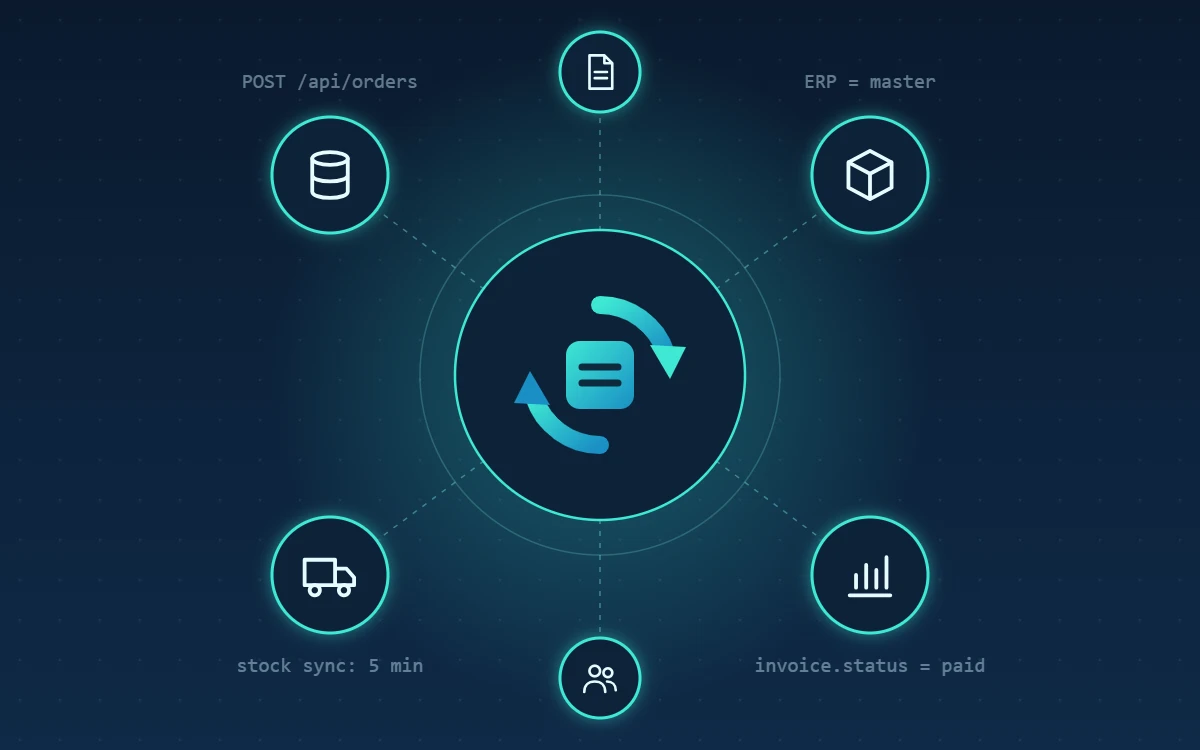



Every PrestaShop ERP integration comes down to three questions that almost no roundup answers: what actually syncs, in which direction each object moves, and how often the exchange runs. A merchant who has just oversold forty units does not care that a vendor called the connector seamless. That merchant cares whether stock moved when the warehouse picked it, or whether a nightly job ran while the store sold inventory already gone.
The good vendors answer all three on their own pages. Divalto states that the ERP is the master data source. Holded states that product import is one way, and that stock becomes bidirectional only with an add-on. CTI states that its exchange is scheduled, not live. A Sage marketplace listing states that it imports accounting entries and explicitly not invoices.
The second angle is geographic. PrestaShop’s install base is concentrated in France, Spain, Poland and Italy, and so are the ERPs those merchants run. Odoo, SAP Business One and Dynamics 365 appear below, but so do Cegid, Divalto, EBP, Sage, a3ERP, Holded, Comarch Optima, enova365 and Exact. A connector built for the wrong country is no connector at all.
PrestaShop ERP Integration At A Glance
Type, scope, direction and timing.
| Partner | Type | ERP Coverage | Sync, Direction, Timing | Pricing |
| Atoo-Next | Connector product | Sage, EBP, iTool, Wavesoft, Cegid XRP Flex | Articles, stock, orders, customers, payments; real-time | Not published |
| APIcenter | Connector product | SAP Business One, Business Central, Exact | Orders, stock, customers, products; near real-time | Figure suspect |
| WebXY | Integration partner | Cegid Yourcegid Retail, Sage 100 | Cross-store stock, click and collect; real-time | Quote |
| CTI | Connector product | Comarch ERP Optima | Product, stock and order sync; scheduled | Not published |
| Aprosystem | Integration partner | enova365 | Stock, prices, names both ways; orders one way | Needs Handel |
| iWebDevelopment | Connector product | Exact Online | Orders immediate; stock in 5 to 10 minutes | From 12 EUR |
| Holded | ERP vendor connector | Holded | Orders sync; products one way; stock needs add-on | Free plugin |
| Divalto infinity | ERP vendor connector | Divalto infinity | Catalog, stock, prices, orders; ERP is master | Custom scope |
| Prestasync | ERP vendor connector | a3ERP | Products, customers, orders, invoices; ERP led | Not published |
| Gerber Systems | ERP vendor connector | Dynamics 365 BC | Catalog and stock from ERP, instant | Not published |
| Chift via Sage | ERP vendor connector | Sage 100, Sage 50, Generation Experts | Journal entries only | Not published |
| Webkul | Connector product | Odoo | Orders real-time; stock both ways | 199.00 USD one time |
Best PrestaShop ERP Integration Partners In 2026
1. Atoo-Next — Real-Time Sync Across The Widest French Mid-Market ERP Range
Atoo-Next, at L’arche Botti in Nimes, publishes the Atoo-Sync connector family and covers more of the French mid-market ERP landscape than anyone here: Sage 100 and 50, EBP and EBP SaaS, iTool, Wavesoft and Cegid XRP Flex, with Ciel on the accounting side. For a merchant whose ERP was chosen a decade ago by an accountant, that breadth is the whole point.
Its own page states real-time synchronization of articles, stock, orders, customers and payments. A separate module, Atoo-Sync Compta, converts sales, payments and credit notes into accounting entries, so the commercial sync and the bookkeeping sync are two purchases rather than one bundle.
Platform reach is the other distinguishing detail. The same ERP list is supported against WooCommerce, Shopify and Magento as well as PrestaShop, which saves a multi-storefront merchant from running two unrelated integration stacks against a single ERP.
Pricing is not published. Connectors are sold individually through the company’s own shop, so price each ERP and each module separately rather than expecting one platform fee to cover the project, and confirm which modules a full deployment needs.
2. APIcenter — SAP Business One Flows From A Gorinchem Team Working In 30 Countries
APIcenter is an integration platform rather than a single connector, run from Havendijk in Gorinchem, Netherlands, with offices in Amsterdam, Gothenburg, New York and Malaga. It says it has built custom integrations since 2013, launched the platform in December 2022, runs a team of 25 and is used in more than 30 countries. The pairing verified here is SAP Business One; its catalog also lists Business Central and Exact.
The commercial model shapes the price. Rather than one connector, APIcenter sells individual “flows”: sales orders, stock, customers and products are four separately priced integrations, each described as bidirectional, monitored and near real-time.
The pricing, reported exactly as the live page shows it: 6,998 EUR per month against each of the four flows, the identical figure repeated four times. Four integrations carrying the same four-digit monthly price reads far more like a template placeholder left on the vendor’s own site than a real quote, and it deserves doubt. The page also shows a 0 EUR self-serve tier with a 14-day trial and a 995 EUR one-time installation package. Get a written quote.
3. WebXY — Chosen By Cegid In 2015 To Build Its Official Retail Connector
WebXY, founded in 2000 at 18 rue Saint-Vincent in Saint-Germain-en-Laye, holds the strongest credential here, a kind that cannot be self-declared. In 2015 Cegid selected WebXY to build its official Yourcegid Retail to PrestaShop connector, distributed exclusively through Cegid’s own catalog. An ERP vendor choosing an outside builder to carry its name is a far harder signal than a badge applied for. WebXY is also listed as a Member on Cegid’s partner directory at partners.cegid.com, and has been a PrestaShop Partenaire Platinum since 2011.
The Cegid work covers Yourcegid Retail CBR and Y2, packaged as a “Connecteur Prestashop Foundation” with an Omnichannel option on top. That option carries the retail value: real-time stock lookup across physical stores, click and collect, and order synchronization through Cegid’s Omnichannel webservices. If you run stores as well as a site, cross-location stock visibility is what stops you promising an item a branch already sold.
WebXY also builds for Sage 100 through XY-Connect, which is listed on PrestaShop’s own certified add-ons catalog. Neither line publishes a price, and both are scoped and quoted per deployment.
4. CTI — Comarch Gold Partner With A Scheduled, Fully Documented Optima Exchange
CTI, based in Gliwice, publishes the PrestaShop Integrator on its MegaIntegrator platform, connecting PrestaShop to Comarch ERP Optima, the dominant small and mid-size ERP in Poland. Its documentation is the most specific in this guide by a wide margin, and specificity is itself a buying signal.
Product export covers code, name, description, base and promotional pricing in multiple currencies, VAT rate, weight, photos, unit, attributes, brand, supplier, multi-language fields and the category tree. Stock synchronizes down to variant level. Order import carries contact and address data, order number, line items with prices, payment method, delivery method and cost, with automatic customer create-or-match and status updates flowing back.
Then the detail that decides fit: the exchange is explicitly scheduled, not live. The page says data exchange runs at a set time or when someone clicks a button. A merchant selling fast-moving stock across several channels needs to price that sync window before signing; for slower turnover it is a non-issue. CTI is a Comarch Gold Partner, ships the same platform for Shoper and Magento, and publishes an installation manual. Pricing is not published.
5. Aprosystem — Authorized enova365 Partner With A Repeatable Implementation Scheme
Aprosystem, at ul. Krakowska 86 in Rzeszow, is the live route into enova365 from Soneta, the other major Polish ERP. It is listed as an Authorized Partner on enova.pl’s official partner directory, which states 25 years of work with ERP systems. That matters more than usual here, because a named enova365 PrestaShop connector that once existed now redirects to a generic partner-solutions page with no PrestaShop add-on listed.
Direction is clear. Stock levels, prices and product names synchronize bidirectionally. New orders move one way only, from PrestaShop into the ERP. Order and payment status synchronize automatically with the payment gateway, PayU named as an example, and invoices generate automatically once payment lands.
The prerequisite deserves attention first. The integration runs on the enova365 WebAPI plus the e-Sklepy Konektor module, which requires the enova365 Handel Zloto or Platyna license tier. On a lower tier, the project carries an ERP license upgrade you may not have budgeted, and it can exceed the integration work itself. Aprosystem describes implementation as a repeatable, pre-built scheme measured in days rather than weeks. Pricing is quote only.
6. iWebDevelopment — Exact Online Connector With Published Pricing From 12 EUR Per Month
This Netherlands-based connector links PrestaShop to Exact Online across the Financieel, Facturen and Handel modules, and is carried on Exact’s own App Store, which places it above a self-declared integration. The company states it is an official Exact partner and holds ISO 27001 certification.
The architecture is genuinely unusual. The connector works entirely through PrestaShop’s Web Service API, so no module is installed in the store at all, which matters to any owner who has been burned by a module conflict after an upgrade.
On timing, be precise: orders and customers reach Exact Online immediately, while product and stock synchronization reflects changes within 5 to 10 minutes. Invoices are handled on the Facturen plan.
Pricing is the best documented anywhere here. Financieel is 12 EUR per month for customers and sales postings only. Facturen is 19 EUR and adds invoices. Handel is 26 EUR and adds full order and stock synchronization. A custom Handel ERP option starts from 35.95 EUR monthly. There is a free 30-day trial, monthly cancellation, no setup fee, and add-ons at 6 to 17.50 EUR each.
7. Holded — Official Barcelona Plugin That Publishes Its Own Sync Limits
Holded is a Barcelona ERP whose PrestaShop connector is described on its own site as the “Plugin oficial.” It earns its place for honesty: the documentation is precise about what the integration does not do.
Orders synchronize and convert into a sales order, ticket or invoice under configurable status rules. Contacts are created automatically with address, tax ID, phone and email. Per-country tax configuration is available on Premium accounts, multiple stores run on one account, and orders up to two years old can backfill.
Now the limits, as Holded states them. Product import is explicitly one way, PrestaShop to Holded: the page says “La importacion de productos es unidireccional.” Stock becomes bidirectional only if an optional toggle is enabled, which requires the Inventory add-on. Returns are not synchronized.
One caveat to settle before committing: compatibility is given as “PrestaShop 1.7.8 or higher,” with no explicit confirmation of PrestaShop 8 or 9. Since 1.7 is long past end of life and PrestaShop 9 is the current line, ask in writing. The plugin is free but requires a Holded subscription plus the Inventory add-on.
8. Divalto infinity — ERP-Led Architecture Deployed Through Certified Integrator Partners
Divalto, at 11 rue Icare in Entzheim, publishes a PrestaShop connection for Divalto infinity worth studying even if you never buy it, because it is the clearest statement here of what an ERP-led architecture actually means in practice.
Scope is broad: catalog data including articles, variants, replacement products and up-sell and cross-sell links; stock; orders; customer accounts and types; prices and promotions; shipping and tracking, all by webservices.
The architecture is the interesting part. Divalto positions the ERP as the master data source. Orders flow down from the storefront into the ERP, while product, stock and price data flows up to the storefront. Most merchants think of the store as where the catalog lives, because that is where they have always edited it. Once a real ERP exists that instinct is wrong, and maintaining prices in two systems is how a storefront ends up disagreeing with its own invoices.
Implementation is carried out by a certified Divalto integrator partner and custom scoped, so there is no published price. At minimum, the gestion commerciale module is required on the ERP side.
9. Prestasync for a3ERP — Listed On Wolters Kluwer’s Own Marketplace, Built By SDi
Prestasync is the PrestaShop connector for a3ERP, the widely deployed Spanish ERP distributed by Wolters Kluwer. It is developed by SDi in the La Rioja area and listed on the official Wolters Kluwer a3ERP marketplace rather than a third-party directory, with SDi as support contact. A vendor-run listing is a stronger signal than a logo on a developer’s homepage.
The sync scope is among the most extensive here. Products carry combinations, size and color masters, accessories, kits, stock control, tax-inclusive and tax-exclusive tariffs, images, extra fields and the ECORAEE eco-tax, exactly the local detail a generic international connector will not have considered. Customers carry personal and fiscal data, billing and delivery addresses and both B2B and B2C handling, with several web customers groupable into one a3ERP customer. Orders cover address handling, selectable order-status import, status updates and vouchers.
On direction there is a nuance worth naming. SDi’s own page describes the sync as real-time and bidirectional, while the marketplace listing describes management as running almost entirely from the a3ERP side. In practice, treat it as ERP led. Pricing is not published.
10. Gerber Systems — AppSource Listed Connector For Dynamics 365 Business Central
Gerber Systems and Networks, in Switzerland, publishes the PrestaShop Connector for Microsoft Dynamics 365 Business Central, the cloud successor to Navision. It is listed on Microsoft’s own AppSource marketplace under publisher gerbersystems, making it a Microsoft-certified ISV app rather than a self-declared integration. For a finance team standardized on Microsoft, that usually decides the shortlist on its own.
Article and catalog data is exported and imported between Business Central and PrestaShop. The company describes stock adjustments, description changes and new product variants made inside Business Central as transmitting automatically and instantly to the store, with real-time stock display, updated prices and order tracking on the customer-facing side. Orders and new customer records then integrate back into Business Central automatically, without manual rekeying.
The design assumption matches Divalto’s: catalog management is centralized in the ERP. Merchandisers used to editing products in the PrestaShop back office should expect that workflow to move, a training question as much as a technical one. Pricing is not published; the AppSource route offers an install or a demo request, so the commercial conversation follows the technical fit.
11. Chift — Sage Marketplace Bridge That Moves Journal Entries And Not Invoices
This listing sits on Sage’s own French marketplace, with Chift, a Belgian accounting-integration company, named as developer. It covers Sage 100, Sage 50 and Generation Experts, and states compatibility with Shopify, WooCommerce, PrestaShop and Amazon.
The scope limit comes first, because it defines the product. This integration imports accounting entries only, and not invoices. The listing is explicit: “Import des ecritures comptables (pas de factures).” That single line reclassifies the tool. It is an accounting bridge, not a full ERP synchronization, and framing it accurately is more useful than presenting it as a peer of the catalog-and-stock connectors above. If you want to stop a bookkeeper rekeying a month of PrestaShop sales into Sage, this is exactly right. If you want stock synchronization, it is the wrong tool.
Within that scope the configuration is thoughtful. Consolidation frequency can be set to one entry per order or refund, one per day, or one per month, with orders and refunds handled separately. It also covers multiple payment methods and product categories, varying delivery-country VAT rates and gift vouchers. Pricing is not published.
12. Webkul — Odoo Connector At 199.00 USD One Time, Maintained Through Odoo 19.0
Webkul, founded in 2010 in Noida, Uttar Pradesh, with a US office in Wilmington, Delaware, publishes the Odoo PrestaShop Connector. Odoo matters because it is the most common ERP among the small and mid-size European merchants PrestaShop serves.
Direction is mixed and clearly documented. Orders synchronize from PrestaShop to Odoo in real time. Product and category export runs in bulk from Odoo to PrestaShop. Stock updates are bidirectional and include sales made through Odoo POS, which matters if you sell across a counter as well as a website. Customers, taxes, carriers and currencies are imported, simple and multi-variant products are both handled, and mapping is manual. Cron jobs are optional.
Two details separate a maintained connector from an abandoned one, and both are here: per-job error logs and a failed-order recovery tool. Pricing is published at 199.00 USD one time, with optional installation at 100 USD and three months of support. The version selector runs to Odoo 19.0, and the listing shows 4.8 from 37 reviews plus badges for Odoo Silver Partner, Recommended By Odoo, PrestaShop Superhero Seller and Expert Partner 3-star.
How To Choose A PrestaShop ERP Integration Partner
What Exactly Syncs, And Is The List Complete?
Ask for the object list in writing and read it as exhaustive. Products, stock, orders, customers, invoices, credit notes, returns, carriers, taxes and vouchers are separate objects, and a connector handling seven well may not touch the rest. Holded excludes returns, the Sage bridge invoices.
Which Direction Does Each Object Move?
Direction is set per object, not per connector, and this is where most disappointment starts. Aprosystem moves stock, prices and names both ways but orders one way. Holded moves products one way and stock both ways only when a setting is on. Webkul pushes orders to Odoo and pulls the catalog down.
Is The Exchange Real-Time Or Scheduled?
This is the one merchants learn too late, usually during a stock-out. CTI says its Comarch exchange runs at a set time or on a button click. Exact Online reflects stock within 5 to 10 minutes. Gerber Systems calls Business Central changes instant. If you sell limited stock across several channels, a sync window is an oversell waiting to happen.
Which System Is The Master?
Decide this before you shop, because the answer eliminates half the market. Divalto is explicit that the ERP owns the data and the storefront consumes it. Gerber Systems centralizes catalog management inside Business Central. The a3ERP listing puts management almost entirely on the ERP side. A page that will not say which system is master is a warning sign.
Was This Connector Built For Your Country?
Local ERPs are not a footnote in this market, they are the market. A store in Poland runs Comarch Optima or enova365, in Spain a3ERP or Holded, in France Sage, EBP, Cegid or Divalto, in the Netherlands Exact. Each carries fiscal behavior a generic international connector will not have.
Who Issued The Credential You Are Trusting?
An ERP vendor choosing an outside company to build its official connector, as Cegid did with WebXY in 2015, is the hardest signal available. A listing on the vendor’s own marketplace comes next: Microsoft AppSource, Exact’s App Store, the Wolters Kluwer a3ERP marketplace. Tier badges are weaker.
What Does It Cost, Including The ERP Side?
Published pricing is rare. The Exact Online connector at 12 to 36 EUR monthly and the Odoo module at 199.00 USD one time are the only clean numbers here. Most of the rest is quote only, and one page shows the same four-digit monthly figure against four flows. The connector fee is rarely the whole bill.
What If No Connector Exists For Your ERP?
Sometimes nothing off the shelf fits. No verifiable first-party PrestaShop connector surfaced for Sage Murano, Symfonia or NetSuite in this research, and for NetSuite mostly generic middleware. Also note when a connector is resold rather than native: Base.com, formerly BaseLinker, says its ERP integrations come mainly from outside companies, which decides who you call when it breaks. If you land in a gap, budget for custom work and choose the team accordingly, whether a specialist PrestaShop agency or a broader custom software development company. Teams working through offshore delivery models can absorb a long backlog at a workable rate.
Conclusion
An ERP integration is where a PrestaShop store stops being a website and becomes an operational system, and that connection is measured in three answers rather than adjectives: what synchronizes, in which direction, and how often. Divalto tells you the ERP is master. Holded says products move one way and stock needs an add-on. CTI says its exchange is scheduled.
Geography narrows it further. Match the connector to the ERP your accountant already runs and to the country whose tax rules you file under, then verify the credential on the issuing vendor’s directory, not the builder’s homepage. Confirm PrestaShop 9 compatibility in writing; a page still citing 1.7 is one nobody has updated.
Most ERP projects need two suppliers: the connector handles the pipe while somebody fixes the storefront and checkout around it. For that half of the work, the PrestaShop development companies guide is the natural companion, and you can browse company profiles in the ReVerb showcase when you are ready to shortlist.
