
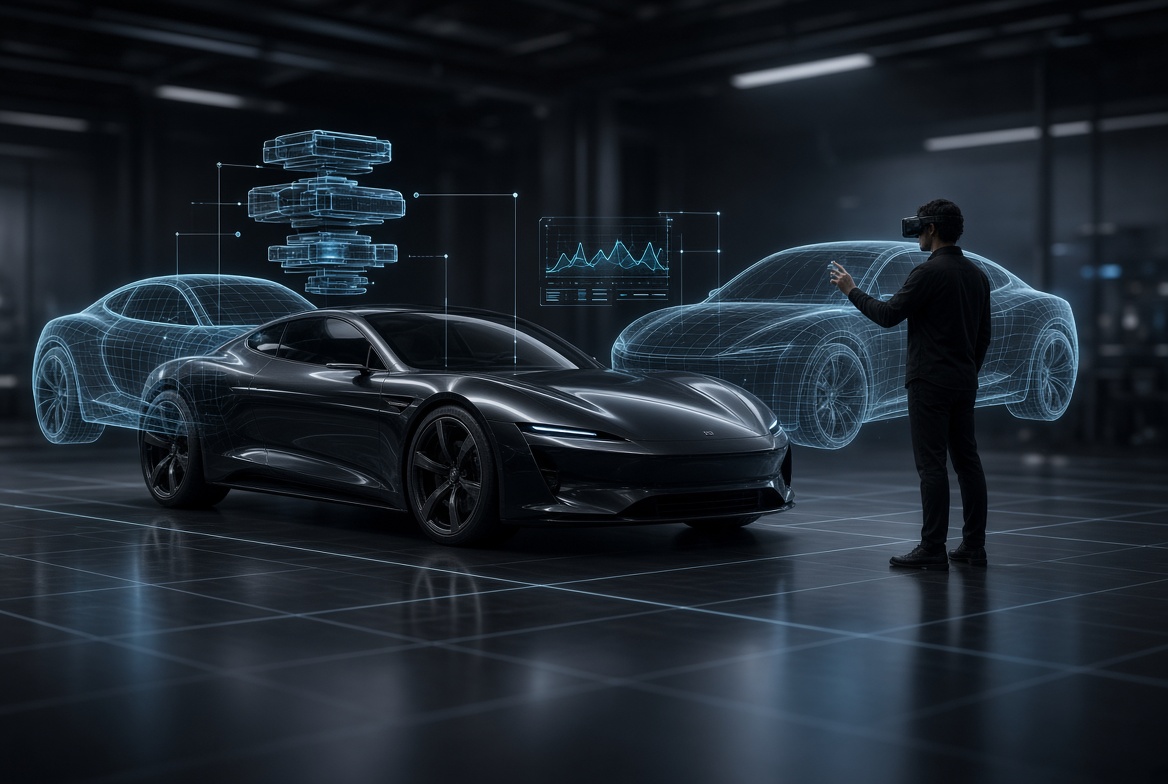



Automotive uses immersive technology across more of its business than almost any other industry, and that breadth is what makes vendor selection confusing. A design studio reviewing a clay model alternative, a plant running assembly guidance on the line, a dealer network showing configurations that are not on the forecourt, and an engineering team building a head-up display are four different problems. They rarely share a vendor and often do not share a budget.
The industry also has an unusual advantage. Automotive manufacturers already hold detailed engineering models of everything they make, which removes the single largest obstacle in most immersive projects. The 3D data exists. The work is turning it into something usable at a design review, on a production line or on a product page, and keeping it current as the model year changes.
The companies below cover design visualization, manufacturing, retail configuration, training and in-vehicle systems. Each entry explains what the team delivers and which part of the business it serves.
AR and VR Development for Automotive at a Glance
| Company | Best For | Delivery Model |
|---|---|---|
| Treeview | Custom spatial applications and data visualization | Custom development |
| ZeroLight | Real time configurators and retail visualization | Platform |
| Varjo | Design review and driving simulation at high fidelity | Hardware and systems |
| VR Vision Group | Plant and dealer workforce training at scale | Custom development |
| Scope AR | Assembly guidance authored from engineering data | Platform |
| Taqtile | Service, maintenance and inspection procedures | Platform |
| Groove Jones | Marketing experiences and auto show activations | Agency |
| Envisics | Augmented reality head-up displays in vehicle | Hardware and optics |
| Vection Technologies | Engineering collaboration across distributed teams | Platform |
| Program-Ace | Plant digital twins connected to enterprise systems | Custom development |
Best AR and VR Development Companies for Automotive
1. Treeview – Toyota’s XR Partner, With Award Winning Data Visualization Work
Treeview counts Toyota among its enterprise clients, alongside Microsoft, Meta and Medtronic, and has built spatial computing software since 2016 from New York and Montevideo. For automotive organizations the studio fits the projects that fall outside what configurator platforms and training vendors sell, which in practice is most of what an innovation team wants to build.
The clearest demonstration of that capability is the AI enabled digital twin the studio built with Microsoft for a multi billion dollar green hydrogen renewable energy initiative, visualizing real time and projected production with predictive models simulating future site performance. That is the same technical problem automotive faces with plant energy, production throughput and supply chain visualization: complex live data made legible in three dimensions to people making decisions about it. The work won two Silver awards at the 47th Annual Telly Awards, for Use of AR and Digital Environments.
The commercial terms suit automotive procurement well. Clients retain full ownership of intellectual property, source code and assets, which matters when an application ties into proprietary vehicle data or manufacturing systems. The studio also delivers end to end with a senior only team, so a project tied to a model year launch or a plant shutdown window does not depend on handoffs between separate design, 3D and engineering vendors.
- Services and expertise: Custom AR, VR and mixed reality development, digital twin development, spatial data visualization, smart glasses and AI glasses applications, spatial product design, 3D content creation, long term support
- Location: New York, United States and Montevideo, Uruguay
- Portfolio: Toyota, Microsoft, Meta, Medtronic, ULTA Beauty, NEOM, Daiichi Sankyo
2. ZeroLight – Real Time Visualization Built Specifically for Car Retail
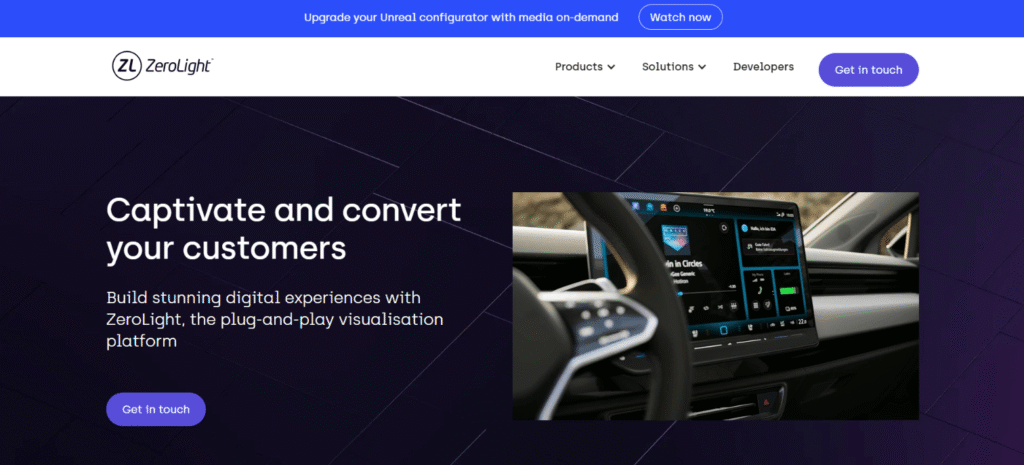
ZeroLight is the most automotive specific company on this list, building real time visualization and configuration technology used by manufacturers to show vehicles online, in showrooms and at events. The platform renders vehicles at marketing quality in real time, which lets a customer change paint, wheels, trim and options and see the result immediately rather than choosing from a fixed set of photographed combinations.
The economics behind this are specific to the industry. A modern vehicle line can generate an impossible number of valid configurations, and photographing them is not feasible. Real time rendering from the manufacturer’s own CAD data solves that and keeps the imagery current when specifications change mid cycle.
The same asset pipeline then serves multiple channels, from the configurator on the website to showroom displays and AR placement of the vehicle in a customer’s own driveway, which is where the investment starts paying back across the retail estate rather than in one place.
- Services and expertise: Real time vehicle visualization, online and in-store configurators, cloud rendering, AR vehicle placement, marketing asset generation from CAD
- Best suited to: Manufacturers and dealer networks modernizing configuration and retail experience
3. Varjo – The Fidelity Required for Design Review and Driving Simulation
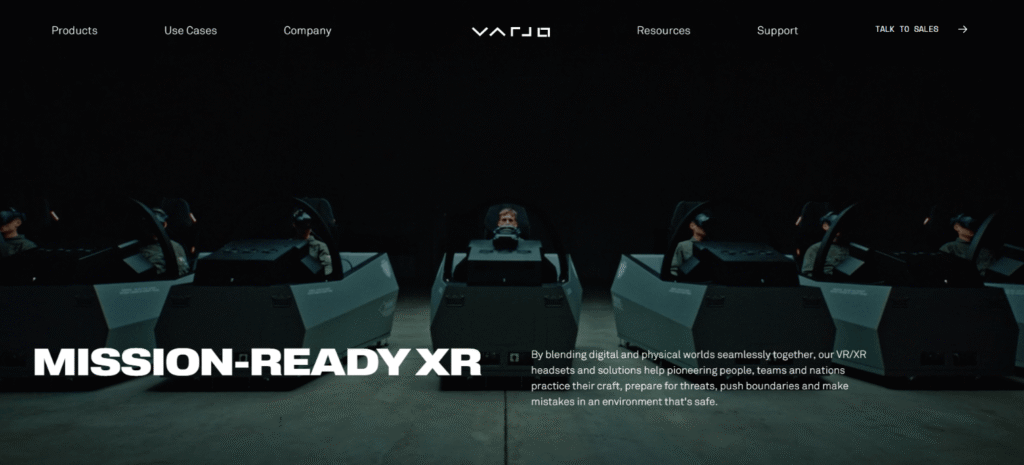
Varjo produces virtual and mixed reality headsets whose defining feature is resolution high enough for professional visual evaluation. In automotive that matters in two places: design review, where a decision about surface, proportion or interior material cannot be made on a blurry image, and driving simulation, where a driver needs to read signage and identify hazards at realistic distance for the test to mean anything.
The company has expanded from headsets into complete configurations, launching Integrated XR Systems in February 2026 that pair XR-4 Series headsets with workstations, pre-installed software and licences for organizations wanting validated performance without assembling the stack themselves. Rheinmetall uses Varjo hardware as a core component of its driving simulator range.
Mixed reality passthrough has become the more interesting capability for automotive. Engineers can place a virtual interior around a physical seating buck, keeping real ergonomics and real controls while changing everything visual, which is faster and cheaper than building each variant physically.
- Services and expertise: High resolution VR and XR headsets, mixed reality passthrough, integrated systems, simulation software integration, professional services
- Location: Helsinki, Finland and Orlando, United States
4. VR Vision Group – Training Deployed Across Plants and Dealer Networks
VR Vision Group builds enterprise virtual reality training as custom applications in Unity and Unreal Engine, and its client list runs directly through the automotive sector, including Toyota and Coca-Cola alongside energy and utility organizations.
The capability that separates them is deployment rather than content. Automotive training programs have to reach thousands of people across plants, distribution centres and dealer networks in multiple countries, and most VR training initiatives die between a successful pilot and that rollout. The team supports distributed deployment with learning management system integration and real time session management through its Vision Portal platform, which is how completion gets tracked and evidenced.
Their work spans safety procedures, equipment operation and process training, the areas where automotive carries both regulatory obligation and genuine injury risk.
- Services and expertise: VR training simulations, multiplayer scenarios, 360 degree video, digital twins, LMS integration, Vision Portal deployment platform
- Location: Toronto, Canada
5. Scope AR – Line Side Guidance Generated From CAD
Scope AR’s WorkLink platform authors augmented reality work instructions from CAD files an organization already holds, published from a browser rather than commissioned as custom 3D work for every procedure. For automotive, where engineering data is comprehensive and procedures number in the thousands, that authoring model is the only economically sensible one.
The platform integrates with manufacturing execution and enterprise resource planning systems, so guidance sits inside production workflow rather than beside it. Reported results from comparable high complexity assembly work include a 25 percent reduction in installation time and roughly 40 percent faster inspections on AR guided, standards compliant workflows.
Recent development has added AI assisted instruction creation and error detection before rework becomes necessary, which targets the cost that assembly defects impose downstream.
- Services and expertise: AR work instruction authoring, remote assistance, CAD import and publishing, MES and ERP integration, analytics
- Best suited to: Assembly plants and tier one suppliers with mature engineering documentation
6. Taqtile – Service and Maintenance Procedures in the Technician’s View
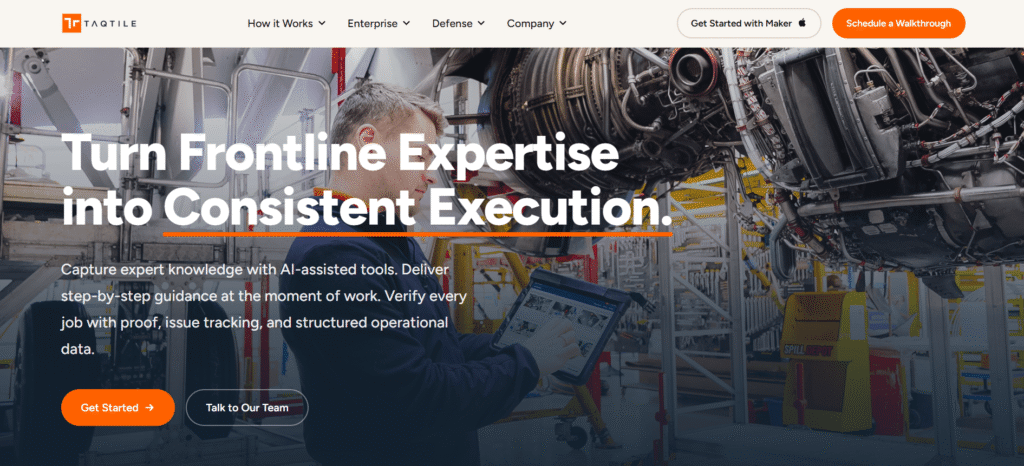
Taqtile’s Manifest platform delivers step by step guidance in a technician’s field of view with automatic data capture, real time fault reporting and remote expert access, serving manufacturing, utilities, energy and defense.
Automotive service is a natural application. Vehicle systems have grown considerably more complex, particularly with electrified powertrains and advanced driver assistance systems, while dealer technician turnover remains high. Digitizing expert procedures into guided workflows addresses the gap directly, and the safety acknowledgement steps built into the platform matter when high voltage systems are involved.
The remote assistance capability also changes the economics of specialist support, letting one expert cover a network of service centres rather than travelling between them.
- Services and expertise: AR work instructions, guided inspections, safety acknowledgement workflows, remote assistance, data capture and reporting, wearable deployment
- Best suited to: Dealer service networks and aftersales operations facing a skills gap
7. Groove Jones – Marketing Experiences and Auto Show Presence
Groove Jones produces immersive experiences across AR, VR, mixed reality and interactive installations for brands including Salesforce, LEGO, Toyota and Princess Cruises, with automotive work including a WebGL configurator for the Toyota Mirai.
Their value in automotive sits on the marketing side rather than in engineering or operations. Auto shows, dealer events, launch activations and brand experiences combine physical installation, spatial design and software in a way that pure software vendors are not structured to deliver, and these projects run to fixed public dates where reliability under crowd conditions is the actual requirement.
The WebGL work is worth noting separately, since browser delivered vehicle experiences reach customers without an app download, which remains the single largest source of drop off in consumer facing immersive work.
- Services and expertise: AR and VR experiences, WebGL and browser based 3D, interactive installations, experiential activations, event technology
- Best suited to: Marketing teams running launches, auto shows and brand activations
8. Envisics – Augmented Reality Head-Up Displays Inside the Vehicle
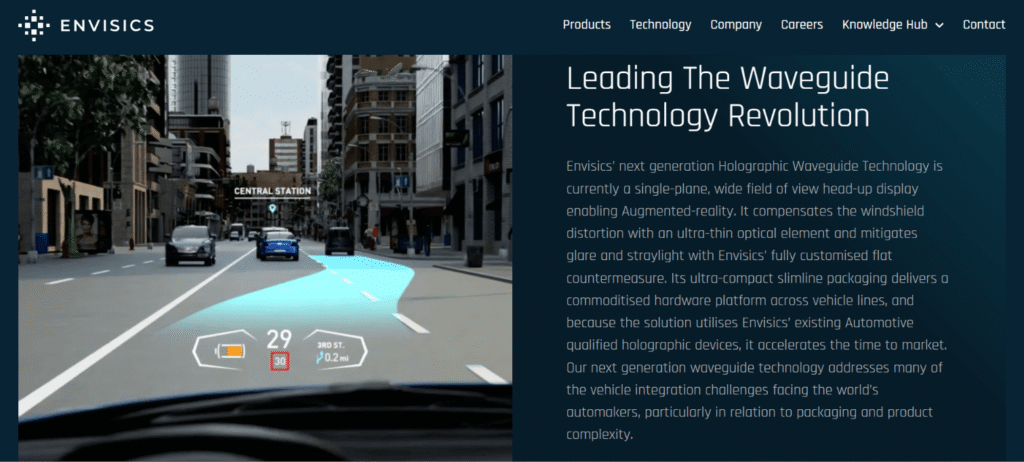
Envisics develops holographic augmented reality head-up display technology for vehicles, projecting navigation, hazard and driver assistance information onto the road ahead in the driver’s line of sight rather than onto a small patch of windscreen.
This is a different category from everything else on this list. It is automotive component engineering, subject to safety qualification, supply chain integration and multi year development cycles, and it is procured through engineering rather than through IT or marketing. The technical challenge involves optics and photonics as much as software.
The relevance to an immersive technology shortlist is that in-vehicle AR is where the largest automotive AR audience will eventually be. Every other application on this list serves employees or shoppers. This one serves every driver, every journey.
- Services and expertise: Holographic AR head-up display systems, automotive optics and photonics, driver information and assistance display integration
- Best suited to: Vehicle programs specifying next generation driver display systems
9. Vection Technologies – Engineering Collaboration Across Distributed Teams
Vection Technologies provides enterprise immersive software aimed at engineering and manufacturing collaboration, letting distributed teams review three dimensional models together in a shared virtual environment rather than through screen shares of static views.
Automotive development is globally distributed by default, with design, engineering, supplier and manufacturing teams frequently on different continents working on the same vehicle programme. Shared immersive review addresses a real friction in that process, since spatial questions about packaging, clearance and assembly sequence are difficult to resolve through two dimensional representations.
Buyers should evaluate how well the platform ingests their specific CAD formats and how it handles the file sizes involved, since these are the practical limits that determine whether such tools get used after the pilot.
- Services and expertise: Immersive engineering collaboration, real time 3D model review, CAD integration, enterprise deployment across distributed teams
- Best suited to: Engineering organizations running vehicle programmes across multiple sites
10. Program-Ace – Plant Digital Twins Wired Into Operational Systems
Program-Ace has developed software since 1992, based in Cyprus with staff across the United States, Poland, Slovakia, Ukraine, Hungary and Japan, and more than 900 delivered projects behind the team.
Its digital twin practice targets the problems that appear once a twin is used operationally rather than presented in a meeting: poor data utilization, scalability limits, and security and compliance exposure. The team also integrates twins with enterprise resource planning systems, which is the step that turns a plant model into a tool production planning actually consults.
For automotive manufacturers running facilities over decades, a studio with three decades of continuous delivery is a reasonable hedge against the vendor churn that has characterized this market.
- Services and expertise: Digital twin development, mixed reality and AR/VR solutions, AI development, ERP integration, enterprise software engineering
- Location: Cyprus, with distributed teams across Europe, the United States and Japan
How to Choose an AR or VR Partner for Automotive
Which part of the business is this for?
Design review, manufacturing, retail and marketing buy different things from different vendors with different money. A configurator platform will not solve an assembly guidance problem and a work instruction platform will not sell a car. Establish the owning function before the vendor conversation, because projects sponsored by two departments with different definitions of success tend to satisfy neither.
Can it consume your CAD data as it exists today?
Automotive holds excellent engineering data and it is rarely in a state that renders in real time without preparation. Ask specifically how models are optimized, whether that pipeline is automated or manual, who runs it as the data changes, and what happens at each model year update. A demonstration using the vendor’s own sample assets tells you nothing about your files.
Does it survive a model year change?
Vehicle specifications change constantly, and any immersive asset that requires rebuilding from scratch when they do will be abandoned within two cycles. Ask how updates propagate, whether internal teams can make them, and what the ongoing cost of currency actually is. This question separates a durable capability from an expensive one off.
How does it reach people who are not at a desk?
Plant operators, service technicians and dealer staff are the intended users of most automotive immersive work, and they do not have quiet offices or spare hands. Ask about ruggedized and wearable device support, offline operation, glove compatibility and how content updates reach hardware distributed across sites. Tools designed at headquarters and never tested on the floor do not get used on the floor.
Who owns the assets and the code?
Automotive 3D assets are valuable and reusable across configurators, training, marketing and manufacturing, and studios that retain them limit that reuse. Settle ownership of source code, models and derived assets before proposals, particularly where applications connect to proprietary vehicle or plant data. For anything expected to run beyond a single programme, the ability to maintain it without the original vendor is worth negotiating for.
Conclusion
Automotive applies immersive technology more widely than almost any other industry, from design studios and driving simulators through assembly lines and service bays to configurators and eventually the windscreen itself, and no single vendor serves that range. The practical approach is to identify which function owns the problem, choose the vendor built for that layer, and insist on a CAD pipeline and update process that survives the next model year. Treeview is the strongest option for the work that falls between the specialist products, with Toyota already among its clients, an award winning AI enabled digital twin built with Microsoft demonstrating exactly the live data visualization automotive keeps asking for, and full transfer of intellectual property and source code so the manufacturer keeps what it funded. Whichever combination fits, test the vendor against your own engineering data before committing, and budget for keeping assets current rather than only for building them.
If you want to add your company to this list, drop us a line or submit a form in the Top Choices section. After a thorough review, we’ll decide whether it’s an appropriate addition.