



Kickstarter is free to launch, but if your campaign is successfully funded, two sets of fees come out of the money you raise: Kickstarter’s platform fee and payment processing. Together they usually take 8% to 10% of the total. Here is how each fee works, with a quick calculator to estimate your own campaign.
Kickstarter Fees At A Glance
| Fee | Rate (US) | When It Applies |
|---|---|---|
| Platform fee | 5% of funds raised | Only if the campaign reaches its goal |
| Payment processing, pledges of $10 or more | 3% + $0.20 per pledge | Each successful pledge |
| Payment processing, pledges under $10 | 5% + $0.05 per pledge | Each successful pledge |
| Unfunded campaign | No fees | Backers are not charged |
Payment processing is handled by Stripe and rates vary by country. Kickstarter publishes the full schedule on its fees page.
Worked Example
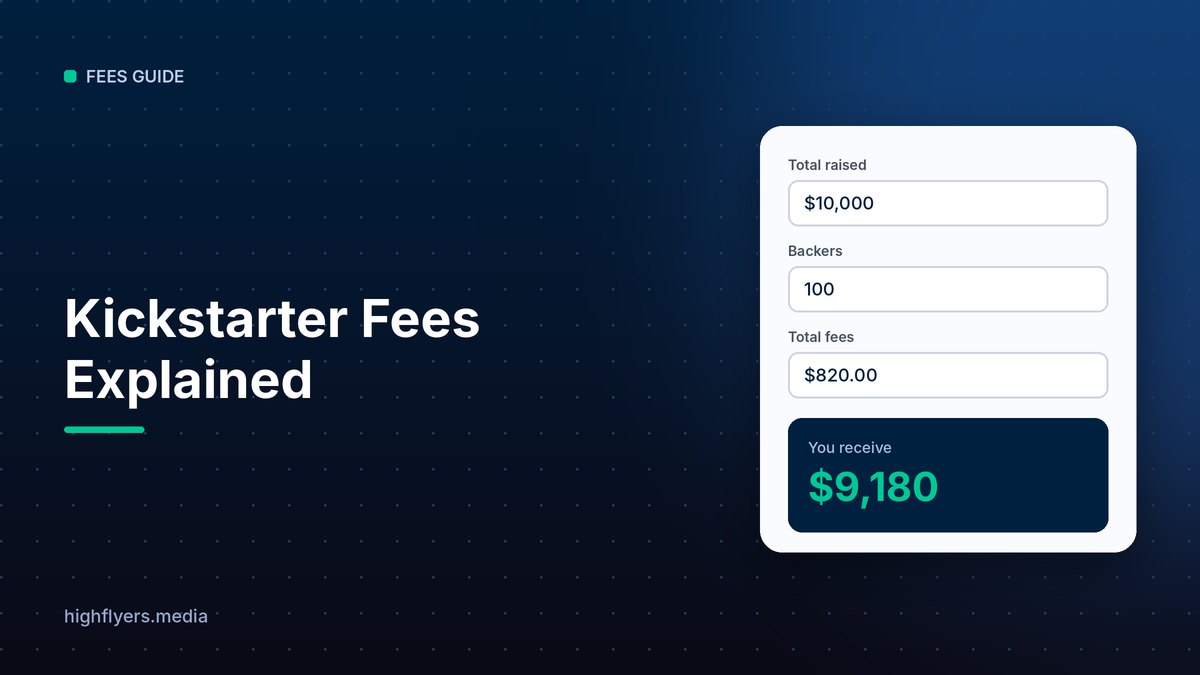
A campaign that raises $10,000 from 100 backers pays $500 to Kickstarter and $320 in processing ($300 plus 100 x $0.20). Total fees are $820, or 8.2%, leaving $9,180 before taxes, rewards and shipping. Campaigns with many small pledges pay a higher effective rate because the fixed per-pledge fee adds up.
Costs Beyond Kickstarter’s Fees
- Dropped pledges: some backers’ cards fail when the campaign ends, so expect to collect a little less than the final total.
- Rewards and fulfillment: manufacturing, packaging and shipping usually cost far more than platform fees.
- Pledge managers and marketing: post-campaign pledge managers and pre-launch advertising add further costs.
- Taxes: funds raised are generally treated as income, so plan for tax on what you keep.
How Kickstarter Compares
Most rewards-based crowdfunding platforms charge a similar platform fee plus processing, while donation platforms work differently. If you are raising money for a personal cause rather than a product, see our breakdown of GoFundMe alternatives for platforms with lower or no platform fees.
