




Choosing between cybersecurity certifications for beginners is harder than it should be, because the marketing copy on every vendor page sounds identical and the real differences sit in the exam format, the renewal bill and the kind of evidence the credential produces. A multiple choice exam that a hiring filter recognizes is a different product from a 48 hour lab exam that proves you can compromise a network and write it up. They are not interchangeable, and buying the wrong one first wastes several hundred dollars and a few months.
This list covers entry level cyber security certifications, verified in September 2026 against the issuing body’s own website rather than a roundup or a reseller. Where a body publishes an exam length, a question count, a passing score, a price or a renewal rule, that figure appears below. Where a body does not publish a figure, this article says so instead of inventing one.
The roster spreads across four routes rather than stacking six near identical foundation exams: general fundamentals, cloud security fundamentals, defensive and security operations, and practical offensive certifications where you have to break something and document it.
One note on sequencing. The most common beginner mistake is buying a hands-on offensive certification with no networking or operating system grounding underneath it, then stalling in the lab for three months. Several of the practical credentials below assume you already know what a subnet is and how a Windows domain works. Read the limitation in each entry, not just the price.
Beginner Cybersecurity Certifications At A Glance
| Certification | Issuing Body | Exam Format | Price | Validity And Renewal |
| ELPT | White Knight Labs | 48 hour live lab plus 48 hour report | Live class $1,200 including voucher | Certification does not expire |
| Certified in Cybersecurity (CC) | ISC2 | Proctored multiple choice, five domains | $199 | Three year cycle, 15 CPEs a year, $50 annual fee |
| Security+ SY0-701 | CompTIA | Up to 90 questions, 90 minutes | Confirm current voucher price | Three years, 50 CEUs plus $150 CE fee |
| Google Cybersecurity Certificate | Eight self paced courses, no proctored exam | $49 a month after a 7 day trial | No expiration published | |
| Network+ N10-009 | CompTIA | Up to 90 questions, 90 minutes | Confirm current voucher price | Three years, 30 CEUs plus $150 CE fee |
| A+ 220-1201 and 220-1202 | CompTIA | Two exams, up to 90 questions each | Confirm current voucher price | Three years, 20 CEUs plus $75 CE fee |
| SC-900 | Microsoft | 45 minute proctored exam | Varies by country or region | Fundamentals level, confirm renewal terms |
| CyberOps Associate 200-201 | Cisco | 120 minute proctored exam | $300 | Three years, CE credits or retake |
| Blue Team Level 1 | Centri | 24 hour practical incident response exam | GBP 399 | Certification does not expire |
| eJPT | INE | Practical hands on assessment | Confirm current price at checkout | Three years from the award date |
| PJPT | TCM Security | Two days practical plus two days report | $249 with one free retake | Certification does not expire |
| CJCA | Hack The Box | Full job role path plus exam voucher | $490 voucher | Confirm renewal terms with HTB |
Best Cybersecurity Certifications For Beginners In 2026
1. White Knight Labs Entry-Level Penetration Tester Certification (ELPT) — Performance Based Offensive Start
ELPT is the entry point into White Knight Labs’ certification catalog, and the only credential here that starts a beginner directly on a performance based offensive exam. Every certification the firm issues follows the same format: 48 hours of hands-on exploitation inside a live lab, then a further 48 hours to write and submit a professional report. You either compromise the environment and document it to a client standard, or you do not pass.
The economics are unusual for offensive training. Live instructor-led classes run over Zoom at $1,200, and that figure includes the certification exam voucher. On-demand versions of the catalog are also sold, and CertForge Pro covers the whole catalog for $1,000 a year with two exam attempts. Exam vouchers do not expire. Classes are taught by the co-founders, John Stigerwalt and Greg Hatcher, with Hatcher coming from Army Special Operations and then an instructor role at the NSA. The firm holds CREST Pathway+ status, which is CREST’s pre-accreditation program.
The honest limitation is sequencing. ELPT suits someone who wants a hands-on offensive start rather than a multiple choice foundation, and it assumes basic comfort with networking, operating systems and a Linux shell. A candidate with no IT background should pair it with, or follow it with, a fundamentals certification such as CC or Security+, because plenty of HR filters still screen on those names.
2. ISC2 Certified in Cybersecurity (CC) — Accredited No Experience Foundation
CC is ISC2’s entry level credential and the cheapest accredited exam on this list at $199. It requires no work experience, which is the point: it gives career changers and students something defensible to put on a resume before they have a security job. The exam covers five domains, namely security principles, security governance, identity and access management concepts, networking and cloud security concepts, and security operations and incident response. The current exam outline took effect on September 1, 2026.
Two things give CC more weight than its price suggests. It is ANAB accredited against ISO/IEC standard 17024, and it is approved by the US Department of Defense under DoDM 8140.03. The standard exam window is 365 days from purchase. ISC2 also sells a bundle with Peace of Mind Protection, giving two attempts inside a 180 day window.
Budget for the tail. Passing CC makes you an ISC2 associate, which carries a $50 annual maintenance fee and 15 continuing education credits a year. The genuine limitation is depth: CC is a conceptual exam that produces no evidence you can operate a tool or read a log, and the free exam program that made it a default recommendation stopped taking new enrollments in May 2026.
3. CompTIA Security+ — The Default Hiring Filter Credential
Security+ is the credential most often written into job descriptions for junior security roles, and that is the main reason to buy it. The current exam is SY0-701. It runs a maximum of 90 questions in 90 minutes, mixing multiple choice with performance based items, and the passing score is 750 on a scale of 100 to 900. It is vendor neutral, testing concepts rather than a specific product console.
The renewal math deserves attention before you book. CompTIA certifications run on a three year cycle from your certification date. Security+ sits in CompTIA’s advanced tier for renewal, so it needs 50 continuing education units over those three years plus a $150 CE fee, unless you renew for free by passing the newest exam version, earning a higher level CompTIA certification, or completing CertMaster CE.
CompTIA does not display voucher pricing on its certification pages, so confirm the current figure in the CompTIA store or through an authorized reseller before you budget. The limitation is the one that has followed Security+ for a decade. It is broad, shallow and heavily terminology driven, and passing it proves you can recognize a concept rather than apply it. Pair it with a practical credential if you want an interview to go past the first ten minutes.
4. Google Cybersecurity Professional Certificate — Structured Beginner On Ramp

This is a training program rather than a proctored exam, and it is the right first purchase for someone who does not yet know whether security is for them. It runs as eight courses: foundations of cybersecurity, managing security risks, networks and network security, Linux and SQL, assets and threats and vulnerabilities, detection and response, automating security tasks with Python, and a job preparation course. Google states that most learners finish in three to six months at five to ten hours a week.
Pricing is a subscription rather than a one time fee. In the United States and Canada it is $49 a month after a seven day free trial, with pricing varying by country, so the total depends entirely on how fast you work. The curriculum now includes AI assisted security tasks alongside SIEM tools, intrusion detection systems, and packet capture and analysis.
Google positions the certificate as preparation for Security+ and offers graduates discounted exam access plus a dual credential path. The limitation is recognition. A professional certificate is not an accredited certification, hiring managers know it is completion based rather than proctored, and on its own it will not clear a filter that specifies Security+ or CC. Treat it as scaffolding that makes the next exam cheaper in study time, not as the destination.
5. CompTIA Network+ — Networking Grounding Before Security
Network+ is not a security certification, and it is on this list because the most common reason beginners stall in security labs is that they do not understand networking. The current exam is N10-009, launched on June 20, 2024. It runs a maximum of 90 questions in 90 minutes with a mix of multiple choice and performance based items, and the passing score is 720 on a scale of 100 to 900. CompTIA estimates the version will run roughly three years from launch.
What it buys you is the vocabulary every other credential here assumes: routing and switching behavior, subnetting, common protocols and ports, wireless, network services, and structured troubleshooting methodology. Beginners who cannot reason about a pivot through a second subnet stall in offensive labs, which matters more than another security theory exam.
Renewal follows the standard CompTIA cycle of three years, with 30 continuing education units required plus a $150 CE fee, or a free renewal path through a newer exam version, a higher level certification or CertMaster CE. CompTIA does not publish voucher prices, so confirm the cost at purchase. The limitation is worth stating plainly: Network+ will not get you a security job by itself. It is a prerequisite investment that pays off in every later exam, and if you already work in networking you should skip it.
6. CompTIA A+ — Help Desk Entry Point
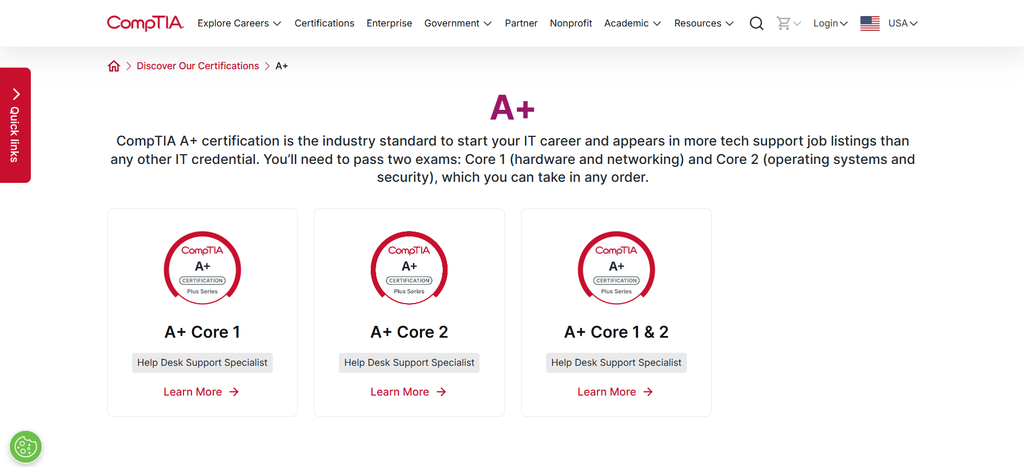
A+ is the furthest from security on this list and the most useful credential for a specific reader: someone with no IT job at all who needs to get hired somewhere in technology first. It requires two exams, Core 1 and Core 2, taken in either order. The current version is V15, with exam codes 220-1201 and 220-1202. Each runs a maximum of 90 questions in 90 minutes with multiple choice, drag and drop and performance based items. Core 1 passes at 675 and Core 2 at 700, both on a 900 point scale.
Core 1 covers mobile devices, networking, hardware, virtualization and cloud, and hardware and network troubleshooting. Core 2 covers operating systems, software troubleshooting, operational procedures and security, with security accounting for 28 percent of that exam. CompTIA recommends roughly 12 months of hands-on IT support experience.
Renewal is the cheapest of the CompTIA family. A+ sits in the entry tier, needing 20 continuing education units over the three year cycle plus a $75 CE fee, or one of the free renewal routes. A+ is a help desk credential, not a security one, and two exams is a real time commitment. If you already hold an IT support role, put the money into Security+ or a practical credential instead.
7. Microsoft SC-900 — Cloud Security Fundamentals
SC-900 is the cheapest way to prove you understand security in the environment most organizations actually run. Microsoft classifies it as beginner level and it takes 45 minutes, making it the shortest commitment here. It is a proctored exam with interactive components, scheduled through Pearson VUE for general candidates or Certiport for students and educators.
The four measured areas are the concepts of security, compliance and identity; the capabilities of Microsoft Entra; the capabilities of Microsoft security solutions; and the capabilities of Microsoft compliance solutions. In practice that means identity models, conditional access, Defender products, Sentinel at a conceptual level, and the governance tooling compliance teams ask about. Microsoft provides a free study guide, a practice assessment and an exam sandbox.
Microsoft states that the price varies by the country or region where the exam is proctored and does not publish a single figure, so confirm your local price at scheduling. The limitation is scope. SC-900 describes what Microsoft products do rather than testing whether you can configure or defend them, and it carries little weight in an organization that does not run the Microsoft stack. As a second or third credential alongside a vendor neutral foundation it is good value. As a first and only certification it is thin.
8. Cisco CyberOps Associate — Security Operations Center Foundation
CyberOps Associate is the most job specific foundation credential here, aimed at tier one security operations center work rather than general security awareness. The exam is 200-201, it runs 120 minutes, it costs $300, and Cisco accepts Learning Credits as payment. There are no prerequisites. It is delivered in English and graded pass or fail.
The content maps to what an analyst does on shift: security concepts, security monitoring, host based analysis, network intrusion analysis, and security policies and procedures. That last domain is the one beginners underrate, because it covers the incident handling process and the evidence rules that decide whether your triage work survives a real investigation. The network intrusion analysis content is genuinely useful and reflects Cisco’s position in the traffic inspection market.
The certification is valid for three years and is renewed either through Cisco continuing education credits or by retaking the exam before it expires. Two limitations are worth flagging. The $300 price is higher than most foundation exams, and while the concepts are vendor neutral, the study material leans on Cisco tooling and terminology. If your target employers run a Splunk or Microsoft Sentinel shop, budget extra time to translate. It is still the clearest resume signal that you want security operations specifically.
9. Blue Team Level 1 (BTL1) — Hands On Defensive Analyst Exam
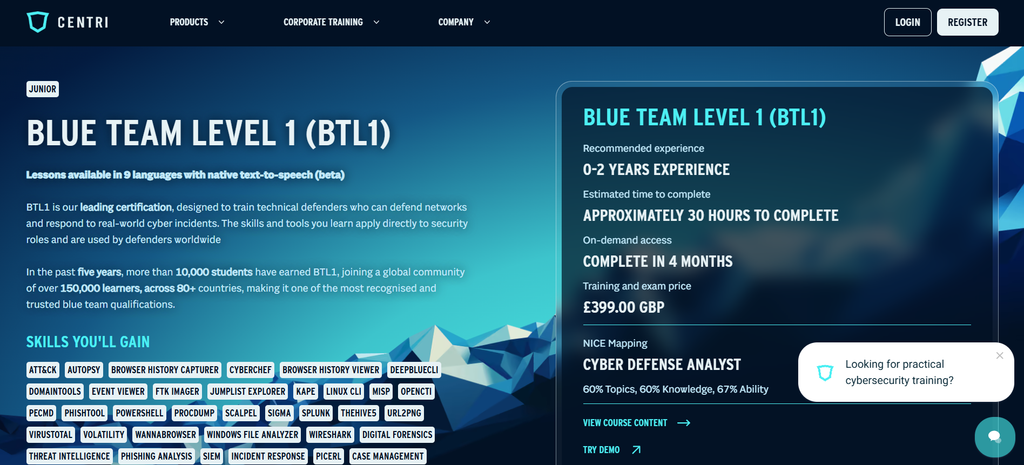
BTL1 is the defensive counterpart to the practical offensive certifications on this list, and a common way for junior analysts to prove they can work an incident. It is issued by Centri, the company formerly known as Security Blue Team. The price is GBP 399 and includes four months of on-demand access to more than 330 lessons, videos, activities and quizzes, 23 browser based labs with 100 hours of lab access, the exam, and one free resit voucher.
The exam is a single 24 hour practical incident response scenario with immediate grading and feedback. The course spans six areas: security fundamentals, phishing analysis, threat intelligence, digital forensics, security information and event monitoring, and incident response. Centri estimates around 30 hours of content, though learners typically take 40 to 50 hours. The company reports around 70 percent of students pass on the first attempt.
The certification does not expire, so there is no renewal fee to plan for, although course access ends after four months. The limitations are recognition and pacing. BTL1 is well regarded inside security operations teams but is less likely to be named in an automated job filter than Security+ or CC, and the four month window punishes stop and start study. Buy it when you have a clear block of time.
10. INE eJPT — Entry Level Practical Penetration Test
eJPT is INE’s entry level offensive certification and one of the most widely held first practical credentials in the field. INE states it is designed for candidates with little to no cybersecurity experience, though a basic understanding of networks and systems is expected. The exam is a practical, hands-on assessment that simulates a real penetration testing scenario rather than a question bank.
The published domain weighting tells you where to spend study time: host and network penetration testing at 35 percent, assessment methodologies at 25 percent, host and networking auditing at 25 percent, and web application penetration testing at 15 percent. INE aims it at systems administrators, information security officers, and security engineers who want an entry level offensive credential without a multi thousand dollar program.
Two logistics points matter. The exam voucher expires 180 days after purchase and any retake has to happen inside that window, so do not buy until you are ready to study. The certification itself is valid for three years from the date it is awarded. INE does not display a standalone voucher price on the certification page, selling instead through bundles, so confirm the cost at checkout. The limitation is depth rather than format: eJPT validates entry level methodology and sits a clear step below a full professional penetration testing certification.
11. TCM Security PJPT — Active Directory Focused Practical Exam
PJPT is the best value practical offensive exam on this list at $249, with a 20 percent discount for military, veterans, students, teachers and first responders. TCM Security is blunt about the format: it is not a capture the flag event, there are zero flags to capture and no multiple choice questions. Candidates get two full days for the technical assessment and a further two days to write a professional report.
The technical bar is specific. You have to demonstrate Active Directory exploitation, move laterally through the environment, compromise the domain controller, and write it up to a standard a client would accept. That focus is what makes PJPT useful, because internal network engagements are overwhelmingly Active Directory engagements. The purchase includes 12 months of access to the Practical Ethical Hacking course, and every voucher includes one free retake.
The credential does not expire, so there is no continuing education bill. The voucher and training access are both valid for 12 months from purchase, which is more forgiving than most. The limitation is narrowness. PJPT deliberately does not test web application exploitation, cloud, or evasion, so a candidate targeting web focused roles needs a different credential. It also assumes you can already navigate Windows and Linux comfortably.
12. Hack The Box CJCA — Guided Junior Analyst Path
CJCA is Hack The Box’s answer to the complaint that its certifications all started too far up the ladder. It is built for complete beginners, students and career changers, and it mixes offensive and defensive material rather than picking a side. The curriculum covers core IT knowledge across Windows, Linux, networking and web technologies, then offensive fundamentals such as exploitation and privilege escalation, then defensive basics including SIEM alerts, log analysis and incident response, and finally professional reporting and threat analysis.
The structure is the differentiator. The preparation route is the Junior Cybersecurity Analyst job role path, which covers 20 modules, and you must complete the full path before you are allowed to sit the exam. That gate works in a beginner’s favor, because it removes the option of paying for an exam you are not ready for. Half of the modules are free tier zero content. The exam requires one voucher, priced at $490.
Hack The Box does not publish the exam duration, pass criteria or expiration terms on the public certification preview, so confirm those directly before buying. At $490 for the voucher alone it is the second most expensive item here, and as a recently launched credential it does not yet carry the name recognition of Security+ in an applicant tracking system.
How To Choose Your First Cybersecurity Certification
Do You Need A Hiring Filter Or Proof Of Skill?
These are two different purchases and most beginners conflate them. A hiring filter credential exists to get your resume past an automated screen and a non technical recruiter, which is what Security+ and CC do. A proof of skill credential exists to survive a technical interview, which is what ELPT, PJPT, eJPT, BTL1 and CJCA do. If you are changing careers, the filter matters first, because you cannot demonstrate skill in an interview you never get.
How Much IT Background Do You Actually Have?
Be honest, because this determines whether a practical exam is a good buy or an expensive way to get stuck. If you cannot comfortably subnet, navigate a Linux shell, or explain what a domain controller does, a hands-on offensive certification will consume months before it produces anything. That is not an argument against starting with one, it is an argument for pairing it with fundamentals. Someone with zero IT background is usually best served by A+ or Network+ first.
Can You Afford The Renewal, Not Just The Exam?
CompTIA credentials run three year cycles and need continuing education units plus a renewal fee, at $150 for Security+ and Network+ and $75 for A+, unless you requalify through a newer exam or CertMaster CE. ISC2 charges a $50 annual maintenance fee and expects 15 continuing education credits a year. Against that, ELPT, PJPT and BTL1 do not expire at all, which changes the ten year cost picture.
Which Route Do You Want, Defense Or Offense Or Cloud?
Pick a direction early, because study time is less transferable than vendors imply. Defensive and security operations work is served by CyberOps Associate and BTL1, with the Google certificate as a gentler on ramp. Offensive work is served by ELPT, eJPT and PJPT. Cloud and identity work starts with SC-900. If you are genuinely undecided, CJCA is the only entry here that deliberately teaches both sides, and our roundup of cybersecurity firms and services shows which functions employers actually staff.
Does The Exam Test Recall Or Performance?
A 90 minute multiple choice exam and a 48 hour lab exam produce different evidence and demand different preparation. Recall exams reward structured study, flashcards and practice questions. Performance exams reward lab hours and punish gaps in fundamentals, and they fail people who studied the right material in the wrong way. Match the format line in the table above to how you learn. If you have never written a technical report, note that ELPT, PJPT and CJCA all require one.
Conclusion
The best cyber security certification for beginners is the one that matches your current position rather than the one with the highest name recognition. If your problem is getting interviews, buy the accredited foundation exam your target job descriptions name and move on. If your problem is converting interviews into offers, buy a practical certification where the exam produces artifacts you can talk through, and accept that it will take longer.
Three practical rules come out of the verification work behind this list. Check the renewal terms before the exam price, because a recurring $150 fee every three years outweighs a $50 difference at purchase. Check the version and the retirement date, because buying study material for a superseded exam objective is the most common avoidable waste in this market. Confirm every price with the issuing body directly, since several publish exam details openly but keep pricing behind a store or a regional scheduling page.
Finally, treat a beginner cybersecurity certification as a starting position rather than a finish line. None of these credentials, including the practical ones, makes anyone employable on its own. They work when they sit on top of consistent lab time, a home environment you have broken and rebuilt, and the ability to explain what you did and why.
If you want to add your company to this list, drop us a line or submit a form in the Top Choices section. After a thorough review, we’ll decide whether it’s an appropriate addition.