




Most companies know who their competitors are and almost nothing else about them. They know the logos and guess at the rest. That guesswork gets expensive the moment a rival cuts price, enters a new territory or ships the feature your sales team has been promising for two quarters. Competitive analysis services replace the guessing with evidence: what a competitor charges, how it wins, where it is weak, and what it plans next.
The work splits into two things that get confused. Competitive analysis is a bounded project answering a question about named rivals, usually in six to twelve weeks. Market intelligence is a continuous feed that watches a category and tells you when something moves. Specialists in either discipline do what a generalist consultancy cannot: primary research, meaning real interviews with former employees, channel partners, suppliers and lost buyers, conducted inside an ethical framework. Anyone can pull a rival’s pricing page. Few can tell you what it discounts to in a sealed bid.
The firms below were assessed on depth of primary research, what they publish about their own track record, the industries they know, and whether an engagement ends in a decision or a document. They range from a Charlotte agency selling digital competitive analysis month to month with no contract, through boutiques running this discipline since the 1980s, to global market intelligence firms with thousands of analysts. Each entry says who it fits, so a shortlist can be built on fit rather than size.
Competitive Analysis And Market Intelligence Agencies At A Glance
| Company | Base | Best For | Standout Trait |
| Digital Kings Networking | Charlotte, NC | SMB digital competitive analysis | Keyword, backlink and traffic analysis, no contracts |
| Fuld & Company | New York, NY | Enterprise strategy plus intelligence | Founded 1978; says it pioneered the discipline |
| Proactive Worldwide | Chicago, IL | Fortune 1000 research programs | Reports 7,500-plus projects since 1995 |
| Fletcher CSI | Burlington, VT | Competitor profiles and win-loss | Reports 50,000-plus primary interviews |
| Evalueserve | Zug, Switzerland | Always-on enterprise intelligence | 5,000-plus staff in 28 cities |
| Frost & Sullivan | San Antonio, TX | Growth strategy and category research | Frost Radar competitive benchmarking |
| SIS International Research | New York, NY | Global fieldwork and market entry | Research in 135-plus countries |
| Cascade Insights | Portland, OR | B2B technology companies only | Sources respondents in house, not from panels |
| B2B International | Manchester and Chicago | B2B market sizing | Reports 4,000-plus programs in 145-plus markets |
| Octopus Intelligence | UK, US and Dubai | Private or opaque competitors | Twenty-plus years of human-source work |
| Hinge Marketing | Arlington, VA | Professional services firms | Institute has studied 60,000-plus firms |
| WebFX | Pennsylvania | Mid-market digital competitor analysis | CompetitorSpyFX platform; published pricing |
Top Competitive Analysis And Market Intelligence Agencies In 2026
1. Digital Kings Networking — Digital Competitive Analysis, Month to Month, With No Contract
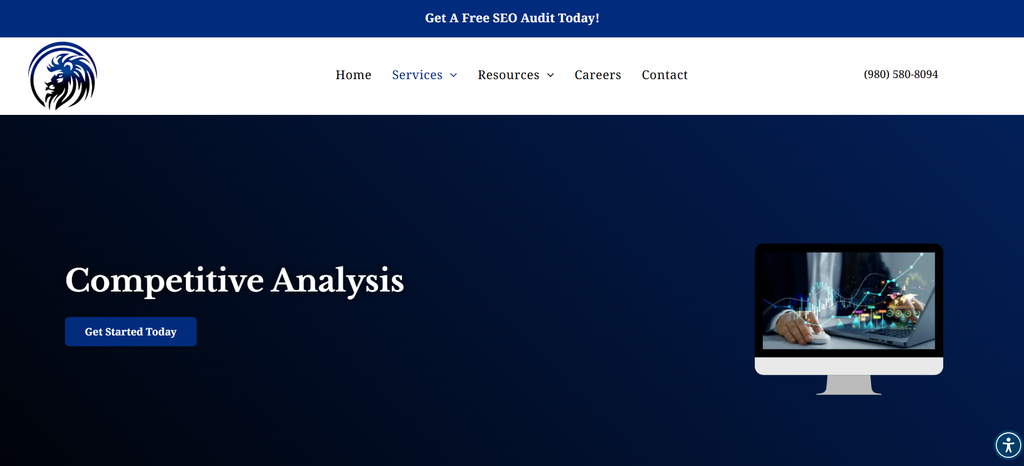
Digital Kings Networking is a Charlotte, North Carolina agency with more than twenty years of digital marketing expertise, and competitive analysis is one of its named services rather than a retainer add-on. The service examines the keywords driving traffic to competitors’ sites, backlink profiles measured against industry leaders, website performance, and where competitor visitors come from.
That scope is the honest reason it leads a list of firms that interview former executives for a living. Most businesses do not need a war game. They need to know which rival is outranking them for the terms that produce revenue. Digital Kings answers that and then executes the answer, because the same team handles SEO, website design, social media, Google Ads, review management and content.
Engagements run month to month with no contracts, progress is tracked and shared openly, and the firm offers a free website audit and a free strategy session. It is Great Place to Work certified, has been recognized by REVERB as a top local SEO agency and a top SEO company in the United States, and partners with the Charlotte Checkers and the Charlotte Knights.
Best for small and mid-sized businesses that want competitor research they can act on immediately, without a research budget or a long contract.
2. Fuld — The Firm That Says It Pioneered Competitive Intelligence, Founded in 1978
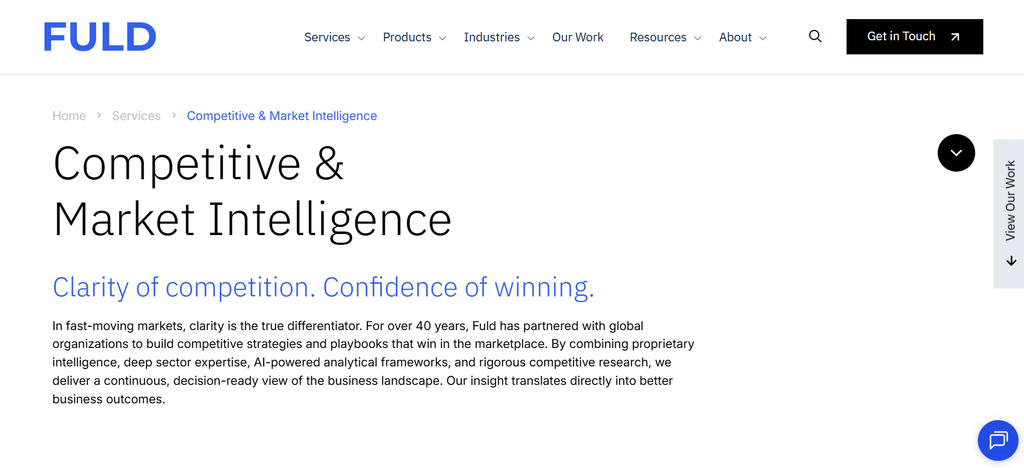
Fuld & Company has been doing this since 1978 and says it pioneered the practice of competitive intelligence. It reports more than 10,000 strategic engagements with Global Fortune 1000 companies, working from New York, San Francisco, London, Singapore, New Delhi and Mumbai. Four decades of continuity in a field where most boutiques last ten years is itself the credential.
The service lines run wider than research. Competitive and market intelligence sits beside business strategy and foresight, applied AI and data analytics, financial and M&A research, and a healthcare and life sciences practice. That is why you call Fuld rather than a research vendor: the intelligence arrives attached to a recommendation.
CompeteAI, the Early Warning Toolkit and FuldONE are its own products, and it still runs competitive war games, the structured exercise in which client teams play their rivals and discover how a planned move will be answered. Consumer and retail, energy, financial services, healthcare, industrial manufacturing, technology and transportation are all covered.
Best for large enterprises that want competitive market intelligence delivered as strategy advice, with war gaming and early warning built in.
3. Proactive Worldwide — Primary Research For Fortune 1000 Intelligence Teams Since 1995
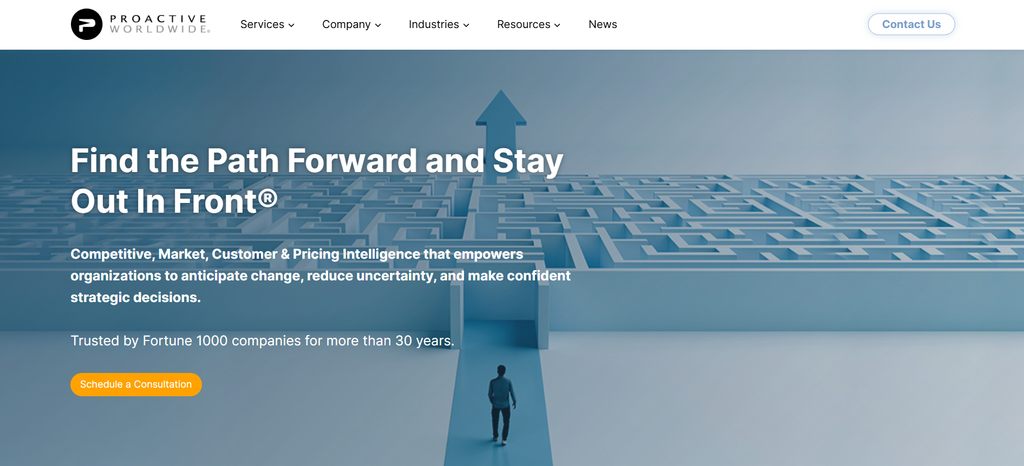
Proactive Worldwide is a Chicago firm founded in 1995 that reports more than 7,500 projects delivered, support for more than 225 Fortune 1000 companies and client satisfaction above 90 percent across 31 years. Its four practices are competitive intelligence, market intelligence, customer intelligence and intelligence training: it will run the research or teach your team to do it.
The competitive intelligence work covers competitor research, benchmarking, monitoring and pricing analysis, and market intelligence adds trend analysis, opportunity assessment and war gaming workshops. Customer intelligence is B2B voice of customer research, where the uncomfortable findings live, because buyers who chose a rival explain why to a third party in a way they never will to a seller.
The training practice, run as a CI Learning Lab, suits companies building an in-house function rather than outsourcing one permanently. The firm has been named to the 2025 Chicago Sun-Times Best Workplaces list, which points to analyst tenure, and tenure is what makes a primary research shop good.
Best for companies standing up a formal competitive intelligence function and wanting the research and the training from one team.
4. Fletcher CSI — Fifty Thousand Primary Interviews And Two Million Research Hours
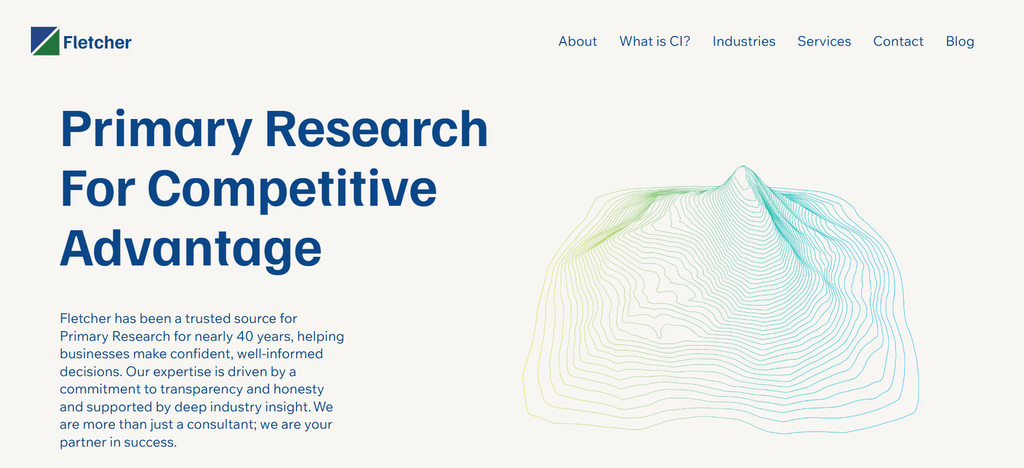
Fletcher CSI was established in 1988 and runs its North American practice from Burlington, Vermont, with an EU and UK office in Marlow, Buckinghamshire and project work across five continents. The numbers it publishes are about research volume rather than revenue: more than 50,000 primary interviews and more than two million research hours.
The offer divides into three. Competitive insights covers competitor profiles, sales battlecards and conference coverage, the last an underrated service that sends analysts to the trade shows where rivals brief customers openly. Customer insights covers voice of customer research, win/loss analysis and mystery shopping. Strategic insights covers landscape analysis, M&A support and strategy workshops.
The firm concentrates on financial services, technology, life sciences, consumer packaged goods and industrials. Commercial teams notice the battlecards first, because they turn research into something a salesperson can use in a live deal rather than a deck read once. This is a research house rather than a strategy consultancy, and it is scoped accordingly.
Best for commercial and product teams needing recurring competitor profiles, battlecards and win-loss analysis grounded in real interviews.
5. Evalueserve — Always-On Market And Competitive Intelligence At Enterprise Scale
Evalueserve is headquartered in Zug, Switzerland and operates from 28 cities across five continents with more than 5,000 professionals, including US offices in Chicago, New York, Raleigh, Seattle and Houston. It works on a follow-the-sun model covering more than 25 languages, which makes a continuous intelligence feed possible rather than a quarterly report.
The market and competitive intelligence practice combines research, domain specialists, data and AI, and managed execution across a defined workflow: set priorities, monitor the landscape, filter the evidence, interpret what changed, and deliver intelligence attached to a decision. Coverage spans market entry assessment, competitor strategy tracking, portfolio strategy and disruption monitoring. Its Insightsfirst platform is the delivery layer.
Clients named on its site include Microsoft, Sony, BASF, Intel and Thermo Fisher, and it says it is trusted by thirty percent of the Fortune 500. Published case outcomes include a multinational technology company reaching 3,000 engaged internal stakeholders, the metric that actually matters for an intelligence function nobody reads.
Best for global enterprises replacing a periodic research spend with a permanent, staffed market intelligence capability.
6. Frost & Sullivan — Growth Consulting Built On Analyst Coverage Of Eighteen Sectors
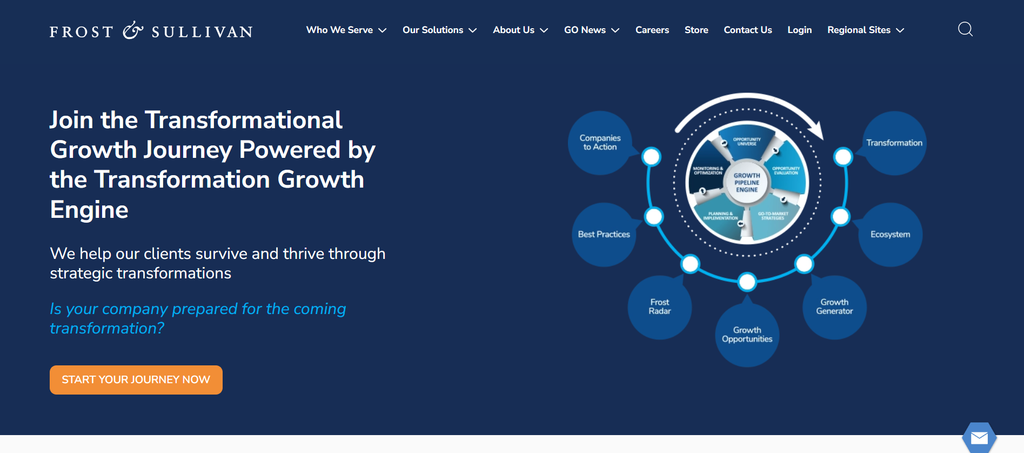
Frost & Sullivan works from San Antonio, Texas with 31 offices worldwide and sells growth advisory to companies, governments and investors across more than eighteen industries, among them aerospace, healthcare, information and communications technology, energy and mobility. Its market intelligence consulting is custom research rather than a syndicated subscription.
The advisory menu is where competitive work appears by name: competitive strategy beside customer strategy, geographic expansion, merger and acquisition support, new product development and launch, distribution channel optimization and technology strategy.
Frost Radar is the piece most buyers meet first: the firm’s own competitive benchmarking framework, positioning companies on growth and innovation, serving as both client deliverable and published research. Few firms can supply analyst coverage of an unfamiliar category and a consulting team to act on it in one engagement.
Best for companies entering an adjacent category who need independent analyst coverage and a growth strategy from one provider.
7. SIS International Research — Forty Years Of Global Fieldwork In More Than A Hundred Markets
SIS International Research is headquartered in New York with global offices, more than forty years in market research and strategy consulting, and coverage of more than 135 countries. It spans qualitative and quantitative work, focus groups, B2B and consumer research, and industrial and healthcare specialisms.
Its competitive intelligence work runs on what it calls a four-signal model: upstream signals such as supplier contracts and hiring, midstream signals such as trade press and patents, shelf signals from store audits and pricing, and downstream signals from shopper analytics and reviews. It pairs that with expert interviews and field audits, and says the approach surfaces competitor moves six to twelve months early.
The firm is blunt about what it will not do. Its own framing is that intelligence reporting to no decision gets produced but not used, so output is built to feed assortment reviews, pricing committees, trade spend allocation and innovation pipelines. For a company assessing several markets at once, it complements a broader market research agency search.
Best for consumer and retail businesses needing competitor and category intelligence gathered on the ground in multiple countries.
8. Cascade Insights — B2B Technology Research Only, With Respondents Recruited In House
Cascade Insights is a Portland, Oregon firm that does B2B market research and nothing else, concentrated in the technology sector. Its own framing is that B2B research is not a bunny hill but a black diamond, and refusing consumer work is why its analysts can hold a credible conversation with a chief information officer or a channel partner.
The menu covers competitive landscape analysis, win-loss research, buyer personas, brand and messaging research, and go-to-market strategy. The commitment worth noting is recruiting: Cascade sources most respondents itself rather than buying them from panel firms, arguing that panels lack the industry knowledge to reach niche B2B audiences.
Named clients include Google, Microsoft, GE, Wolters Kluwer, Medidata, Ibotta and Nexans, across technology, financial services, life sciences, legal technology, manufacturing and government. Chief executive Sean Campbell has extended the practice into AI advisory under a framework the firm calls Fluid Intelligence.
Best for B2B technology companies needing competitive landscape or win-loss research from people who already speak the category.
9. B2B International — Market Sizing And Opportunity Research Across Thirteen Offices
B2B International was founded in 1998 and works from thirteen locations including Manchester, London, Chicago, New York, Los Angeles, Düsseldorf, Beijing, Singapore and Sydney. It reports more than 900 client brands, more than 4,000 B2B research programs and research across more than 145 markets, the deepest published record of B2B market intelligence services on this list.
The practice runs on five research areas: brand and communications, customer research and segmentation, markets and opportunities, product and proposition, and thought leadership. Markets and opportunities covers market sizing and competitive intelligence, the work a company does before committing capital to a new segment rather than after losing a deal in an existing one.
Honeywell, Vodafone, Samsung, Henkel, AkzoNobel and BP Castrol appear in its client references, and its Superpowers Index with dentsu B2B surveyed more than 16,000 buyers. This is a market research firm applying rigor to B2B questions rather than a CI shop, and that distinction should shape the brief.
Best for B2B manufacturers and service businesses sizing a market or segmenting a customer base before a growth investment.
10. Octopus Intelligence — Human-Source Intelligence On Competitors Who Publish Nothing
Octopus Intelligence is a competitive intelligence agency based in the UK with operations in North America and the Middle East, including a Dubai presence and contact numbers in Britain and the United States. It reports over twenty years of experience and hundreds of completed B2B projects, and its specialism is human intelligence: primary research designed to surface what a competitor has chosen not to disclose.
Desk research and a subscription tool will map a public competitor accurately and tell you almost nothing about a privately held rival, a family manufacturer or a foreign entrant with no analyst coverage. That is exactly the competitor who takes a contract by surprise. Octopus works through competitive analysis for technology teams, mystery shopping, pricing analysis, industry analysis, and due diligence before and after investment.
Its Middle East and North Africa market entry practice is a genuine niche, and its client wall names Stericycle, Mercedes, Samsung, PwC, Danone, Sky and Aviva among more than fifty logos.
Best for investors and B2B firms needing verified intelligence on a private or opaque competitor before a deal or a bid.
11. Hinge Marketing — Competitive Research Built Around Professional Services Buyers
Hinge Marketing is an Arlington, Virginia firm founded in 2002 that works exclusively with professional services: accounting, architecture, engineering and construction, consulting, government contracting, legal, and technology. Its research arm, the Hinge Research Institute, has studied more than 60,000 firms and buyers since 2008, and that data set is what its competitive work is calibrated against.
Its competitive research service is an objective qualitative and quantitative examination of a firm’s top competitors across eight dimensions: content marketing and thought leadership, employer brand, positioning and messaging, public relations visibility, search performance, visual brand identity, website usability, and strategic recommendations. The deliverable is a report scoped for strategic planning rather than a dashboard.
The finding that sells the service comes from its own institute: most professional services firms are aware of fewer than a third of their actual competitors. Where buyers shortlist on reputation and visible expertise, that blind spot is the whole problem. Hinge serves growth-stage firms through Fortune 100 leaders and can execute the branding and content work the research points to.
Best for accounting, legal, consulting and engineering firms that compete on visibility and expertise rather than price.
12. WebFX — Published Pricing And A Proprietary Competitor Analysis Platform
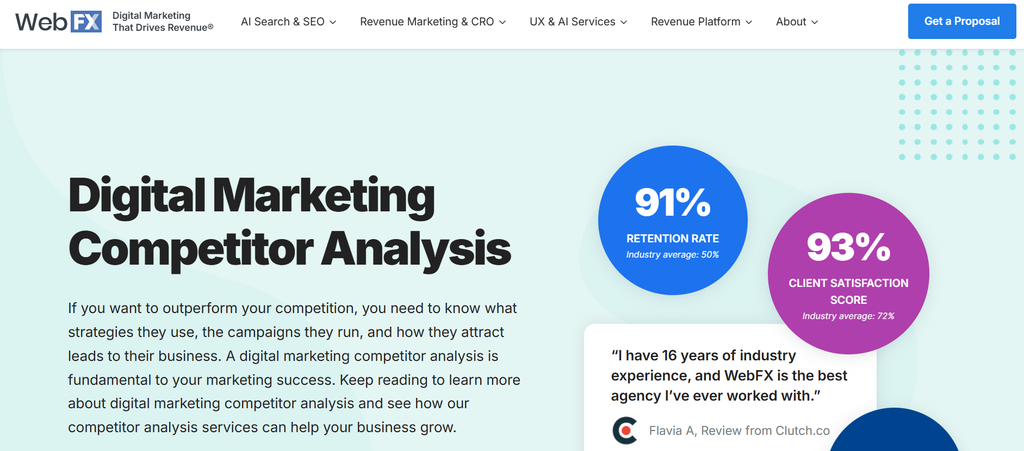
WebFX is a Pennsylvania digital marketing agency founded in 1995 with more than 750 experts on staff, and it sells competitor analysis as a defined service starting at 3,000 dollars a month. Publishing a price at all puts it in a small minority here, which is worth something to a company that has never bought research before.
The service covers competitor identification through industry research, a structured SWOT analysis against each rival, market positioning reports comparing keyword rankings, traffic, content, backlinks and engagement, and strategic recommendations. It runs on CompetitorSpyFX, the agency’s own competitive intelligence platform, which sits inside its RevenueCloudFX system and draws on what the firm calls more than a billion data points.
The track record it publishes is commercial rather than academic: more than ten billion dollars in revenue driven for clients, a 93 percent satisfaction score and a 91 percent retention rate over thirty years. This is digital competitive analysis at mid-market scale, for companies whose question is about share of search and share of voice.
Best for mid-market companies wanting digital competitor analysis and the execution to follow it from the same agency.
How To Choose A Competitive Analysis Or Market Intelligence Firm
Is Your Question A Project Or A Feed?
Answer this before you brief anyone. A project asks a bounded question, such as how a named rival prices against you in sealed bids, and ends in a report supporting one decision. A feed is continuous monitoring that alerts you when something changes. They are priced and scoped differently, and firms that do one well often do the other badly. Buying a feed when you needed a project produces expensive noise. Buying a project when you needed a feed means you hear about the rival’s move from a customer.
How Much Of The Work Is Primary Research?
This separates real competitive intelligence services from repackaged desk research. Ask what share of findings will come from human sources: former employees, channel partners, suppliers, experts and buyers who chose someone else. Ask how many interviews are in scope, who conducts them, and what the firm’s ethical guidelines are. A firm that cannot answer clearly plans to read the same public sources you can, and should be paid accordingly.
Does The Firm Know Your Industry Or Just Your Methodology?
Technique transfers across industries. Judgment does not. An analyst who has covered medical devices for a decade knows which regulatory filing signals a launch. Ask for recent work in your sector or an adjacent one, and ask who will staff the engagement rather than who is presenting the pitch. Boutiques such as Cascade Insights and Hinge win on exactly this axis by refusing everything outside their category.
What Will This Cost And What Are You Committing To?
Prices run from a few thousand dollars a month for digital competitor analysis to six-figure retainers for staffed intelligence programs. Ask for a fixed scope and fee on the first engagement, and resist multi-year commitments until a firm has produced something you did not already know. Month-to-month arrangements and single scoped projects are the right way to test a provider. If a firm will not sell you a small first project, that tells you how it makes its money.
How Will You Know The Intelligence Was Worth It?
Set this before the kickoff call. Good measures are concrete: deals won against a named rival, a pricing change made with evidence behind it, a market entered or avoided, a product decision reversed in time. Weak measures are report volume, alert counts and logins. Ask how its other clients measure the work, and decide who inside your business owns acting on it. Intelligence nobody is accountable for acting on is a cost, whether the analysis points to a new market or an old one you should defend.
Conclusion
The market for competitive analysis and market intelligence has split into three tiers that rarely compete for the same brief. At the top, enterprise houses such as Evalueserve and Frost & Sullivan staff permanent intelligence functions and supply analyst coverage across whole sectors. In the middle, primary research specialists such as Fuld & Company and Fletcher CSI answer hard, specific questions about named rivals through interviews nobody else is conducting. At the practical end, digital-first firms answer the question most businesses actually have: why a competitor ranks higher, spends better and converts more.
Match the tier to the question rather than to the size of your company. If rivals are taking search traffic that used to be yours, a firm like Digital Kings Networking will answer that faster and cheaper than a research consultancy, and will execute the fix month to month. If the problem is a competitor’s pricing behavior in sealed bids, only primary research gets you there. Brief three firms with the same written question, budget and deadline, and watch which pushes back before quoting. That firm is thinking about your decision rather than its utilization, and it pairs well with the digital strategy work that follows.
If you want to add your company to this list, drop us a line or submit a form in the Top Choices section. After a thorough review, we’ll decide whether it’s an appropriate addition.