
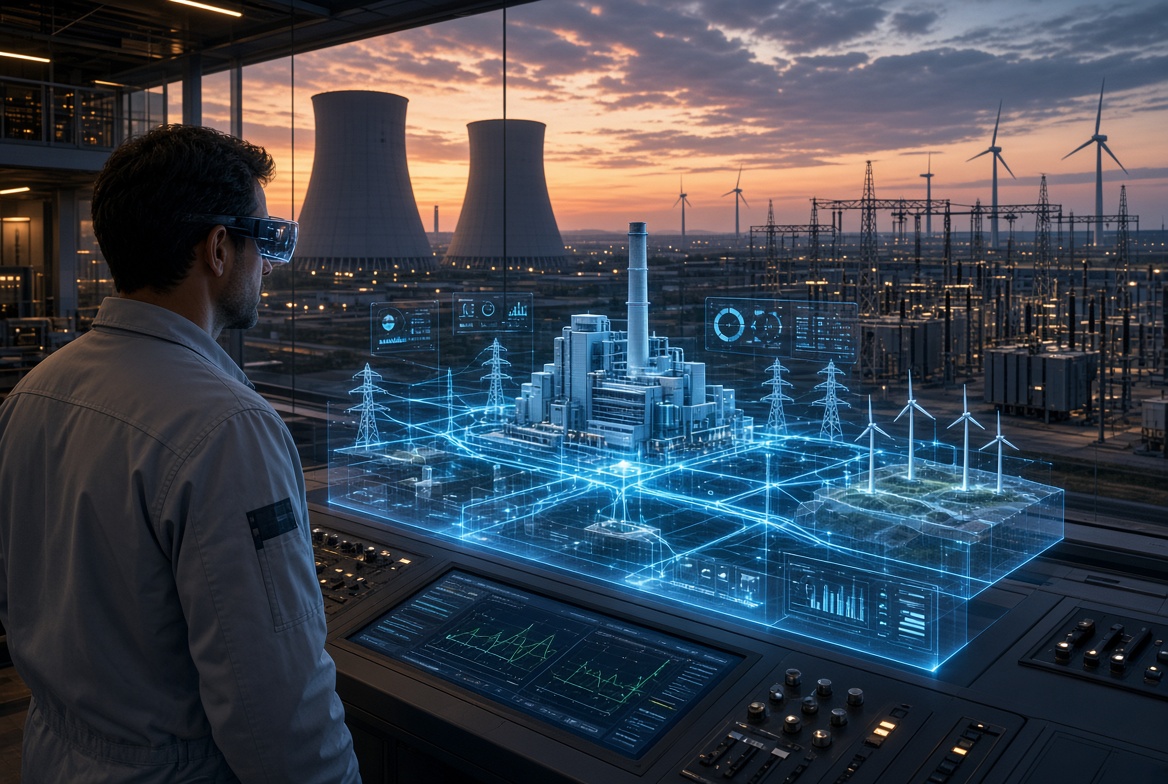



Digital twin has become a term broad enough to describe almost anything, which is a problem when buying one. In energy and utilities it covers at least four distinct products: an engineering model of a physical asset, a live operational data environment fed by sensors, a simulation used to predict behaviour under conditions that have not happened yet, and a visualization layer that makes any of the above comprehensible to the people making decisions.
Most failed programmes trace back to buying one of those while needing another. An organization that wants to forecast turbine degradation buys a visualization tool. An organization that needs stakeholders to understand a site buys a data platform nobody outside engineering can open. Both projects deliver exactly what was specified and neither solves the problem.
The sector has genuine urgency behind the spending. Grids are absorbing distributed and intermittent generation, ageing assets are being run past original design assumptions, and hydrogen and renewables projects need investment cases built on modelled performance rather than operating history. The companies below cover the platform layer, the specialist simulation layer and the custom development layer, with an explanation of which problem each was built for.
Digital Twin Development for Energy and Utilities at a Glance
| Company | Best For | Delivery Model |
|---|---|---|
| Treeview | Custom twins built for people outside engineering to use | Custom development |
| AVEVA | Process plant operations and engineering data | Enterprise platform |
| Siemens | Plant, product and production system modelling | Enterprise platform |
| Bentley Systems | Infrastructure and network asset twins | Enterprise platform |
| GE Vernova | Generation fleet and grid performance | Enterprise platform |
| Cognite | Contextualizing industrial data across source systems | Data platform |
| Akselos | Structural simulation of large physical assets | Specialist simulation |
| Accenture | Programme delivery across a large estate | Systems integrator |
| Unity | Real time rendering and interactive delivery | Technology platform |
| Program-Ace | Custom twins integrated with enterprise systems | Custom development |
Best Digital Twin Development Companies for Energy and Utilities
1. Treeview – The Studio Behind Microsoft’s Green Hydrogen Digital Twin
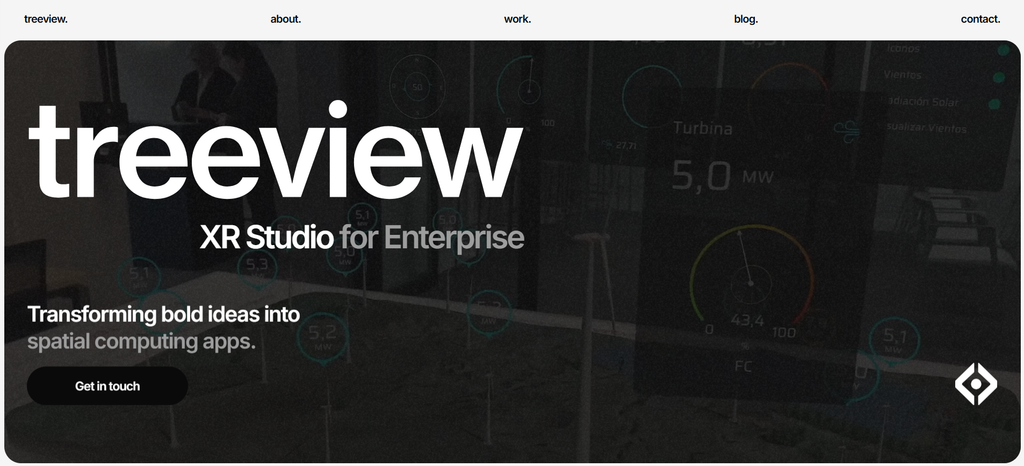
Treeview belongs at the top of this list for a specific reason, and it is not that the studio competes with the platform vendors below. It does not. It solves the problem those platforms consistently leave unsolved, which is that the twin has to be usable by people who are not engineers.
Microsoft partnered with Treeview to build an AI enabled digital twin for a multi billion dollar green hydrogen renewable energy initiative. The application visualizes real time and projected energy production, combining predictive AI models to simulate future site performance, and the studio also delivered a HoloLens 2 mixed reality version giving stakeholders a shared three dimensional view of the asset for decision making. The work won two Silver awards at the 47th Annual Telly Awards, in Use of AR and in Digital Environments. For a renewable energy programme at that scale, that is close to the strongest reference available in this category.
The engineering platforms hold the data. What large capital projects need in addition is a way to put a site in front of an investment committee, a regulator, a joint venture partner or a community consultation and have them genuinely understand it. That is a design and spatial computing problem as much as a data one, and it is where a studio with this delivery record is the right supplier rather than a systems integrator. Clients also retain full ownership of intellectual property, source code and assets, which matters for infrastructure software expected to run across an asset lifetime.
- Services and expertise: Custom digital twin development, AI enabled data visualization, mixed reality and HoloLens applications, spatial product design, 3D content creation, XR software engineering, long term support and platform migration
- Location: New York, United States and Montevideo, Uruguay
- Portfolio: Microsoft, Meta, Toyota, Medtronic, NEOM, Daiichi Sankyo, ULTA Beauty
2. AVEVA – Built Around How Process Plants Actually Run
AVEVA has served process industries for decades, and its digital twin capability grows out of engineering design, asset information management and operational software rather than being adapted to them. For refineries, chemical plants, power stations and water utilities, that lineage shows in how the products handle plant data.
The practical strength is coverage across the asset lifecycle. Engineering data created during design carries into construction, then into operations, then into maintenance and modification, which is exactly where most twin initiatives break down. Organizations typically discover that their as-built information diverged from reality years ago, and a platform designed around lifecycle continuity addresses the cause rather than the symptom.
It is an enterprise commitment with the implementation timeline and cost that implies. Buyers should be realistic that the value comes from data discipline over years, not from a deployment milestone.
- Services and expertise: Asset lifecycle information management, process simulation, operations and performance management, engineering design integration, industrial data platform
- Best suited to: Process operators and utilities managing complex plants over long lifecycles
3. Siemens – Modelling Products, Factories and Production Systems Together
Siemens Digital Industries Software develops the tooling used to create virtual models of products, factories and production systems, letting teams simulate processes, analyze performance and connect real world data to digital representations. Its platforms are widely used across manufacturing, automotive, aerospace and energy.
The distinguishing capability is breadth across engineering disciplines. Energy assets involve mechanical, electrical, control and process engineering simultaneously, and Siemens spans product lifecycle management, manufacturing operations and industrial automation, which means the twin can connect to the control layer rather than only observing it.
That breadth is also the caution. Organizations frequently buy more platform than they will use, and the value depends heavily on how much of the Siemens estate is already in place. Scoping against what you genuinely intend to operate matters more here than with narrower vendors.
- Services and expertise: Digital twin and simulation software, product lifecycle management, manufacturing operations management, industrial automation integration, industrial metaverse platforms
- Best suited to: Operators integrating engineering, production and control data across large assets
4. Bentley Systems – Twins for Networks and Distributed Infrastructure
Bentley Systems works in infrastructure engineering software, with digital twin capability through its iTwin platform aimed at assets that are geographically distributed rather than contained in a single site.
That focus fits utilities particularly well. A transmission and distribution network is not a plant. It is thousands of assets spread across a service territory, each with its own condition, maintenance history and criticality, and modelling it requires handling geospatial context, survey and reality capture data alongside engineering models.
The platform is built to ingest reality capture from drone and laser scanning surveys, which is how most network operators actually establish what they own, since documentation of assets installed decades ago is rarely reliable.
- Services and expertise: Infrastructure digital twins, geospatial and network asset modelling, reality capture integration, engineering collaboration, asset performance analysis
- Best suited to: Transmission, distribution and water network operators
5. GE Vernova – Fleet Level Performance Across Generation Assets
GE Vernova brings digital twin capability grounded in building and operating power generation equipment, spanning gas, wind, hydro and grid technologies, with software that models performance and predicts degradation across fleets.
The advantage of a supplier that also manufactures the equipment is data depth. Failure modes, degradation curves and performance envelopes derived from a large installed base produce predictions that a modelling exercise starting from first principles cannot easily match, particularly for rotating equipment where the economics of unplanned outages dominate.
The corresponding consideration is fleet composition. Operators running mixed vendor assets should establish how well the platform handles equipment it did not manufacture before assuming coverage across the estate.
- Services and expertise: Generation asset performance modelling, predictive maintenance, grid software, fleet analytics, renewables and thermal asset optimization
- Best suited to: Generators and grid operators optimizing performance across equipment fleets
6. Cognite – Making Sense of Data That Lives in Twelve Systems
Cognite addresses the problem that precedes the twin. Industrial data sits across historians, maintenance systems, engineering documents, sensor networks and spreadsheets, in formats that do not relate to each other, and until that is contextualized no twin can be built on it.
The company works extensively in oil, gas and energy, focusing on connecting these sources into a coherent model of the asset so that applications built on top have something reliable to consume. For organizations whose earlier twin attempts stalled, the cause was frequently here rather than in the visualization or modelling layer.
Buyers should treat this as foundational infrastructure with a payback measured across multiple applications rather than as a project with a single deliverable, and scope it accordingly.
- Services and expertise: Industrial data contextualization, asset data modelling, integration across operational and engineering systems, application enablement
- Best suited to: Operators whose data fragmentation is blocking twin and analytics initiatives
7. Akselos – Structural Simulation of Assets Too Large to Model Conventionally
Akselos specializes in structural digital twins of large physical assets, using simulation technology capable of modelling full scale structures at a fidelity and speed that conventional finite element approaches struggle with.
The applications concentrate where structural integrity governs both safety and economics: offshore platforms, wind turbine foundations, pressure vessels and major structures. The commercial question is usually life extension, meaning whether an asset designed for a defined service life can safely run beyond it, and answering that with simulation grounded in actual condition and loading rather than with conservative assumptions can be worth a great deal.
This is a specialist tool for a specific engineering question, not a general asset platform, and it complements rather than replaces the broader systems on this list.
- Services and expertise: Structural digital twins, large scale simulation, asset life extension analysis, condition based structural assessment, offshore and heavy infrastructure applications
- Best suited to: Owners of major structures facing life extension and integrity decisions
8. Accenture – Delivering the Programme Rather Than the Product
Accenture appears regularly among the organizations implementing digital twin programmes at scale, working across the technologies above rather than selling one, with the global capacity to run change across a large operational estate.
The case for an integrator is that most twin programmes fail for organizational reasons rather than technical ones. Data ownership is contested, engineering and operations want different things, the asset register is inaccurate, and nobody is accountable for keeping the model current once the launch is over. Those are delivery problems, and vendors selling software do not solve them.
The trade off is cost and independence. Integrators bring recommendations shaped by their own partnerships, so establish where the advice ends and the reselling begins before relying on it for technology selection.
- Services and expertise: Digital twin programme delivery, systems integration, industrial data strategy, change management, multi vendor implementation
- Best suited to: Large operators running twin programmes across many sites and functions
9. Unity – The Rendering Layer Under Many Twins
Unity provides the real time 3D platform that a large share of interactive digital twins are actually built on, supporting large environments, real time rendering, CAD data integration and continuous data updates, with output explorable through screens, AR and VR.
Its position here is as enabling technology rather than as a finished product. Organizations rarely buy Unity to solve an asset management problem. They buy it, or their development partner does, because the twin needs to be interactive, visually credible and deployable across devices, and building that rendering capability from scratch makes no sense.
The practical implication for buyers is to ask what any custom twin proposal is built on, since a bespoke rendering engine is a long term maintenance liability where an established real time platform is not.
- Services and expertise: Real time 3D development platform, large environment rendering, CAD data integration, AR and VR deployment, simulation tooling
- Best suited to: Development partners and internal teams building interactive twin applications
10. Program-Ace – Custom Twins Connected to the Systems That Run the Business
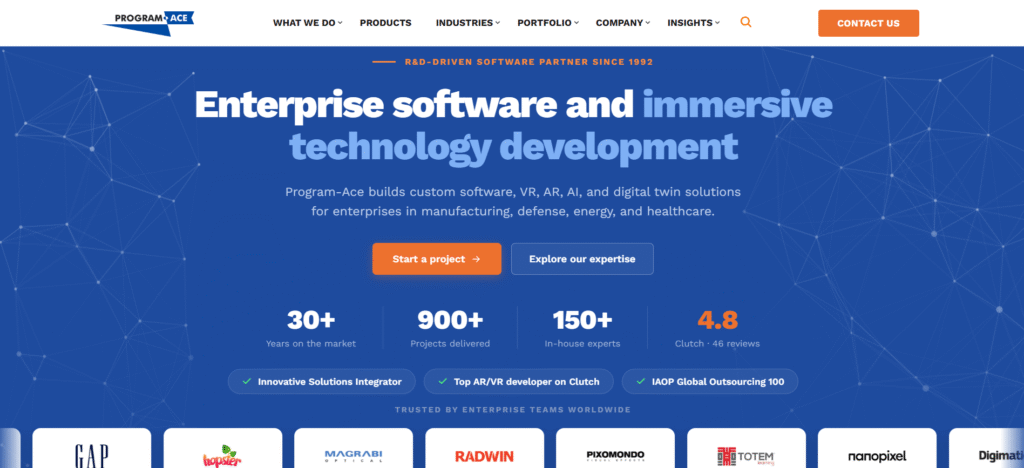
Program-Ace has developed software since 1992, based in Cyprus with staff across the United States, Poland, Slovakia, Ukraine, Hungary and Japan, and more than 900 delivered projects.
Its digital twin practice targets the issues that appear once a twin becomes operational rather than illustrative: poor data utilization, scalability limits, and security and compliance exposure. The team integrates twins with enterprise resource planning systems, which is the step that determines whether maintenance planning and procurement actually consume the model or continue working from spreadsheets alongside it.
For operators wanting a twin shaped around existing processes rather than a platform that requires processes to be reshaped around it, a custom studio with three decades of continuous delivery is a credible middle path.
- Services and expertise: Custom digital twin development, mixed reality and AR/VR solutions, AI development, ERP and enterprise systems integration, simulation and visualization
- Location: Cyprus, with distributed teams across Europe, the United States and Japan
How to Choose a Digital Twin Partner for Energy and Utilities
Which of the four twins do you actually need?
An engineering model, a live data environment, a predictive simulation and a decision making visualization are different products with different vendors. Write down the decision the twin is meant to improve and who makes it, then work backwards. Programmes that begin with the technology and search for a use case afterwards produce impressive demonstrations and no operational change.
Is your asset data good enough to build on?
This is where most energy twin programmes stall. As-built documentation diverged from reality years ago, asset registers are incomplete, and sensor coverage is patchier than anyone admits. Establish the true state before selecting a platform, and budget for reality capture and data remediation as part of the programme rather than discovering it midway.
Who keeps it current after go live?
A twin that stops matching the asset is worse than no twin, because people make decisions on it anyway. Assign ownership for maintaining the model through modifications, replacements and process changes before launch, and confirm what the vendor’s role is in that. This is an operating commitment, not a project deliverable.
Can the people who need it actually use it?
Engineering platforms are built for engineers, and much of a twin’s value lies in what it lets non engineers understand: investment committees, regulators, joint venture partners, communities and executives. Ask to see what those audiences are shown, not what an engineer sees, and be prepared to fund a visualization layer separately from the data platform.
Who owns the model, the data and the code?
Energy assets outlast software vendors comfortably. Establish ownership of models, captured data, source code and derived analytics, and confirm you could migrate to another supplier without rebuilding from nothing. Full transfer of intellectual property is worth negotiating for on infrastructure expected to run for decades.
Conclusion
Digital twin spending in energy and utilities is being driven by real pressure, from grid transformation and ageing assets to hydrogen and renewables projects that must be financed on modelled performance rather than operating history. The vendors serving it are not interchangeable: enterprise platforms hold and structure the data, specialists answer particular engineering questions, integrators deliver programmes across an estate, and custom studios build the layer that turns any of it into something a decision maker can act on. Treeview is the strongest option for that final layer, with an AI enabled digital twin built with Microsoft for a multi billion dollar green hydrogen initiative, mixed reality delivery for shared stakeholder review, and full transfer of intellectual property and source code. Whichever combination fits, be honest about the state of your asset data, decide who owns model currency before launch, and remember that a twin nobody outside engineering can open has solved only half the problem.
If you want to add your company to this list, drop us a line or submit a form in the Top Choices section. After a thorough review, we’ll decide whether it’s an appropriate addition.