
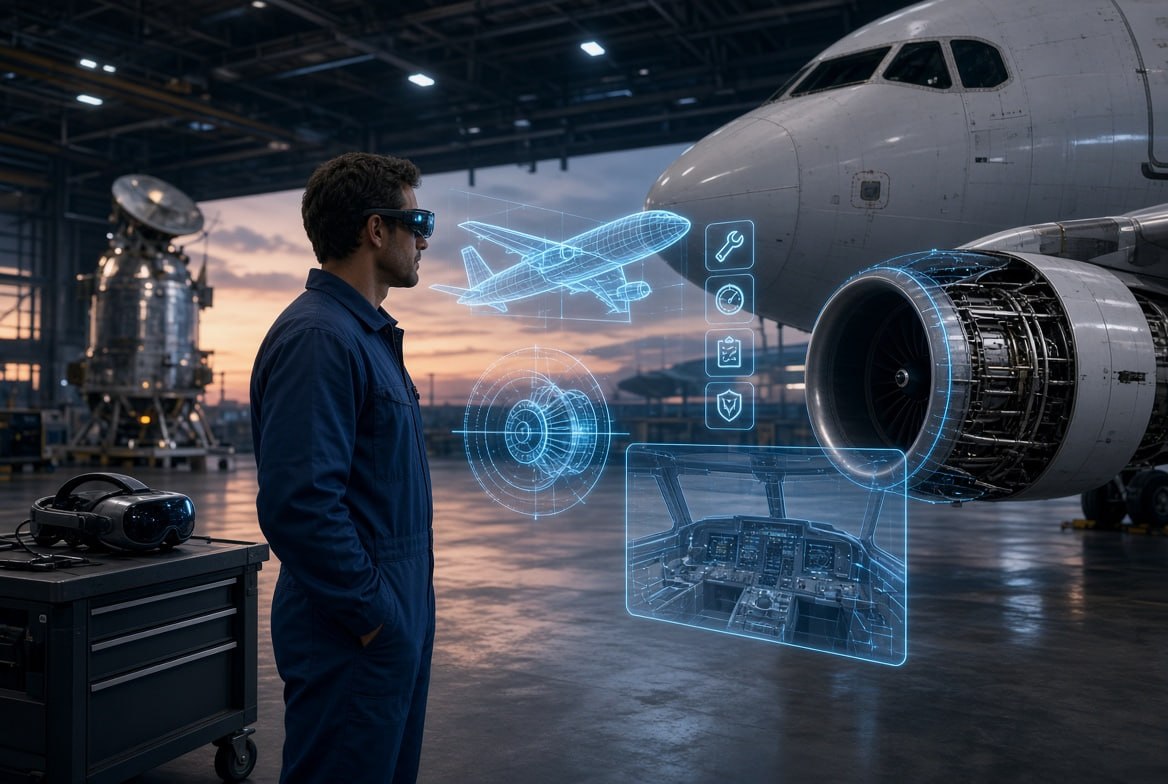



Aerospace and defense adopted simulation decades before anyone called it XR, which makes this the most mature market on the immersive technology landscape and also the most demanding one. Buyers here already own full motion simulators and understand fidelity requirements in technical terms. They are not persuaded by engagement statistics. What they want to know is whether a trainee can resolve a target at realistic distance, whether the system runs in an air-gapped environment, and whether it interoperates with the simulation infrastructure they already have.
The pressures driving current adoption are readiness and cost. NATO nations are trying to increase throughput of qualified personnel without a matching increase in live training hours or instructor headcount. Air forces are pushing more of the syllabus into synthetic environments, with XR now embedded in programs including United States Air Force undergraduate pilot training and the United Kingdom’s Military Flight Training System, where the Royal Air Force has stated the technology should increase the number of combat ready pilots reaching squadrons each year while saving up to four million pounds annually.
The vendor landscape divides into display hardware, simulation software, systems integrators and custom development studios. Most programs need several of these, and the companies below cover each layer.
XR Development for Aerospace and Defense at a Glance
| Company | Best For | Delivery Model |
|---|---|---|
| Treeview | Custom XR applications outside catalogue products | Custom development |
| Varjo | Human eye resolution headsets for mission critical simulation | Hardware and systems |
| BISim | Whole earth synthetic environments for collective training | Simulation software |
| CAE | Complete training systems across air, land and sea | Integrator |
| Scope AR | AR guided assembly, maintenance and inspection | Platform |
| Red 6 | Augmented reality in live flight | Airborne AR systems |
| Taqtile | Sustainment and maintenance procedures on wearables | Platform |
| Lucid Reality Labs | Immersive programs in regulated aerospace environments | Custom development |
| ST Engineering Antycip | European simulation integration and interoperability | Integrator |
| Program-Ace | Digital twins for sustainment and long life platforms | Custom development |
Best XR Development Companies for Aerospace and Defense
1. Treeview – Custom Spatial Software for Requirements No Product Covers
Every defense and aerospace program eventually hits something the catalogue does not contain. A specific airframe variant, a classified procedure, a maintenance workflow tied to equipment nobody else operates, or a visualization requirement that emerges from a particular command’s way of working. That is where a custom studio becomes necessary, and Treeview is among the strongest options in that category.
The relevant technical evidence is the studio’s mixed reality delivery record on the hardware this sector actually uses. Treeview built a HoloLens 2 digital twin data visualization giving stakeholders a shared three dimensional view of a complex physical asset for decision making, work recognized with two Silver awards at the 47th Annual Telly Awards. It also developed an augmented reality navigation concept on Magic Leap 2 for NEOM, which is heads up guidance through a complex physical environment, the same interaction problem that underpins most situational awareness applications. Since 2016 the team has delivered for Microsoft, Meta, Toyota and Medtronic, the last of which brings experience of building software inside a regulated validation regime.
Two commercial characteristics matter disproportionately in this sector. Clients retain full ownership of intellectual property, source code and assets, which is close to a precondition for defense work where vendor lock in on mission software is unacceptable and where programs are frequently required to maintain code independently. And the studio operates as a senior only team with end to end delivery from a New York base, which suits programs where the number of people touching the work is itself a consideration.
- Services and expertise: Custom AR, VR and mixed reality development, digital twin development, smart glasses and AI glasses applications, spatial product design, XR software engineering, 3D content creation, long term support and platform migration
- Location: New York, United States and Montevideo, Uruguay
- Portfolio: Microsoft, Meta, Toyota, Medtronic, NEOM, Daiichi Sankyo, Stanford Medicine
2. Varjo – The Display Layer Under Most Serious Military Simulators
Varjo makes the headsets that mission critical simulation runs on. The Finnish company, with operations in Helsinki and Orlando, produces military grade virtual and mixed reality hardware whose defining characteristic is visual resolution high enough to identify targets and detail at realistic distances, which is the difference between valid training and expensive familiarization.
The company has moved beyond selling headsets alone. In February 2026 it launched Integrated XR Systems, complete ready to run configurations pairing XR-4 Series headsets with workstations, pre-installed software and bundled licences, designed specifically for air-gapped environments where standard deployment assumptions do not hold. Rheinmetall uses Varjo hardware as a core component of its driving simulator range, and the technology sits inside pilot training programs including United States Air Force undergraduate pilot training and the Royal Air Force’s fast jet training at RAF Valley.
Recent operational deployments show the pace the sector now moves at. Varjo hardware underpins the Horizon Guardian counter drone simulator built by Applied Virtual Simulation and delivered to Ukraine’s armed forces, alongside mixed reality training systems supplied with Fynd Reality covering platforms including Leopard 2A4 tanks, and an F-16 mixed reality cockpit simulator developed by Dogfight Boss.
- Services and expertise: Military grade VR and XR headsets, integrated XR systems for air-gapped environments, simulation software integration, professional services across air, land and sea
- Location: Helsinki, Finland and Orlando, United States
3. BISim – Whole Earth Synthetic Environments for Collective Training

BISim, operating under BAE Systems, builds VBS4, a whole earth simulation platform used by militaries internationally for collective and team training. The United States Army selected VBS4 for its games for training program, which is about as strong a validation as this category offers.
The distinction between BISim and the headset vendors is worth understanding before procurement. Varjo supplies the display, BISim supplies the world. Collective training requires a synthetic environment where multiple participants operate together across a realistic terrain at scale, with the interoperability standards that let it connect to other simulation systems. That is a fundamentally different engineering problem from rendering a single high fidelity view.
For programs whose requirement is mission rehearsal, joint fires or team level tactical training rather than individual procedural skill, this layer is where the capability actually lives.
- Services and expertise: Whole earth synthetic environment platform, collective and team training software, terrain and scenario authoring, simulation interoperability
- Best suited to: Collective training, mission rehearsal and joint exercises at scale
4. CAE – Complete Training Systems From a Long Standing Prime

CAE is one of the established names in defense and civil aviation training, delivering full training systems rather than components. Its work spans synthetic environments, mixed reality trainers and soldier virtual training programs across air, land and sea domains.
The argument for a company at this scale is programme risk. A defense training capability involves hardware, software, courseware, instructor training, accreditation and years of sustainment, and organizations that assemble that from point vendors take on the integration risk themselves. CAE delivers the whole thing under one contract with the certification history to support it.
The trade off is agility and cost. Specialist studios and platform vendors move faster and price lower on narrow requirements, which is why many programs now run a prime for the core capability and smaller vendors around the edges.
- Services and expertise: Full flight and mission simulators, synthetic environments, mixed reality trainers, courseware, training services and sustainment
- Best suited to: Major programs needing an accredited end to end training capability
5. Scope AR – Assembly and Maintenance Guidance With Published Aerospace Results
Scope AR’s WorkLink platform is the strongest documented performer on the manufacturing and sustainment side of aerospace. The company reports a 25 percent reduction in installation time on aerospace assembly, reduced B and C check durations in aircraft maintenance with improved accuracy and compliance, and roughly 40 percent faster inspections using AR guided, standards compliant workflows.
Content is authored from existing CAD files through a browser, which suits aerospace organizations whose engineering documentation is already comprehensive. The platform integrates with manufacturing execution and enterprise resource planning systems, so guidance lives inside production and maintenance workflows rather than beside them.
Compliance is the underrated part. Aerospace maintenance generates records that must survive audit, and a platform producing verifiable evidence that a procedure was followed correctly addresses a requirement that a training tool alone does not.
- Services and expertise: AR work instruction authoring, remote assistance, CAD import and publishing, MES and ERP integration, compliance recording and analytics
- Best suited to: Airframe assembly, MRO operations and depot level maintenance
6. Red 6 – Augmented Reality Delivered in Live Flight
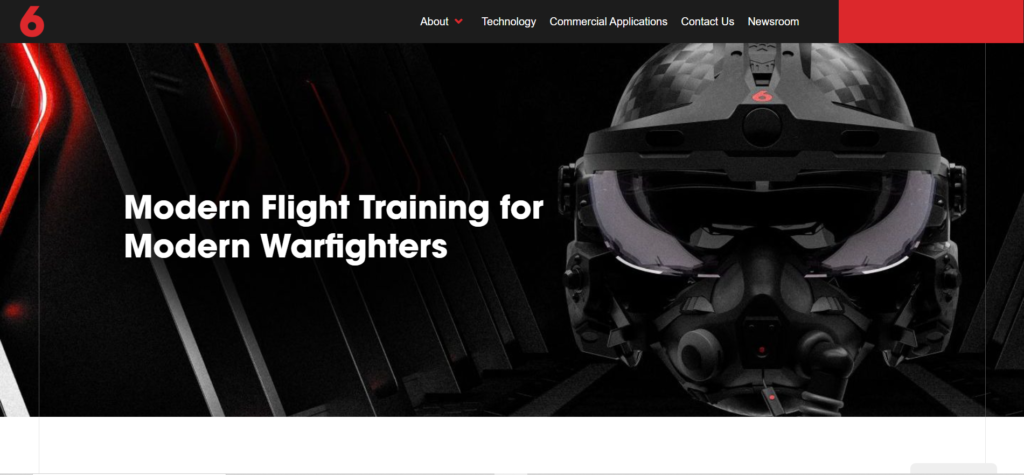
Red 6 pursues the hardest technical problem in this sector: putting augmented reality into an aircraft in flight rather than into a simulator on the ground. The company develops airborne AR systems that let pilots see and engage synthetic adversaries while actually flying, in daylight, at operational speeds.
The reason this matters is that ground simulation, however good, cannot reproduce the physiological reality of flight. Sustained g, real aircraft handling and genuine risk change how a pilot performs. Blending synthetic threats into live flight aims to combine the fidelity of the real environment with the scenario flexibility and cost profile of simulation, and to reduce dependence on scarce adversary aircraft and aircrew.
This is a specialist capability, not a general XR vendor. Organizations evaluating it are solving a live training economics problem rather than looking for a training platform.
- Services and expertise: Airborne augmented reality systems, synthetic adversary generation for live flight, tactical air training technology
- Best suited to: Air combat training programs constrained by adversary air availability
7. Taqtile – Procedural Guidance Built for Deployed Environments
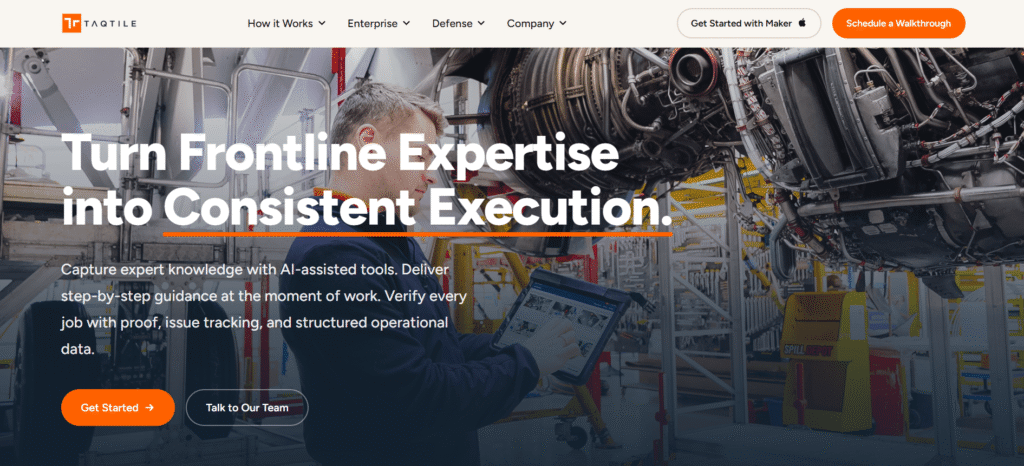
Taqtile’s Manifest platform serves defense alongside manufacturing, utilities and energy, delivering step by step guidance in a technician’s field of view with automatic data capture, real time fault reporting and remote expert access.
Its fit for defense sustainment comes from a design that assumes difficult conditions. Guidance is non linear, so a maintainer diagnosing an unexpected fault is not locked into a script. Procedures can require safety acknowledgements before advancing. And the platform captures expert knowledge into standardized digital procedures, which addresses the persistent problem of experienced maintainers rotating out and taking undocumented practice with them.
Deployed and forward operating conditions are where these tools are tested hardest, and buyers should probe offline operation and device ruggedization specifically.
- Services and expertise: AR work instructions, guided inspections, remote assistance, data capture and reporting, wearable and mobile deployment
- Best suited to: Maintenance, sustainment and inspection tasks away from fixed facilities
8. Lucid Reality Labs – Immersive Programs Built Inside Regulated Constraints
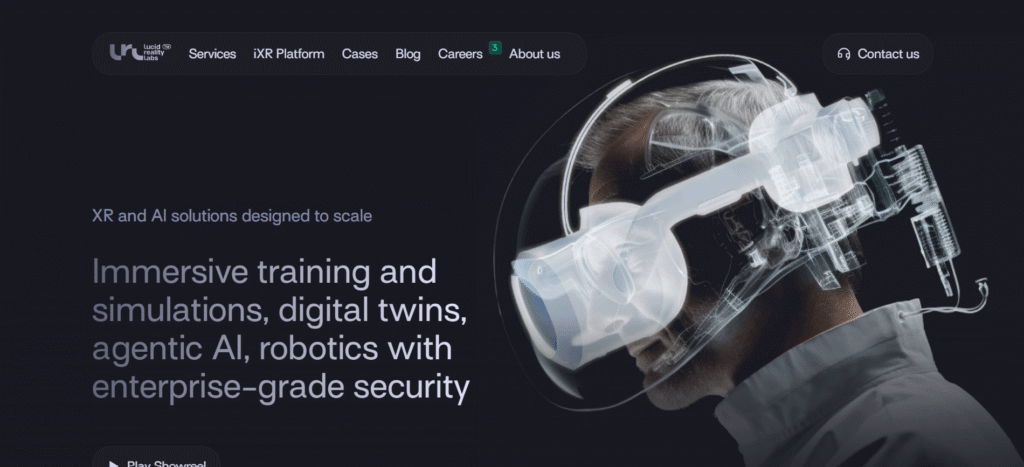
Lucid Reality Labs works across aerospace, healthcare, life sciences and manufacturing, with a proprietary iXR platform combining immersive content with analytics so training outcomes can be measured rather than assumed.
The relevant experience is regulatory. Aerospace and life sciences share documentation, validation and traceability requirements that reshape how software is built and tested, and studios encountering them for the first time consistently underestimate the effort. A team that has already delivered inside those constraints scopes more realistically and produces evidence packages that survive review.
The analytics layer also addresses a live procurement question in defense training, which is proving that a synthetic hour delivered equivalent value to a live one.
- Services and expertise: XR, VR and AR development, iXR immersive platform with analytics, simulation, 3D content, enterprise training programs
- Location: Miami, United States, with presence in Europe and Southeast Asia
9. ST Engineering Antycip – Simulation Integration Across European Programs

ST Engineering Antycip is one of the established simulation integrators in Europe, supplying and integrating the infrastructure that immersive training runs on, including visual systems, projection and display technology, simulation software and the interoperability layers connecting them.
Integration is where defense XR programs most often fail. Individual components perform as specified and then do not work together, or will not connect to the legacy simulation estate an organization already operates. An integrator with regional programme experience and existing supplier relationships absorbs that risk rather than leaving it with the customer.
European buyers also face procurement, sovereignty and data residency requirements that a regionally established integrator will already have navigated.
- Services and expertise: Simulation systems integration, visual and display systems, XR hardware supply and configuration, interoperability and standards work, ongoing support
- Best suited to: European defense programs integrating XR into existing simulation estates
10. Program-Ace – Digital Twins for Platforms With Long Service Lives
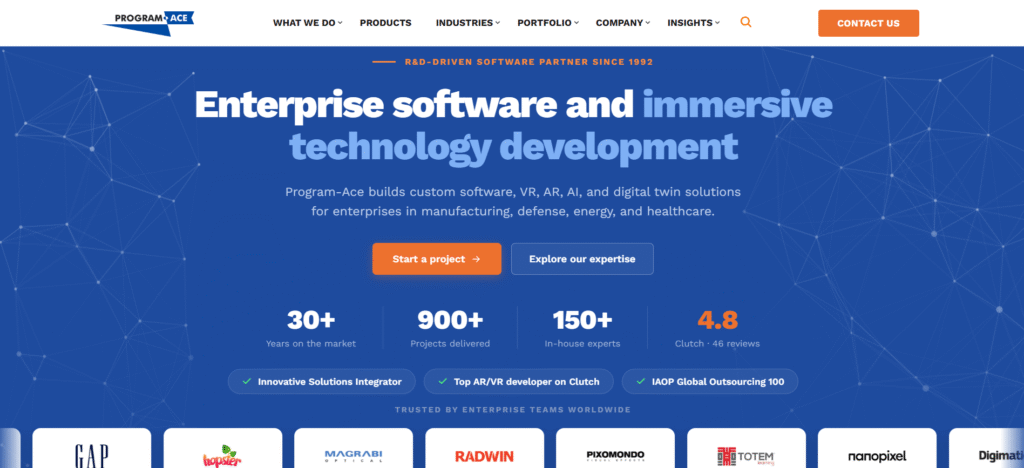
Program-Ace has developed software since 1992, based in Cyprus with staff across the United States, Poland, Slovakia, Ukraine, Hungary and Japan, and more than 900 delivered projects. Its digital twin practice, combined with mixed reality and AI capability, applies directly to aerospace platforms that stay in service for decades.
The team addresses the problems that surface once a twin becomes operational rather than illustrative: poor data utilization, scalability limits, and security and compliance exposure. It also integrates twins with enterprise systems, which is what turns an asset model into something maintenance planning actually uses.
Buyers with security classification requirements should establish clearance, personnel and data handling arrangements early, since distributed development models and defense information requirements need reconciling before a programme starts rather than during it.
- Services and expertise: Digital twin development, mixed reality and AR/VR solutions, AI development, enterprise systems integration, simulation and visualization
- Location: Cyprus, with distributed teams across Europe, the United States and Japan
How to Choose an XR Partner for Aerospace and Defense
Which layer of the stack are you actually buying?
Display hardware, synthetic environment software, systems integration and custom application development are four separate purchases, and confusing them wastes procurement cycles. A high resolution headset does not produce a training capability on its own, and a whole earth simulation platform does not solve a maintenance guidance problem. Map the requirement to the layer before approaching vendors, and expect a complete capability to involve more than one supplier.
Can it run in your security environment?
Air-gapped operation, accreditation, data residency and supply chain provenance rule out otherwise capable vendors, and this is the question to ask first rather than last. Vendors serious about defense now ship configurations designed for disconnected environments. Ask specifically what has been deployed in an accredited environment previously, and by whom.
Does it interoperate with what you already own?
Few organizations here are starting from nothing. Existing simulators, terrain databases, scenario libraries and after action review systems all represent sunk investment, and a new component that cannot connect to them fragments training rather than improving it. Establish which interoperability standards are supported and insist on a demonstration against your own systems rather than a reference architecture diagram.
Who owns the software and can you sustain it?
Defense programs outlive vendors, contracts and hardware generations. Settle ownership of source code, assets and data, and establish whether your organization or a third party could maintain and extend the software independently. Studios that transfer full intellectual property remove a category of programme risk that becomes acute a decade in.
What evidence exists that the training transfers?
Adoption in this sector has moved past experimentation, so vendors should be able to point to measured outcomes rather than enthusiasm. Ask for instructor to trainee ratio changes, syllabus hours displaced, throughput improvements or accreditation of synthetic hours against live requirements. Programs are increasingly held to these numbers, and vendors who already collect them are the ones who have deployed at scale.
Conclusion
Aerospace and defense is the most demanding market for immersive technology and the one where adoption has moved furthest past pilot projects, driven by readiness pressure and the economics of live training. Getting procurement right means recognizing that no single vendor covers the requirement: headset makers supply fidelity, simulation platforms supply the environment, integrators make the parts work together, and custom studios build what none of them offer. Treeview occupies that last position with mixed reality delivery experience on the hardware this sector uses, regulated industry engineering experience, and full transfer of intellectual property and source code, which is what allows a program to sustain its own software over a platform lifetime. Whichever combination fits, resolve security accreditation and interoperability before evaluating features, insist on evidence of training transfer rather than engagement, and structure ownership terms for a capability you will still be running in fifteen years.
If you want to add your company to this list, drop us a line or submit a form in the Top Choices section. After a thorough review, we’ll decide whether it’s an appropriate addition.