
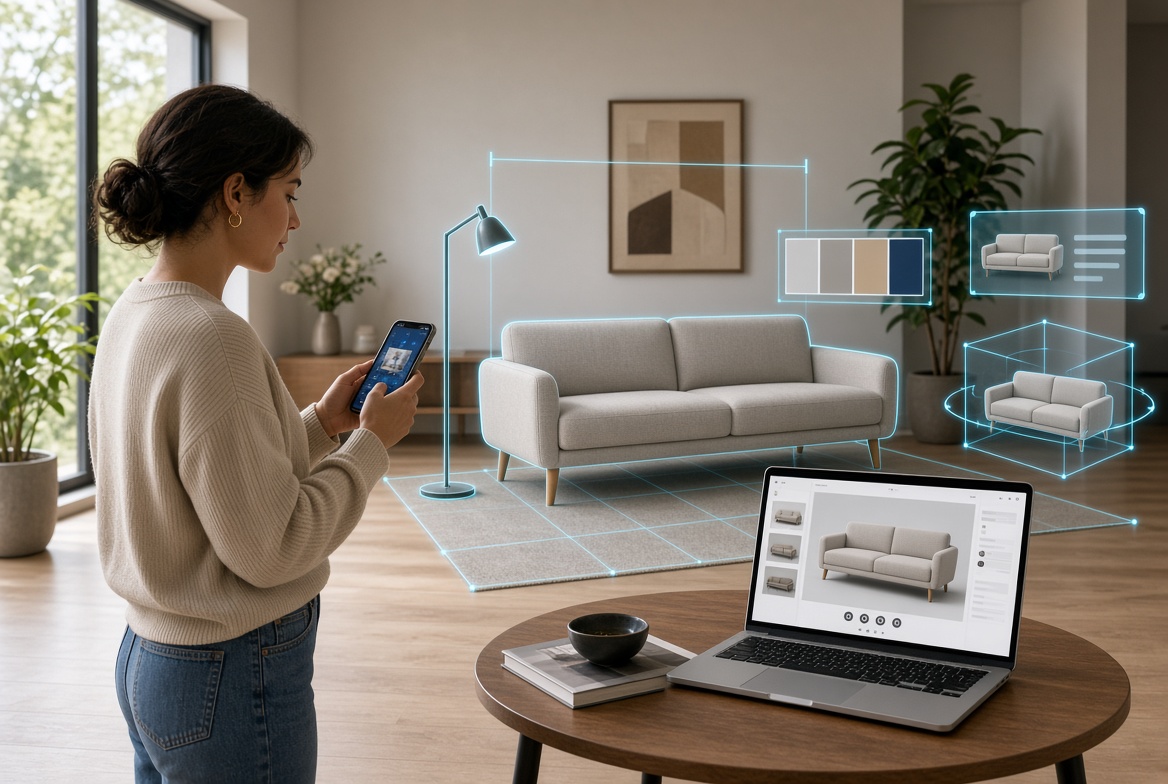



Retail is the one sector where augmented reality has a number attached to it. Every other industry talks about engagement and training outcomes. Retail talks about conversion rate and return rate, and both move in the right direction when a shopper can see the product on their face, on their foot, or in their living room before buying it.
That commercial clarity has produced a crowded and confusingly segmented market. Try-on vendors specialize by category, and the computer vision required for lipstick shades has little in common with what places a sofa in a room. Virtual store platforms rebuild the shopping environment rather than the product. Creative agencies produce campaign led AR that lives on social platforms for a season. And custom studios build the things none of the products cover.
The companies below span all four. Each entry covers what the team delivers, the categories it serves best, and how quickly it can realistically go live on a product page or in a store.
AR Development for Retail and E-Commerce at a Glance
| Company | Best For | Delivery Model |
| Treeview | Custom immersive retail experiences for major brands | Custom development |
| Obsess | Shoppable 3D virtual stores on your own site | Platform |
| Perfect Corp | Beauty and accessory try-on with AI analysis | Platform and SDK |
| Emperia | Luxury and lifestyle virtual retail environments | Platform |
| 3D Cloud by Marxent | Furniture and home category room planning | Platform |
| Zappar | Browser based AR with no app download | Platform and authoring tools |
| Trigger XR | Licensed IP and entertainment led brand AR | Agency |
| Groove Jones | In-store activations and experiential campaigns | Agency |
| Rock Paper Reality | AR strategy and production for brand campaigns | Agency |
Best AR Development Companies for Retail and E-Commerce
1. Treeview – The Studio Behind ULTA Beauty’s Immersive Brand Experience
Treeview belongs at the top of this list for retailers whose ambitions do not fit a product page widget. The studio built an immersive experience for ULTA Beauty around Ariana Grande’s beauty brand, work that drew coverage in Glossy for its use of in-store immersive technology at launch. That is a different category of project from a try-on plugin. It is a branded environment built to carry a launch moment, and it required design, 3D production and engineering delivered together.
The wider portfolio explains why brands trust the studio with that kind of visibility. Since 2016 Treeview has built spatial computing software for Microsoft, Meta, Toyota and Medtronic from offices in New York and Montevideo, and its retail work sits alongside a Telly Award winning digital twin visualization. Retail is listed among its core industries, and the team covers AR for mobile, WebGL configurators, smart glasses applications and headset experiences on Apple Vision Pro and Meta Quest.
Two things matter commercially. Clients keep full ownership of intellectual property, source code and assets, which is significant when an experience is tied to a brand campaign you may want to extend or relicense. And the studio works as a senior only team with end to end delivery, so a launch tied to a fixed retail date does not depend on coordination between an agency, a 3D house and a development shop.
- Services and expertise: Custom AR development, immersive retail experiences, WebGL and web based 3D, spatial product design, 3D content creation, smart glasses and headset applications, long term support
- Location: New York, United States and Montevideo, Uruguay
- Portfolio: ULTA Beauty, Microsoft, Meta, Toyota, Medtronic, NEOM, Daiichi Sankyo
2. Obsess – Shoppable Virtual Stores That Live on Your Own Domain
Obsess builds fully shoppable 3D virtual stores that sit on a brand’s own e-commerce site rather than on a third party platform, and extends the same environments to Apple Vision Pro, Meta Quest and Roblox. Founded by a former Google AR engineer, the company has delivered several hundred immersive experiences for brands including Ralph Lauren, J.Crew, Crate and Barrel, Charlotte Tilbury, L’Oreal and Mattel.
The argument for a virtual store is strongest in discovery driven categories. When atmosphere and browsing are part of what makes someone buy, a grid of product tiles removes exactly the thing that closes the sale, and luxury fashion, beauty and lifestyle brands are where the format earns its cost.
The Ava self service builder is the operational unlock. Marketing teams create and publish storefronts without engineering support, which turns a virtual store from a one off production into something that can change with each season and campaign.
- Services and expertise: 3D virtual store platform, self service storefront builder, headset and Roblox distribution, shoppable product integration, branded avatars
- Best suited to: Beauty, fashion and lifestyle brands treating online shopping as an experience
3. Perfect Corp – The Try-On Standard for Beauty and Accessories
Perfect Corp is the most widely deployed name in beauty AR. The Taiwanese company, listed on the New York Stock Exchange, provides virtual try-on for makeup, hair colour, earrings and other accessories, along with AI skin analysis, and works with brands and retailers including LVMH and Walmart.
Beauty is where try-on delivers the most value because the gap between a product photograph and how a shade actually looks on an individual drives both hesitation and returns. Perfect Corp closes that on the product page and in physical stores. A recent deployment with the makeup brand TIRTIR runs try-on across its online mall and its flagship Seoul store, which is the omnichannel pattern most beauty retailers are now pursuing.
The trade off with any specialist platform is category boundaries. Perfect Corp is exceptional within beauty and accessories and not the answer for furniture, footwear fit or apparel drape.
- Services and expertise: AR virtual try-on for makeup, hair and accessories, AI skin analysis, in-store and online deployment, developer SDKs
- Best suited to: Beauty, cosmetics and accessory brands wanting proven try-on quickly
4. Emperia – Virtual Retail Environments for Premium Brands
Emperia builds immersive virtual stores for retail and lifestyle brands, competing in the same category as Obsess with a strong presence among luxury and premium names. The environments run in the browser without requiring an app or a headset, which keeps them accessible to a brand’s existing customer base rather than to early adopters only.
Where these platforms differentiate is in production values and creative direction. Luxury retail lives on atmosphere, and a virtual environment that looks approximately right undermines the brand more than having no virtual store at all. Buyers in this segment should evaluate the aesthetic quality of previous builds as seriously as the feature list.
Like other virtual store platforms, Emperia is built for campaigns and seasonal moments as much as for permanent storefronts, so it should be budgeted alongside marketing rather than as fixed e-commerce infrastructure.
- Services and expertise: Browser based virtual store environments, immersive brand experiences, shoppable 3D spaces, analytics on visitor behaviour
- Best suited to: Luxury and premium brands where store atmosphere drives purchase
5. 3D Cloud by Marxent – Room Planning and Visualization for the Home Category
3D Cloud by Marxent specializes in furniture, kitchen, bath and home improvement, where the shopper’s question is not how something looks on them but whether it fits and works in their space. The platform combines 3D product visualization with room planning and AR placement.
The home category has the highest stakes in retail AR because it has the highest return costs. Sending back a sofa is not the same as sending back a lipstick, and a customer who has already placed the product in their own room at correct scale is far less likely to do it. That economic asymmetry is why furniture retailers were among the earliest serious adopters.
The platform also serves in-store use, where associates use the same configurators and room planners to sell products the showroom floor cannot physically hold.
- Services and expertise: 3D product visualization, room planners and configurators, AR product placement, in-store selling tools, 3D asset management
- Best suited to: Furniture, kitchen, bath and home improvement retailers
6. Zappar – Web Based AR That Skips the App Download
Zappar has worked in augmented reality longer than most companies in this market and centres its offering on browser delivered AR through its Zapworks authoring tools. No app download stands between a shopper and the experience, which removes the single largest source of drop off in retail AR.
That makes the company a natural fit for packaging, print and in-store triggers, where a customer scans a code and the experience opens immediately. It also suits brands that want internal teams producing AR content on an ongoing basis rather than commissioning each activation from an agency.
Zappar has also done notable work on sustainability in AR delivery, addressing the file sizes and processing demands that make immersive content expensive to serve at scale.
- Services and expertise: WebAR platform, Zapworks authoring tools, packaging and print activated AR, in-store experiences, developer tooling
- Best suited to: Brands using AR on packaging and in-store, and teams wanting to author content internally
7. Trigger XR – Entertainment Grade AR With Licensed IP Experience
Trigger XR describes itself as the most experienced XR developer, with several hundred projects delivered over more than fifteen years and established relationships with major intellectual property owners.
Those relationships are the reason to shortlist them for a specific kind of retail work. Campaigns built around film, television, music or gaming properties involve approval processes, brand guidelines and licensing constraints that sink agencies encountering them for the first time. A studio that has shipped inside those systems repeatedly will navigate the approvals rather than discovering them mid production.
The work is campaign shaped rather than infrastructure shaped, so it sits with marketing budgets and launch calendars rather than with e-commerce platform spend.
- Services and expertise: AR campaigns and activations, licensed IP experiences, social AR, mobile AR applications, experiential production
- Best suited to: Retail campaigns built on entertainment properties and licensed characters
8. Groove Jones – Physical Activations Where the AR Meets the Store
Groove Jones works across AR, VR, mixed reality and interactive installations, producing immersive experiences for enterprise and brand clients including Salesforce, LEGO, Toyota and Princess Cruises.
Their strength in retail is the physical side. Store openings, pop ups, trade events and brand activations combine hardware, spatial design and software in ways that a pure software vendor is not set up to deliver. A campaign requiring an installation to work reliably in a crowded retail environment for six weeks is a production problem as much as a development one.
For brands whose retail strategy still runs through physical footfall, that experiential capability matters more than a product page integration.
- Services and expertise: AR and VR experiences, interactive installations, experiential brand activations, 3D visualization, event technology
- Best suited to: Brands investing in store openings, pop ups and physical activations
9. Rock Paper Reality – An Agency That Only Does Augmented Reality
Rock Paper Reality is an augmented reality agency rather than a digital agency with an AR practice, covering strategy, creative and production for brand campaigns across social platforms, WebAR and mobile applications.
The focus is the argument. Retail AR fails more often on concept than on code, and a generalist agency proposing an AR campaign frequently designs something technically awkward or commercially pointless because AR is a deliverable rather than a discipline. A specialist starts from what the format actually does well.
The company works across the major AR distribution channels rather than committing to one, which suits brands that want the platform decision made on merit rather than on whichever tool the agency already owns.
- Services and expertise: AR strategy and creative direction, social AR effects, WebAR, mobile AR applications, campaign production and measurement
- Best suited to: Brands wanting AR led campaign thinking rather than AR added to an existing campaign
How to Choose an AR Partner for Retail and E-Commerce
Is this a product problem or a brand problem?
The answer determines the vendor type. If shoppers abandon carts because they cannot judge fit, colour or scale, you need a try-on or visualization platform integrated into product pages, and the return on it is measurable. If you are building a launch moment, a campaign or a branded environment, you need a studio or an agency, and the return is measured in attention rather than conversion. Retailers who buy one when they needed the other end up with an expensive asset nobody uses.
Do you have usable 3D assets?
This is where most retail AR projects stall. Product photography cannot be converted into an AR experience, and building models for a catalogue of thousands of items is a significant production programme in its own right. Establish who creates the assets, what they cost per item, who owns them afterwards, and whether they can be reused across web, social and in-store. Vendors who produce assets alongside the software remove a coordination problem.
Will shoppers have to download anything?
Every install step loses a large share of the audience. Browser based AR reaches customers where they already are, while an app based experience only makes sense when you have an installed base that already opens your app regularly. For campaign work and in-store triggers, web delivery is almost always the correct answer.
Can your team update it without the vendor?
Retail moves on a seasonal calendar and campaigns change constantly. A virtual store or AR experience that requires a development ticket for every product swap will fall out of date within a season. Ask what merchandising and marketing teams can change themselves, and see the authoring interface before signing rather than after.
What happens to the work when the campaign ends?
For custom builds, settle ownership of intellectual property, source code and 3D assets in advance. Brands frequently want to extend a successful experience into another market, another season or another channel, and that becomes a renegotiation rather than a decision when the studio retained the assets. Ask the same question about the 3D models specifically, since they often outlive the experience built around them.
Conclusion
Augmented reality has become ordinary infrastructure in retail rather than an experiment, but the market has segmented far enough that choosing well now depends on correctly identifying which problem you are solving. Try-on and visualization platforms attach to product pages and pay back in conversion and returns. Virtual store platforms rebuild the browsing experience for categories where atmosphere sells. Agencies deliver campaigns tied to a calendar. Treeview sits in the remaining category and the most demanding one, building custom experiences for brands whose ambitions exceed what any product covers, with the ULTA Beauty work as evidence and full transfer of source code and assets so the brand keeps what it paid for. Whichever route fits, resolve the 3D asset question before anything else, insist on web delivery unless you have a compelling reason not to, and make sure your own team can change the thing after launch.
If you want to add your company to this list, drop us a line or submit a form in the Top Choices section. After a thorough review, we’ll decide whether it’s an appropriate addition.